


This article was automatically translated from the original Turkish version.
+3 More
Carbon-Free Heating Technologies
Main Objective | Provide heating without using fossil fuels and without producing carbon emissions. | ||||||||
|---|---|---|---|---|---|---|---|---|---|
Core Technologies | Heat pumps, hydrogen-based systems, solar energy integration, geothermal systems. | ||||||||
Heat Pump Principle | Transfer heat from natural sources (air - water - soil) using electricity. | ||||||||
Hydrogen Heating | Convert hydrogen into heat by burning it or through catalytic reactions. | ||||||||
By-Products | Water (in hydrogen systems), no harmful emissions. | ||||||||
Related Policies | European Green Deal, Net Zero Targets, Emissions Trading System (ETS), Carbon Border Adjustment Mechanism (CBAM). | ||||||||
Carbon-free heating technologies are systems developed as alternatives to traditional fossil fuel-based systems in line with efforts to combat climate change and achieve net-zero emissions targets by 2050. These technologies do not emit carbon into the atmosphere during the heating process. They play a critical role in reducing carbon emissions caused by buildings and industrial processes. Approximately 39% of global carbon emissions originate from buildings, with a significant portion stemming from heating and cooling activities during their operational phase. For this reason, innovative solutions such as heat pumps and hydrogen-based systems are regarded as cornerstones of the energy transition.
Heat pumps are one of the most efficient and widely adopted solutions in carbon-free heating. Their operating principle relies on transferring heat from renewable natural sources—such as air, water or ground—rather than burning fossil fuels. Heat pumps that use only electricity generate more than one unit of heat energy for each unit of electricity consumed, achieving high efficiency. As a result, they significantly reduce both energy consumption and carbon emissions.
In recent years, significant innovations have emerged in heat pump technology. Smart hybrid systems integrate heat pumps with other renewable energy sources such as solar power to enhance system efficiency and reduce dependence on the electricity grid. Internet of Things (IoT) and artificial intelligence-enabled control systems allow users to remotely monitor and optimize energy consumption. These intelligent systems automatically determine optimal heating settings by analyzing external factors such as weather conditions, maximizing energy savings.
In addition, models using environmentally friendly natural refrigerants do not contain gases that harm the ozone layer. While traditional heat pumps typically produce temperatures of 55–60°C, advanced models now achieve high temperatures of 80–90°C. These high-capacity systems offer suitable solutions for industrial applications such as manufacturing facilities and large commercial buildings. Fifth-generation systems that recover waste heat and can provide comfortable heating even using low-temperature sources such as 35°C water hold particular potential for decarbonizing older buildings.

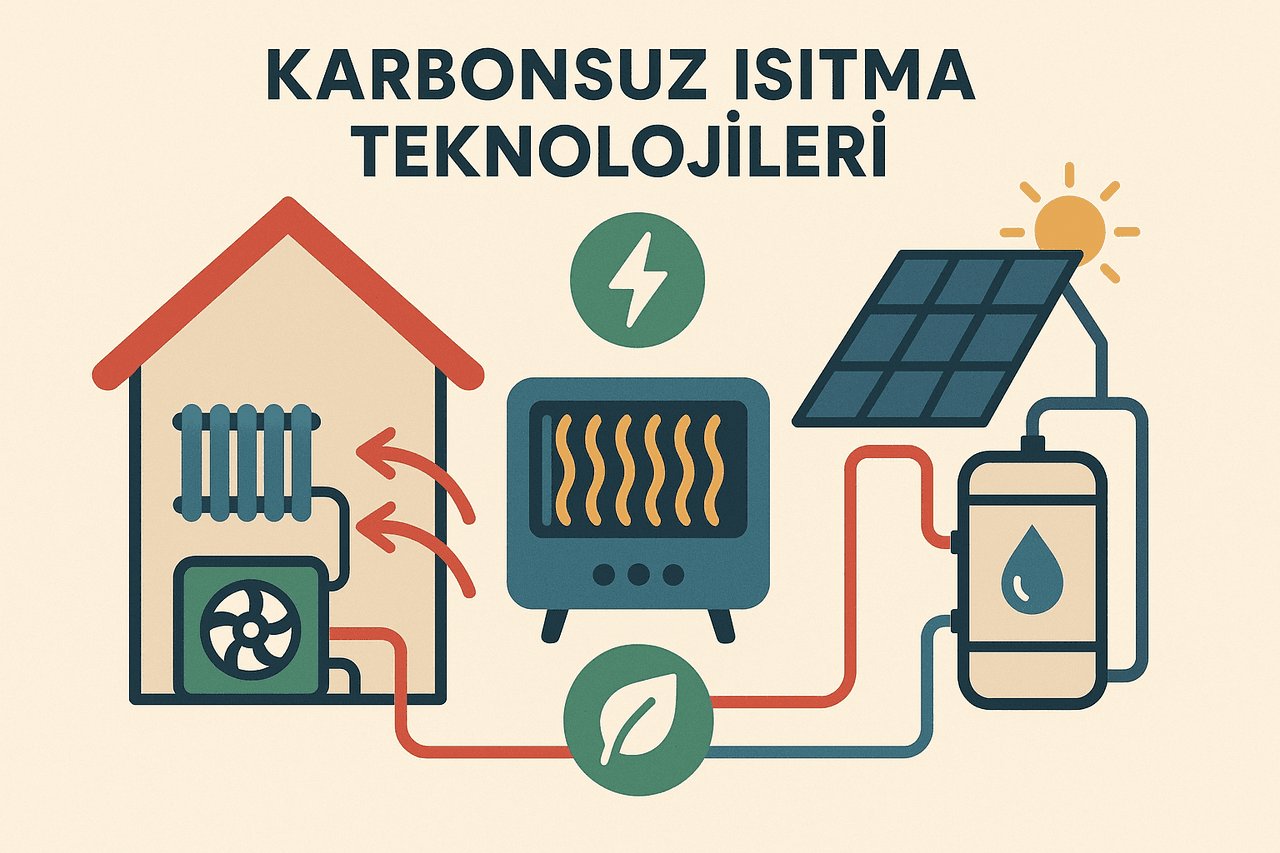
Depiction of Carbon-free Heating Technology (Generated by Artificial Intelligence.)
Hydrogen is increasingly emerging as a clean energy carrier among carbon-free heating technologies. Systems using hydrogen generate heat through combustion or catalytic reactions, producing only water as a byproduct. This eliminates emissions of carbon dioxide (CO2), nitrogen oxides (NOx), or solid particulates.
One innovative approach in this field involves systems that directly convert hydrogen and oxygen extracted from air into heat through a unique catalytic process. Since these technologies operate without combustion and do not rely on flammable hydrogen concentrations, they are inherently safe. Hydrogen can be supplied at low pressures—around 1.5 bar—similar to natural gas networks, eliminating the need for costly compression and storage. Moreover, unlike fuel cells, these systems can operate without high-purity hydrogen. With a modular and scalable design, this technology is produced in capacities ranging from 10 kW to 300 kW, serving a broad range of applications including residential, commercial and industrial buildings, agricultural greenhouses, and commercial vehicles. In the future, widespread adoption of hydrogen-fired boilers is expected.

Depiction of Carbon-free Heating Technology (Generated by Artificial Intelligence.)
Carbon-free heating is part of a broader decarbonization strategy that encompasses not only individual buildings but entire industrial sectors. Sustainability in buildings is addressed under two main categories: embodied carbon and operational carbon. Embodied carbon arises from material production, transportation and construction processes, while operational carbon stems from energy use during the building’s lifetime—for heating, cooling and lighting. Sustainable design, energy efficiency measures, and the use of recycled and local materials—such as green concrete, hemp concrete and mushroom insulation—can reduce a building’s total carbon emissions by 70% to 90%.
Industrial sectors are also undergoing a similar transformation toward carbon-free production. For example, the steel industry, responsible for approximately 7% of global greenhouse gas emissions, is shifting away from coal-based production toward methods such as Direct Reduced Iron (DRI) technology, production using green hydrogen, and recycling scrap steel. Similarly, in aluminum production, traditional carbon anodes that generate high emissions are being replaced by “inert anode” technologies that release oxygen (O2) instead of carbon dioxide (CO2) during the process. These technological transitions play a key role in eliminating fossil fuels from heating and other energy-intensive industrial processes.
The transition to carbon-free heating technologies is driven by international policies such as the European Green Deal and national net-zero targets. Regulatory instruments like the Carbon Border Adjustment Mechanism (CBAM) and the Emissions Trading System (ETS) incentivize industry and buildings to reduce their carbon footprints. Within this framework, investments in carbon-free technologies are steadily increasing.
The heating systems of the future are expected to be based on the integration of multiple technologies. Smart heat pumps powered by renewable energy sources, waste heat recovery systems and hydrogen-based solutions will form the foundation of energy infrastructure for buildings and cities.
Akgün, Muammer, Barbaros Batur, Özlem Yurtsever, and M. Cem Çelik. “Karbonsuz Gelecek.” Presented at: *15. Ulusal Tesisat Mühendisliği Kongresi – Binalarda Enerji Performansı ve Sıfır Enerjili Binalar Sempozyumu*, İzmir, April 26–29, 2023. Accessed July 1, 2025. Accessed Adresi.
Gruber, Sven, Klemen Rola, Danijela Urbancl, and Darko Goričanec. “Carbon-Free Heat Production for High-Temperature Heating Systems.” *Sustainability* 15, no. 20 (2023): 1–18. Accessed July 1, 2025. Accessed Adresi.
Hiltunen, E., B. Martinkauppi, L. Zhu, A. Mäkiranta, M. Lieskoski, and J. Rinta-Luoma. "Renewable, carbon-free heat production from urban and rural water areas." *Journal of Cleaner Production* 153 (2017): 397-404. Accessed July 1, 2025. Accessed Adresi.
Jayabal, Ravikumar. “Towards a Carbon-Free Society: Innovations in Green Energy for a Sustainable Future.” *Results in Engineering* 24 (2024): 103121. Accessed July 1, 2025. Accessed Adresi.
Lee, Jaewon, Seongbin Ga, Dongha Lim, Seongchan Lee, Hyungtae Cho, and Junghwan Kim. “Carbon-Free Green Hydrogen Production Process with Induction Heating-Based Ammonia Decomposition Reactor.” *Chemical Engineering Journal* 457 (2023): 141203. Accessed July 1, 2025. Accessed Adresi.

Carbon-Free Heating Technologies
Main Objective | Provide heating without using fossil fuels and without producing carbon emissions. | ||||||||
|---|---|---|---|---|---|---|---|---|---|
Core Technologies | Heat pumps, hydrogen-based systems, solar energy integration, geothermal systems. | ||||||||
Heat Pump Principle | Transfer heat from natural sources (air - water - soil) using electricity. | ||||||||
Hydrogen Heating | Convert hydrogen into heat by burning it or through catalytic reactions. | ||||||||
By-Products | Water (in hydrogen systems), no harmful emissions. | ||||||||
Related Policies | European Green Deal, Net Zero Targets, Emissions Trading System (ETS), Carbon Border Adjustment Mechanism (CBAM). | ||||||||
No Discussion Added Yet
Start discussion for "Carbon-Free Heating Technologies" article
Heat Pump Technologies
Hydrogen-based Heating Systems
Decarbonization in Buildings and Industry
Future Perspectives and Regulations