

 Recently Added:
This article was automatically translated from the original Turkish version.
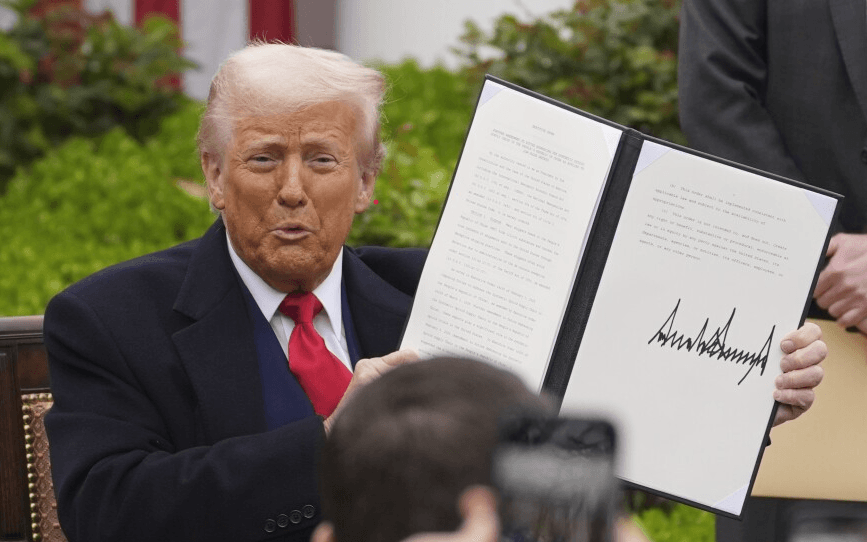
While signing the presidential decree containing new customs tariffs,
Presidential Decree Signing Date | 2 April 2025 | ||||||||
|---|---|---|---|---|---|---|---|---|---|
2 April 2025, U.S. President Donald Trump announced the Global Tariff Policy, a comprehensive economic intervention package aimed at restructuring the United States’ foreign trade relations. Under this policy, a baseline import tariff of 10 percent is imposed on all countries, with higher additional tariffs specified for certain countries and sectors.
Trump stated that the aim of this measure is to revitalize the American economy, encourage domestic production, and correct trade imbalances. Presented as an effort to protect American industry from foreign competition and redirect production toward the domestic market, this policy has generated significant impacts on the global trade order and triggered widespread international debate.
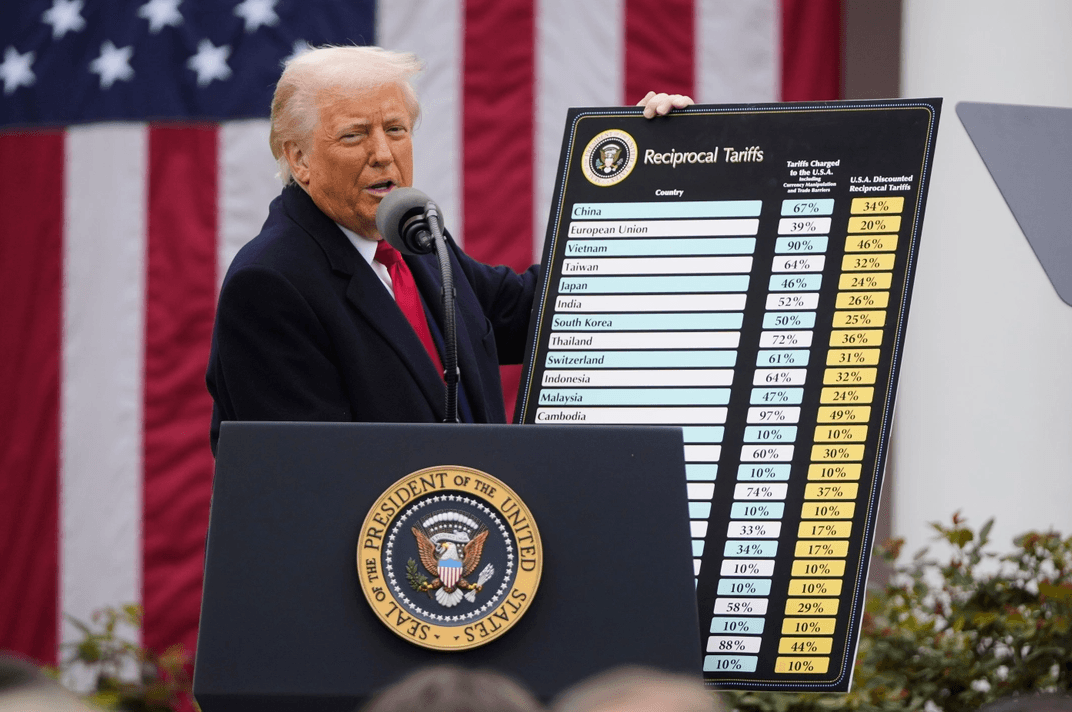
Moments When Donald Trump Announced His New Tariffs - TRT World
The Trump administration announced the tariffs under the authority of the International Emergency Economic Powers Act of 1977. A statement from the White House indicated that this law enables the United States to impose economic measures against countries creating structural imbalances in its foreign trade relations. The 10 percent baseline tariff was set to take effect on April 5, 2025, while country-specific tariffs were announced to come into force as of April 9.
A baseline tariff rate of 10 percent has been set for all countries.
Trump’s tariffs have drawn strong reactions globally, with many countries announcing countermeasures:
Europe Union stated that it has prepared countermeasures against the United States should negotiations fail. The Chinese government declared its strong opposition to the tariffs and affirmed its intention to take counteractions to defend its rights.
Japan labeled the measures as “extremely regrettable” and pledged a swift response. Canada Prime Minister Mark Carney announced that Canada would respond with firm and strong measures against the U.S. tariffs.
The South Korean government implemented emergency support measures for affected sectors. Germany Economy Minister Robert Habeck assessed the tariffs as “the most destructive in the last 90 years” and emphasized the need for a robust response from the European Union. The Indian government stated it is accelerating trade agreement negotiations with the United States while managing the challenges posed by the tariffs. The Vietnamese government indicated that the 46 percent tariff imposed by the United States would negatively impact economic growth and that it is working to manage the situation.
Economists have warned that the tariffs could have negative effects on the global economy. Projections suggest that the U.S. economy could contract by 10 percent in gross domestic product terms during the second quarter of 2025.
Consumer prices are expected to rise, placing upward pressure on inflation. Tensions with trade partners are projected to slow global economic growth and potentially trigger recessions in some regions.
Multinational corporations operating in the automotive, textile, and electronics sectors are facing increased production costs, which are being passed on to consumers.
European Commission President Ursula von der Leyen stated that the tariffs are harming the world economy and negatively affecting vulnerable communities. German Chancellor Olaf Scholz characterized the steps as a threat to the rules-based global trading system. Tensions have increased in trade relations between the United States and its partners. The developments have created uncertainty regarding global economic stability and are expected to yield long-term consequences.
Anadolu Ajansı. "Trump Signs Order Imposing Reciprocal Tariffs on Countries Worldwide." AA, April 2, 2025. https://www.aa.com.tr/en/americas/trump-signs-order-imposing-reciprocal-tariffs-on-countries-worldwide/3526743.
Associated Press. “Donald Trump News Updates: April 2, 2025.” AP News, April 2, 2025. https://apnews.com/live/donald-trump-news-updates-4-2-2025.
Associated Press. “Trump Tariffs Prompt Reactions on Liberation Day.” AP News, April 3, 2025. https://apnews.com/article/trump-tariffs-liberation-day-2a031b3c16120a5672a6ddd01da09933.
BBC News. "Trump's Tariff Move Sends Shockwaves through Global Markets." BBC News, April 3, 2025. https://www.bbc.com/news/articles/c1jxrnl9xe2o.
CNBC. "Trump Tariffs Live Updates." CNBC, April 2, 2025. https://www.cnbc.com/2025/04/02/trump-tariffs-live-updates.html.
Reuters. “Trump Stokes Trade War as World Reels from Tariff Shock.” Reuters, April 3, 2025. https://www.reuters.com/world/trump-stokes-trade-war-world-reels-tariff-shock-2025-04-03/.
TRT World. “Trump’s Global Tariff Move Sparks Mixed Reactions.” TRT World, April 2, 2025. https://trt.global/world/article/f4281cb15e52.
The Guardian. “Trump Tariffs: Key Takeaways on Impact to Global Trade, China, Canada, Mexico, Norfolk Island.” The Guardian, April 3, 2025. https://www.theguardian.com/us-news/2025/apr/03/trump-tariffs-key-takeaways-impact-global-trade-china-canada-mexico-norfolk-island.
The global tariff decisions announced by the Trump administration on April 2, 2025, were met with widespread criticism from numerous countries, beginning with its allies. The responses took the form of reciprocal tariff measures, diplomatic statements, and in some cases, preparations for direct retaliation.
France government spokesperson Sophie Primas characterized Trump’s actions as behaving “like the master of the world.” She added that the European Union is working on a coordinated package of countermeasures, with plans to implement these measures in two stages during April. French President Emmanuel Macron stated that he found Trump’s new customs tariffs “harsh and unjustified.”
Italian Prime Minister Giorgia Meloni noted that the tariffs would be damaging to all parties. She stated that Italy aims to reach a trade agreement with the United States, warning that otherwise a trade war would weaken the West.
Spanish Economy Minister Carlos Cuerpo declared that the European Union possesses the necessary tools and is ready to respond. Prime Minister Pedro Sánchez held a special briefing session to consult with affected sectors.
Türkiye Republic Trade Minister Ömer Bolat reported that the United States has applied a 10 percent customs duty on Türkiye under its global tariff framework, and that this rate falls within the “lowest tariff bracket.” Bolat emphasized that the removal of this basic tariff rate must be addressed during negotiation processes.
Irish Prime Minister Micheál Martin stated that the daily $4.2 billion transatlantic trade volume would suffer and that damaging such a relationship would benefit no one. He confirmed ongoing communication with European Commission President von der Leyen on the matter.
Swiss President Karin Keller-Sutter announced that the Swiss government would take action “in the short term” in response to the United States’ 31 percent tariff. The business organization Ekonomiesuisse described the tariffs as “harmful and baseless.”
Israeli Finance Minister Bezalel Smotrich announced that the government had launched an analysis to assess the risks and opportunities presented by the 17 percent tariff. The Israeli government had previously removed remaining tariffs on U.S. imports prior to the announcement of this decision.
Australia Prime Minister Anthony Albanese stated that the 10 percent tariff was “inconsistent with alliance principles.” It was noted that Australia would not retaliate but would reassess its relations.
New Zealand Prime Minister Christopher Luxon explained that his country benefits from a low-tariff policy and does not wish to raise domestic prices through retaliatory measures.
Malaysia Ministry of Investment, Trade and Industry announced the initiation of a multifaceted strategy to protect the national economy against the 24 percent tariff imposed by the United States.
Thailand Prime Minister Paetongtarn Shinawatra stated that Thailand is ready to negotiate to achieve fair trade balance with the United States. It was noted that Thailand could become a “friendly supplier country” to the United States.
The Taiwanese government described the 32 percent tariff as “deeply unfair” and “regrettable.” Cabinet spokesperson Michelle Lee confirmed that negotiations with the United States are ongoing.
Philippine Presidential Spokesperson Claire Castro noted that the 17 percent tariff has a limited impact and that relations with the United States are being taken into account.
Norwegian Prime Minister Jonas Gahr Støre stated that the United States’ 15 percent tariff would harm Norway’s exports and potentially affect employment. It was noted that Norway remains open to negotiations.
Poland Prime Minister Donald Tusk indicated that the new tariffs could shrink the national economy by 0.4 percent. He emphasized that the “friendship relationship” with the United States must emerge intact from this process.
Ukraine Economy Minister Yuliia Svyrydenko stated that the 10 percent tariff is complex but not critical. It was reported that trade volume with the United States is limited and the impact will remain low.
Colombian President Gustavo Petro declared that the United States’ import tariffs mark the end of the global neoliberal economic order. He announced that Colombia would consider retaliation only on products causing job losses.
Fiji Deputy Prime Minister Biman Prasad described the United States’ 32 percent tariff as “disproportionate” and stated that the rates imposed by the United States do not reflect reality.
Singapore Monetary Authority stated that it is prepared to take measures to ensure stability in financial markets following the 10 percent tariff.
Norfolk Island Administrator George Plant stated that the island has no exports to the United States and could not understand why the tariff was imposed.
China announced that, effective April 10, 2025, it would impose an additional 34 percent customs duty on all U.S.-origin goods. This rate was set as a countermeasure to the existing 20 percent U.S. tariffs on Chinese imports. The Chinese State Council stated that the U.S. decision is unilateral and violates international trade rules. It was also announced that China would pursue diplomatic initiatives at the World Trade Organization, in addition to responding to a lawsuit filed against it in the United States by the New Civil Liberties Alliance.
Brazil has legally anchored its ability to retaliate against any country’s import tariffs through a newly passed “reciprocity law.” The Brazilian Ministry of Foreign Affairs stated that the U.S. tariffs covering steel, aluminum and automotive sectors violate World Trade Organization obligations. It was indicated that Brazil could initiate a dispute process at the WTO.
The European Union began preparing countermeasures in response to Trump’s 20 percent reciprocal tariffs. European Commission President Ursula von der Leyen announced that if negotiations fail, the EU will expand its existing measures and respond with new economic sanctions. It was specifically noted that a comprehensive counter-package is being developed in response to U.S. steel tariffs.
Canada announced it will respond directly to Trump’s 25 percent tariff on imported automobiles. Canadian Prime Minister Mark Carney stated that countermeasures against American products will be implemented. Canada also announced that it will exempt auto parts from import tariffs.
Anadolu Ajansı. "Kanada, ABD’nin Yüzde 25’lik Otomobil Tarifelerine Yanıt Vereceğini Açıkladı." Accessed April 4, 2025. https://www.aa.com.tr/tr/dunya/kanada-abdnin-yuzde-25lik-otomobil-tarifelerine-yanit-verecegini-acikladi/3527724.
Anadolu Ajansı. "Trump’a Çin’e Uyguladığı Gümrük Vergilerinden Dolayı Dava Açıldı." Accessed April 4, 2025. https://www.aa.com.tr/tr/dunya/trumpa-cine-uyguladigi-gumruk-vergilerinden-dolayi-dava-acildi/3527939.
Anadolu Ajansı. “ABD Başkanı Trump Karşılıklı Tarifeleri Açıkladı.” Accessed April 4, 2025. https://www.aa.com.tr/tr/dunya/abd-baskani-trump-karsilikli-tarifeleri-acikladi/3526716.
Anadolu Ajansı. “Dünya Liderlerinden Trump’ın Yeni Gümrük Tarifelerine Tepki.” Accessed April 4, 2025. https://www.aa.com.tr/tr/ekonomi/dunya-liderlerinden-trumpin-yeni-gumruk-tarifelerine-tepki/3527118.
Anadolu Ajansı. “Macron, Trump’ın Yeni Gümrük Tarifelerini ‘Sert ve Yersiz’ Bulduğunu Söyledi.” Accessed April 4, 2025. https://www.aa.com.tr/tr/dunya/macron-trumpin-yeni-gumruk-tarifelerini-sert-ve-yersiz-buldugunu-soyledi/3527586.
Anadolu Ajansı. “Trump En Yüksek Gümrük Tarifesini Afrika’daki Lesotho Krallığına Uyguladı.” Accessed April 4, 2025. https://www.aa.com.tr/tr/dunya/trump-en-yuksek-gumruk-tarifesini-afrikadaki-lesotho-kralligina-uyguladi/3527597.
Anadolu Ajansı. “Çin’den ABD’ye Tarife Misillemesi.” Accessed April 4, 2025. https://www.aa.com.tr/tr/dunya/cinden-abdye-tarife-misillemesi/3528174.
CNN Business. “Trump’s Reciprocal Tariffs: Countries List.” CNN. Accessed April 4, 2025. https://edition.cnn.com/2025/04/03/business/trumps-reciprocal-tariffs-countries-list-dg/index.html.
Reuters. “World Leaders React to Trump’s Global Tariffs.” Accessed April 4, 2025. https://www.reuters.com/world/world-leaders-react-trumps-global-tariffs-2025-04-02/.
Time. “Trump’s Reciprocal Tariffs: World Responses from China, EU Countries, Leaders.” TIME. Accessed April 4, 2025. https://time.com/7274195/trump-reciprocal-tariffs-world-responses-china-eu-countries-leaders-countermeasures/.
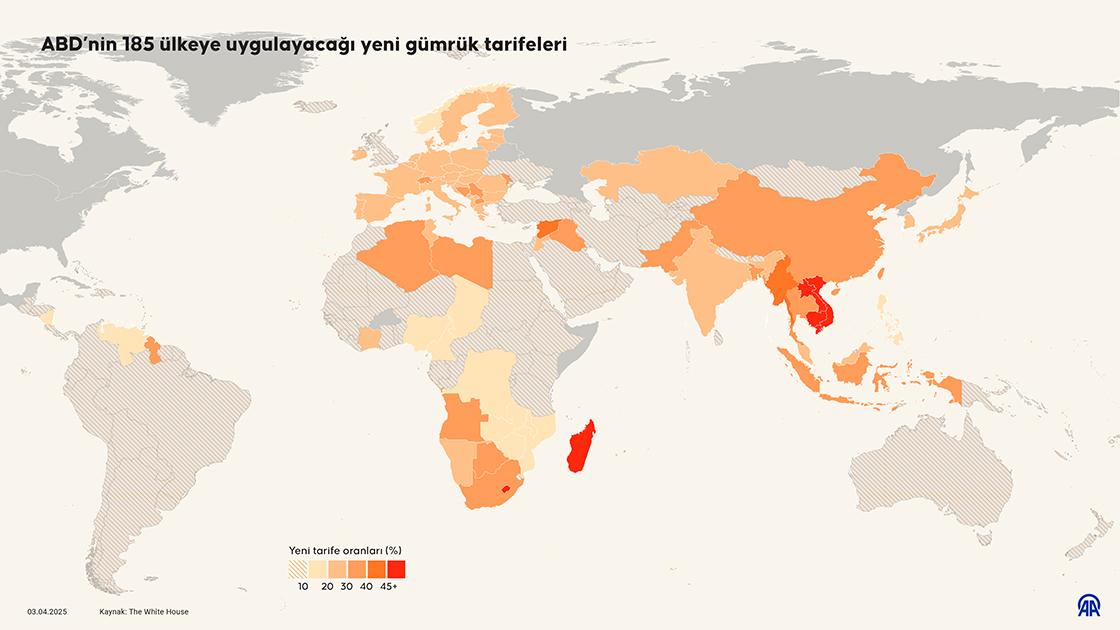
Infographic: Customs tariff rates to be applied by the United States – Anadolu Agency
Anadolu Ajansı. “ABD Başkanı Trump Karşılıklı Tarifeleri Açıkladı.” Accessed April 4, 2025. https://www.aa.com.tr/tr/dunya/abd-baskani-trump-karsilikli-tarifeleri-acikladi/3526716.
The new global tariff regime announced by the United States of America on 7 April 2025 came into effect on 5 April 2025. At 00.01 on that date, the U.S. Customs and Border Protection began applying a base import tariff of 10 percent. Customs collection procedures were launched simultaneously at all seaports, airports, and customs warehouses across the country.
As of the morning of 5 April, goods arriving from numerous countries, including Australia, the United Kingdom, Colombia, Argentina, Egypt and Saudi Arabia, were subject to the 10 percent import tariff.
On the same day, the U.S. Customs and Border Protection issued an advisory bulletin stating that a 51-day transition period would apply to goods shipped before 00.01 on 5 April 2025, meaning those already in transit by sea or air. These products would be exempt from the 10 percent tariff if they arrived in the United States by 27 May 2025.
Reuters. “US Starts Collecting Trump’s New 10% Tariff, Smashing Global Trade Norms.” Reuters, April 5, 2025. Accessed April 5, 2025. https://www.reuters.com/markets/us-starts-collecting-trumps-new-10-tariff-smashing-global-trade-norms-2025-04-05/.
On 6 April, Trump made a statement regarding the tariffs he imposed on the Truth Social social media platform. In his statement, Trump argued that the trade deficits with these countries during the presidency of former US President Joe Biden had increased the burden on the US. He asserted that he would quickly reverse this situation, saying, "One day people will realize that tariffs are a very good thing for the US."
Trump stated, "We have large financial deficits with China, the European Union, and many other countries. The only way to solve this problem is through tariffs that currently bring billions of dollars to the US."
Anadolu Ajansı. “Trump, Ülkesinin Ticaretteki Finansal Açıklarını Gidermenin Tek Yolunun Tarifeler Olduğunu Savundu.” Accessed April 7, 2025. https://www.aa.com.tr/tr/dunya/trump-ulkesinin-ticaretteki-finansal-aciklarini-gidermenin-tek-yolunun-tarifeler-oldugunu-savundu/3530151
The new global tariff program launched by the United States on 7 April 2025 has triggered diplomatic and economic tensions between China and the United States.
The Chinese Ministry of Commerce announced on 3 April 2025 that in response to this decision by the United States, an additional 34 percent tariff would be imposed. The Chinese government declared that "if the United States does not revoke the tariffs in question, China will take firm countermeasures to defend its legitimate rights."
U.S. President Donald Trump, in a statement on 7 April 2025, announced that if China does not withdraw its 34 percent retaliatory tariff by midnight on 8 April, an additional 50 percent tariff on Chinese goods will take effect from 9 April. Trump also declared that all planned trade negotiations with China would be terminated. He stated, "If China does not retract its 34 percent tariff increase in response to the United States’ long-standing trade violations by tomorrow, the United States will impose an additional 50 percent customs duty on China effective from 9 April."
On 8 April 2025, the Chinese Ministry of Foreign Affairs stated in a declaration that it would respond resolutely to the new U.S. tariffs. The statement read, "If the United States continues on this path, China will respond with determined countermeasures to the end."
At a press briefing in Beijing on 7 April, Chinese Ministry of Foreign Affairs spokesperson Lin Jian said, "This is a typical example of unilateralism, protectionism and economic bullying." Lin argued that the United States’ "America First" approach violates international rules, adding, "The United States’ exploitation of tariffs deprives countries, particularly those in the 'Global South,' of their right to development."
Anadolu Ajansı. “ABD Başkanı Trump, Çin’i Yüzde 50 Ek Tarife Uygulamakla Tehdit Etti.” Accessed April 8, 2025. https://www.aa.com.tr/tr/dunya/abd-baskani-trump-cini-yuzde-50-ek-tarife-uygulamakla-tehdit-etti/3530782.
Anadolu Ajansı. “Çin Dışişleri Bakanlığı: ‘Eğer ABD Tarifelerde ve Ticaret Savaşında Israr Ederse, Çin Sonuna Kadar Gidecektir.’” Accessed April 8, 2025. https://www.aa.com.tr/tr/dunya/cin-disisleri-bakanligi-eger-abd-tarifelerde-ve-ticaret-savasinda-israr-ederse-cin-sonuna-kadar-gidecektir/3531064.
Anadolu Ajansı. “Çin, Trump’ın Tarife Tehdidine Yönelik Kararlı Karşı Tedbirler Alacağını Bildirdi.” Accessed April 8, 2025. https://www.aa.com.tr/tr/dunya/cin-trumpin-tarife-tehdidine-yonelik-kararli-karsi-tedbirler-alacagini-bildirdi/3531006.
Anadolu Ajansı. “Çin: ‘ABD’nin Tarifeleri İstismarı, Ülkeleri Kalkınma Haklarından Yoksun Bırakıyor.’” Accessed April 8, 2025. https://www.aa.com.tr/tr/dunya/cin-abdnin-tarifeleri-istismari-ulkeleri-kalkinma-haklarindan-yoksun-birakiyor/3530652.
The United States administration has decided to raise the total import tax rate on China to 104 percent in the next phase of the tariff dispute with China. White House Press Secretary Karoline Leavitt announced at a press briefing on 8 April 2025 that this new tariff rate on China will take effect at 00.01 on 9 April.
The tariff in question is the cumulative result of successive increases: the initial 10 percent tariff introduced on 1 February, raised to 20 percent on 4 March, followed by the 34 percent "reciprocal tariff" announced on 2 April, and the additional 50 percent increase declared on 7 April. As a result, the total customs duty rate applied to imports from China has reached 104 percent.
In her statement, Leavitt said, "When America gets punched, the President responds with a harder punch. That is why the 104 percent tariff on China will take effect at midnight tonight." She also stated that U.S. President Donald Trump believes China wants to reach a trade agreement with the United States and that if China comes to the negotiating table, Trump will respond "with the utmost courtesy."
Anadolu Ajansı. "ABD, Çin'e Yönelik Yüzde 104 Oranındaki Tarifeleri Yürürlüğe Koyacak." Accessed April 8, 2025. https://www.aa.com.tr/tr/dunya/abd-cine-yonelik-yuzde-104-oranindaki-tarifeleri-yururluge-koyacak/3532053.
Following the United States’ implementation of a 104 percent customs tariff on imports from China, the Chinese government announced a new countermeasure. The Chinese Ministry of Finance stated on 9 April 2025 that in addition to existing tariffs on goods imported from the United States, an additional 50 percent customs duty would be applied. With this adjustment, the total import tax rate imposed by China on U.S. products rose to 84 percent. The new tariff is set to take effect on 10 April 2025.
The Chinese Ministry of Commerce announced that it had filed a complaint against the United States at the World Trade Organization (WTO). The statement emphasized that China aims not only to protect its own economic interests but also to safeguard the multilateral trading system and the international economic order. The Chinese government also revealed that it had added 12 American companies to its export control list and six American companies to its list of “unreliable entities.”
At a press briefing in Beijing on 9 April 2025, Chinese Foreign Ministry spokesperson Lin Jian stated, “The United States is attempting to exert pressure on China through tariffs. China will never yield to this bullying behavior.” Lin emphasized that China would defend its sovereignty security and development interests, adding, “We will not allow anyone to deprive the Chinese people of their legitimate right to development.” He affirmed that China remains open to dialogue with the United States only on the basis of equality and mutual respect.
On the same day, it was reported that U.S. President Donald Trump had increased the customs tariff on Chinese goods to 125 percent. This measure was described as a response to countries that have imposed retaliatory tariffs. In contrast, the Trump administration announced that additional tariffs would be suspended for more than 75 countries that have not engaged in retaliation, for a period of 90 days.
Anadolu Ajansı. “Trump, Çin’e Yönelik Tarifeleri Yüzde 125’e Çıkardı.” Accessed April 9, 2025. https://www.aa.com.tr/tr/dunya/trump-cin-e-yonelik-tarifeleri-yuzde-125-e-cikardi/3533209.
Anadolu Ajansı. “Çin, ABD’den İthal Ürünlere Uyguladığı Vergiyi Yüzde 84'e Yükselteceğini İlan Etti.” Accessed April 9, 2025. https://www.aa.com.tr/tr/ekonomi/cin-abd-den-ithal-urunlere-uyguladigi-vergiyi-yuzde-84e-yukseltecegini-ilan-etti/3532775.
Anadolu Ajansı. “Çin, Tarifeler Konusunda ABD'nin Baskısına Boyun Eğmeyeceği Mesajını Verdi.” Accessed April 9, 2025. https://www.aa.com.tr/tr/dunya/cin-tarifeler-konusunda-abdnin-baskisina-boyun-egmeyecegi-mesajini-verdi/3532288.
April 10, 2025
The China State Council Customs Tariff Commission issued Customs Tariff Notices No. 5 and No. 6 in response to the United States’ tariff decisions on April 8 and 9. These notices introduced new customs duties on goods imported from the United States. Additionally, non-tariff measures were implemented, covering sectors such as agriculture, energy, and high-tech products.
April 11, 2025
U.S.-China trade tensions generated widespread reactions in international markets. The World Trade Organization (WTO) called on both parties to engage in consultations. On the same day, the U.S. President’s economic advisers announced they were considering potential second-wave tariffs in response to China’s new measures.
May 12, 2025 – Geneva Joint Statement
Following diplomatic talks held in Geneva, the two countries issued a joint agreement aimed at reducing commercial tensions. The statement included:
May 13, 2025:
The U.S. Trade Representative and China’s Ministry of Commerce simultaneously announced the establishment of a new communication mechanism to institutionalize negotiations.
May 15, 2025
The date for the first meeting was set. The co-chairs of this mechanism were designated as He Lifeng (Vice Premier of the China State Council) and Scott Bessent (U.S. Secretary of the Treasury) along with Jamieson Greer (U.S. Trade Representative).
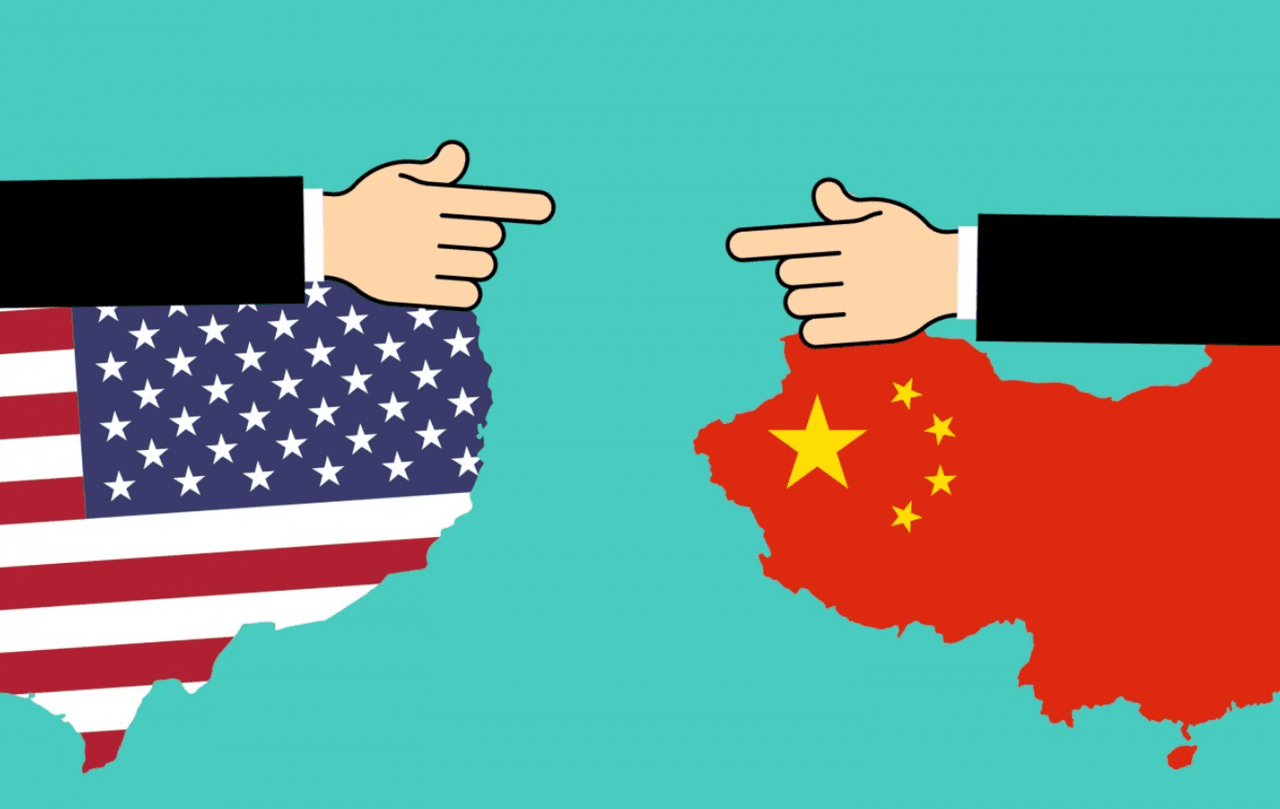
Visual Illustrating the Process of the U.S.-China Trade Dispute (Pxhere)
In May 2025, U.S. President Donald Trump announced the imposition of a 50 percent customs tariff on all goods originating from the European Union. However, it was specified that this measure would not apply to products manufactured within the United States or to EU brands established in the United States. The justification cited was the perceived inadequacy of the EU’s proposals in trade negotiations. U.S. Treasury Secretary Scott Bessent stated that the EU’s offers were weaker compared to agreements reached with China and ASEAN countries, and that the tariffs were introduced to compel the EU into more serious negotiations.
Following these developments, on May 27, 2025, European Commission President Ursula von der Leyen held a telephone conversation with Trump. During the call, she requested a delay in the implementation of the proposed tariffs. Trump responded positively, postponing the effective date of the 50 percent tariff from June 1 to July 9, 2025. In a statement after the delay, von der Leyen emphasized that the economic relationship between the EU and the United States is “one of the closest partnerships in the world” and affirmed the EU’s commitment to continuing constructive negotiations.
Throughout June, both parties are expected to evaluate new proposals at the negotiating table. However, if no agreement is reached by July 9, 2025, the United States has indicated it will implement the tariffs, while the EU has announced it will respond with a 25 percent retaliatory tariff on approximately 18 billion euros worth of U.S.-origin goods.
This process has the potential to directly affect not only trade relations between two major economies but also global supply chains and market balances. July 9 is regarded as a critical turning point both economically and diplomatically.
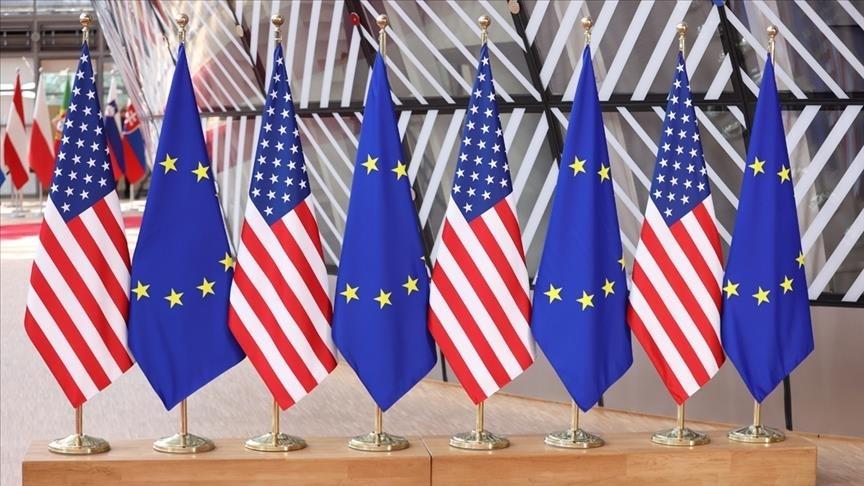
Tariff Negotiations Between the U.S. and the EU Are Ongoing (AA)
U.S. President Donald Trump’s decision to impose a 50 percent customs tariff on goods imported from various countries, primarily those originating in the European Union, triggered significant legal debate. In this context, two separate U.S. courts issued conflicting rulings.
First, the U.S. Court of International Trade, in a ruling on May 28, 2025, determined that the tariffs were in violation of the U.S. Constitution. The court emphasized that the President lacks the authority to impose such tariffs; this power resides exclusively with Congress. Furthermore, the court ruled that the International Emergency Economic Powers Act (IEEPA) does not provide a valid legal basis for this action. Consequently, the court ordered the cancellation and non-enforcement of Trump’s so-called “Salvation Day Tariffs.”
However, this ruling was short-lived. On May 29, 2025, the U.S. Court of Appeals for the Federal Circuit temporarily suspended the lower court’s decision and allowed the tariffs to remain in effect. The Appeals Court granted both parties time to submit their arguments: the plaintiffs’ deadline is June 5, and the U.S. government’s deadline is June 9.
Boak, Josh. “Trump’s New Tariff Plan Could Hit Apple iPhones, Other Consumer Goods.” Associated Press, May 2025. https://apnews.com/article/trump-tariff-apple-iphone-tax-170021e8fad22878d0183b5d48971087.
Hagan, Rachal. “US Delays 50% Tariff on EU Goods until July.” BBC News, May 26, 2025. https://www.bbc.com/news/articles/cdd2mz719yvo.
Knauth, Dietrich, and Daniel Wiessner. “US Court Blocks Trump’s Liberation Day Tariffs.” Reuters, May 29, 2025. https://www.reuters.com/world/us/us-court-blocks-trumps-liberation-day-tariffs-2025-05-28/.
Knauth, Dietrich, and Sarah Marsh. “US Ruling That Trump Tariffs Are Unlawful Stirs Relief, Uncertainty.” Reuters, May 30, 2025. https://www.reuters.com/business/us-ruling-that-trump-tariffs-are-unlawful-stirs-relief-uncertainty-2025-05-29/.
Ng, Michelle Toh. “US and China Announce Breakthrough Trade Deal.” CNN, May 12, 2025. https://edition.cnn.com/2025/05/12/business/us-china-trade-deal-announcement-intl-hnk.
White House. “Joint Statement on U.S.-China Economic and Trade Meeting in Geneva.” The White House, May 2025. https://www.whitehouse.gov/briefings-statements/2025/05/joint-statement-on-u-s-china-economic-and-trade-meeting-in-geneva/.
İrkin, Sercan, and Ata Ufuk Şeker. “Trump, AB’ye Uygulanacak Yüzde 50’lik Tarifeyi 9 Temmuz 2025’e Erteledi.” Anadolu Ajansı, May 26, 2025. https://www.aa.com.tr/tr/ekonomi/trump-abye-uygulanacak-yuzde-50lik-tarifeyi-9-temmuz-2025e-erteledi/3579355.
On 7 July 2025, United States President Donald Trump announced via the Truth Social platform that he had sent official letters to 12 countries outlining new tariff rates. The letters stated that these rates would take effect on 1 August 2025.
According to the countries and tariff rates announced by Trump:
In the letters, Trump indicated that these tariffs could be adjusted based on the development of trade relations with each country. The tariffs were described as “subject to upward or downward revision depending on our relations with your country.” The letters also stated that tariffs could be further increased in the event of retaliatory measures.
On 7 July 2025, the Trump administration announced that a new 25 percent customs duty would be applied to all imports from Japan and South Korea. The tariff was set to take effect on 1 August 2025.
In letters sent to the leaders of Japan and South Korea, Trump indicated that the tariffs could be raised in the event of retaliation, but could be reduced if trade barriers were removed. Japanese Prime Minister Shigeru Ishiba stated that his government received the U.S. tariff decision with “deep regret” and affirmed that negotiations would continue. South Korea’s Ministry of Trade, Industry and Energy announced that talks scheduled before 1 August would aim for “mutually beneficial outcomes.”
On 9 July 2025, United States President Donald Trump announced that the previously scheduled tariff increases would be postponed until 1 August 2025. As part of this delay, a temporary base tariff rate of 10 percent would remain in effect for certain countries until 1 August. The delay was intended to allow ongoing trade negotiations with these countries to reach completion.
The White House statement explained that Trump’s decision to delay the tariffs was based on new trade data and ongoing discussions. Trump described 1 August as “firm but not 100 percent firm,” and indicated that the date could be reconsidered if new offers were presented during negotiations. He also stated that the tariff rates specified in the letters to certain countries were not final and could be revised based on each country’s proposals.
As of July 2025, the United States government continued trade negotiations with several countries and had reached agreements with a limited number. As of 7 July 2025, agreements had been finalized only with the United Kingdom and Vietnam.
The agreement with the United Kingdom was signed on 8 May 2025. Under its terms, a 10 percent customs duty will apply to most British goods, while tariffs on steel and aluminum products will be eliminated. The agreement with Vietnam was announced on 1 July 2025, and stipulates a 20 percent customs duty on imports from Vietnam. The full text of the Vietnam agreement has not been published.
Japanese Prime Minister Shigeru Ishiba stated that Japan is engaged in talks with the United States to reduce its trade deficit and that efforts are underway to achieve results before 1 August. South Korea’s Ministry of Trade, Industry and Energy indicated that negotiations scheduled before 1 August aim to secure outcomes that protect mutual interests in the automotive and steel sectors.
Thailand’s Ministry of Finance confirmed that discussions with the United States are ongoing and that efforts are being made to align Thailand’s tariff rates with those applied to other countries. Malaysia’s Ministry of Investment, Trade and Industry stated that it has taken into account U.S. concerns regarding trade balance and affirmed that negotiations are being conducted on a “mutual benefit” basis.
Indonesia’s Ministry of Trade stated that talks in Washington are continuing and that Indonesia is seeking a resolution to the trade imbalance with the United States. South African President Cyril Ramaphosa described the U.S. decision to impose a 30 percent tariff as “unilateral” and affirmed that dialogue with the United States would continue.
Bangladesh’s Ministry of Commerce reported that negotiations in Washington are ongoing and that Bangladesh is seeking tariff reductions, particularly in the textile sector.
Al Jazeera. “Trump Ramps Up Trade War with Tariff Blitz Targeting 14 Countries.” Accessed July 8, 2025. https://www.aljazeera.com/news/2025/7/7/trump-ramps-up-trade-war-with-tariff-blitz-targeting-14-countries
Anadolu Ajansı. "Trump 12 Yeni Ülkeye Yönelik Tarife Mektuplarını Paylaştı." Accessed July 8, 2025. https://www.aa.com.tr/tr/dunya/trump-12-yeni-ulkeye-yonelik-tarife-mektuplarini-paylasti/3624529#
BBC. “US delays higher tariffs but announces new taxes for some countries.” Accessed July 8, 2025. https://www.bbc.com/news/articles/cd0vkl31085o
Reuters. “Japan, South Korea face 25% tariffs as Trump ramps up trade war in letters to 14 nations.” Accessed July 8, 2025. https://www.reuters.com/world/eus-von-der-leyen-had-good-exchange-with-trump-over-phone-commission-says-2025-07-07/
The Guardian. “Trump Tariffs Explained: What’s Changed and Why Have Asian Countries Been Hit so Hard?” Accessed July 8, 2025. https://www.theguardian.com/us-news/2025/jul/08/trump-tariffs-explained-whats-changed-and-why-have-asian-countries-been-hit-so-hard
U.S. President Donald Trump announced new customs tariffs on the Philippines, Brunei, Moldova, Algeria, Iraq, Libya and Sri Lanka in a statement posted on his Truth Social account on 9 July 2025. Trump notified these countries via official letters that the new tax rates will take effect on 1 August 2025. The announced countries and their respective tariff rates are as follows:
In the letters Trump stated that these tariffs may be adjusted up or down depending on the development of trade relations between each country and the United States. It was also indicated that in the event of any retaliatory measures these rates would be increased.
Trump noted that these letters follow those issued on 8 July 2025 targeting 14 other countries. It was stated that no agreement was reached with most of these countries during the previously conducted 90-day negotiation period.
U.S. President Donald Trump announced during a cabinet meeting on 8 July 2025 that a 50 percent customs duty will be applied to copper imports effective 1 August 2025.
Trump stated that this decision was made following a national security review and publicly disclosed the effective date via the Truth Social platform.
Trump emphasized that copper is used in strategic sectors including semiconductors aircraft and ship components munitions data centers lithium ion batteries radar systems missile defense systems and hypersonic weapons. According to the Department of Defense assessment copper is the second most widely used essential material in the defense industry.
Referring to previous tariffs imposed on steel aluminum lumber and the automobile sector Trump stated that this new tariff on copper imports is intended to protect America’s strategic industries.
U.S. President Donald Trump announced on 9 July 2025 that the existing 10 percent customs duty on imports from Brazil will be raised to 50 percent. The increase is set to take effect on 1 August 2025.
The Trump administration cited Brazil’s digital trade practices toward the United States content moderation decisions on social media platforms and restrictions on freedom of expression as justifications for the tariff hike. Trump also referenced political developments in Brazil and legal proceedings against former President Jair Bolsonaro stating that these factors were considered within the context of commercial relations.
Trump directed the Office of the United States Trade Representative to initiate a new “Section 301” investigation into Brazil. The investigation will examine Brazil’s trade practices and restrictions on digital services affecting American technology companies.
Brazilian President Luiz Inácio Lula da Silva responded to Trump’s announcement by stating that his country will defend its commercial interests and respond within the framework of Brazilian law to any unilateral actions by the United States.
Al Jazeera. “Trump Issues New Tariffs for Six Countries, Including Iraq and the Philippines.” Accessed July 10, 2025. https://www.aljazeera.com/economy/2025/7/9/trump-issues-new-tariffs-for-six-countries-including-iraq-and-the-philippines
Anadolu Ajansı. "ABD Başkanı Trump Bakır İthalatına Yüzde 50 Tarife Getireceklerini Duyurdu." Accessed July 10, 2025. https://www.aa.com.tr/tr/dunya/abd-baskani-trump-bakir-ithalatina-yuzde-50-tarife-getireceklerini-duyurdu/3625445
Anadolu Ajansı. “ABD Başkanı Trump 7 Yeni Ülkeye Yönelik Tarife Mektuplarını Paylaştı.” Accessed July 10, 2025. https://www.aa.com.tr/tr/dunya/abd-baskani-trump-7-yeni-ulkeye-yonelik-tarife-mektuplarini-paylasti/3626453#
Anadolu Ajansı. “ABD Başkanı Trump Bakır İthalatına Yüzde 50 Tarife Uygulanacağını Açıkladı.” Accessed July 10, 2025. https://www.aa.com.tr/tr/dunya/abd-baskani-trump-bakir-ithalatina-yuzde-50-tarife-uygulanacagini-acikladi/3626636
Reuters. “Trump sets 50% US tariffs on copper, Brazilian imports starting in August.” Accessed July 10, 2025. https://www.reuters.com/world/asia-pacific/eu-seeks-trade-deal-with-trump-this-month-new-tariff-notices-due-2025-07-09/
Brazilian President Luiz Inácio Lula da Silva announced on 10 July 2025 via the social media platform X that Brazil would respond to the United States’ imposition of a 50 percent customs tariff on imports from Brazil.
Lula da Silva stated that the United States’ unilateral decision would be assessed under Brazil’s Economic Reciprocity Law. The Brazilian government declared that these tariffs violate the country’s commercial sovereignty and that Brazil will respond exclusively in accordance with its own laws.
The Brazilian President emphasized that Brazil is a sovereign nation and will not serve the interests of any foreign country. Lula recalled that over the past 15 years the United States has achieved a trade surplus of approximately $410 billion in its trade with Brazil. He also noted that all companies operating in Brazil, whether domestic or foreign, are required to comply with Brazilian laws.
In his statement Lula da Silva said: “Sovereignty respect and the protection of the interests of the Brazilian people will be the fundamental principles guiding Brazil’s foreign relations.”
U.S. President Donald Trump announced on 10 July 2025 that a new 35 percent customs tariff would be imposed on goods imported from Canada. The new levy is set to take effect on 1 August 2025.
The Trump administration clarified that this tariff would be applied separately from existing sectoral tariffs. The United States stated that Canada has created a trade imbalance with the U.S. through fentanyl trafficking and both tariff and non-tariff barriers. Trump indicated that if Canada does not cooperate with the United States on these issues the tariffs could be increased further.
Trump also announced that Canadian exports to the United States via third countries would be subject to higher tariffs. However it was stated that companies in Canada that produce goods in the United States would be granted tax exemptions. The Trump administration indicated that approval processes for such investments would be accelerated.
Canadian Prime Minister Mark Carney stated in his remarks that his government is working to protect Canadian workers and businesses. Carney said negotiations with the United States are ongoing with the aim of reaching a new trade agreement before 1 August.
The U.S. administration clarified that under the ongoing negotiations with Canada the existing tariff exemptions for goods covered by the USMCA (United States-Mexico-Canada Agreement) will be preserved and that the 10 percent tariffs applied to the energy and fertilizer sectors will remain unchanged.
Al Jazeera. "Trump Slaps 35 Percent Tariff on Canada Starting August 1." Accessed July 11, 2025. https://www.aljazeera.com/news/2025/7/11/trump-slaps-35-percent-tariff-on-canada-starting-august
Anadolu Ajansı. "ABD Başkanı Trump, Kanada Mallarına Yüzde 35 Tarife Uygulanacağını Duyurdu." Accessed July 11, 2025. https://www.aa.com.tr/tr/dunya/abd-baskani-trump-kanada-mallarina-yuzde-35-tarife-uygulanacagini-duyurdu/3627652#
Anadolu Ajansı. “Brezilya, Trump’ın Ülkeye Yönelik Gümrük Tarifelerine Karşılık Verecek.” Accessed July 11, 2025. https://www.aa.com.tr/tr/dunya/brezilya-trump-in-ulkeye-yonelik-gumruk-tarifelerine-karsilik-verecek/3626924#
Reuters. “Trump Puts 35% Tariff on Canada, Eyes 15%-20% Tariffs for Others.” Accessed July 11, 2025. https://www.reuters.com/world/us/trump-puts-35-tariff-canada-eyes-15-20-tariffs-others-2025-07-11/
U.S. President Donald Trump, in a statement on July 14 2025, announced that if no peace agreement is reached with Ukraine within 50 days, import tariffs on the Russian Federation will be increased. Trump indicated that this period could be extended to 100 days but warned that if no progress is made within that timeframe, new tariff rates of up to 100 percent would be imposed on Russia.
The statement specified that all imports from Russia to the United States would be targeted, particularly strategic sectors such as energy, metals and technology products. Trump described the tariffs as “very high,” “burdensome” and “severe.”
The Trump administration did not specify an exact effective date for the tariffs but clarified that their implementation would depend on the outcome of any agreement reached between Ukraine and Russia. The U.S. Trade Representative and the Department of the Treasury were reported to be conducting technical analyses of the new tariff plan.
U.S. President Donald Trump, in his July 14 2025 statement, indicated that new tariffs might also be applied not only to Russia but to third countries maintaining economic relations with Russia.
Under this proposed secondary sanctions package, energy imports from Russia by countries such as China, India and Türkiye are targeted. White House officials stated that these countries indirectly provide Russia with foreign currency inflows and that import tariffs of up to 100 percent could be applied to curb such trade.
The statement clarified that these tariffs would not constitute a direct product embargo but would be implemented as “sector-specific price balancing measures.” In this context, refined petroleum products, natural gas equipment and nuclear technology supply chains were specifically identified for review.
The U.S. Department of Commerce announced that technical details of the new tariff application would be finalized by August 1 2025 and that diplomatic engagement with affected countries is ongoing. It was noted that if implemented, the tariffs could also impact energy market prices outside the United States.
The new tax threats and arms support plan for Ukraine announced by U.S. President Donald Trump in July 2025 triggered responses at various levels within the Russian Federation. Kremlin Spokesperson Dmitry Peskov, in a statement on July 14 2025, said that the Trump administration’s remarks had been “taken seriously” and that Russia was evaluating necessary measures to protect its economic interests.
The Russian Ministry of Foreign Affairs characterized Washington’s continued arms shipments to Ukraine as “destabilizing.” It also announced that Russia had entered a process to review existing customs agreements with the United States and was assessing alternative markets for its energy, technology and raw material exports.
On July 15 2025, beginning in the morning hours, shares of Russian companies declined on the Moscow Exchange. Some major firms operating in the defense industry, energy and heavy industry sectors experienced share price losses of between 4 percent and 7 percent.
The Russian Ministry of Finance announced the development of a new domestic financing strategy aimed at “maintaining economic stability” in response to U.S. secondary sanctions threats. Under this strategy, energy revenues are to be restructured, foreign exchange reserves diversified and measures to stimulate domestic consumption are to be introduced.
AP News. “Trump’s Ukraine Arms Deal Includes Patriot Missiles, Raises Tariff Threats on Russia.” Associated Press. Accessed July 15, 2025. https://apnews.com/article/russia-ukraine-war-trump-patriot-missiles-kellogg-ca8cda9b417737188c471390bc312a5d.
Al Jazeera. "Trump Announces New Weapons for Ukraine, Threatens Tariffs on Russia." Al Jazeera Video. Accessed July 15, 2025. https://www.aljazeera.com/video/newsfeed/2025/7/14/trump-announces-new-weapons-for-ukraine-threatens-tariffs-on-russia.
Al Jazeera. “Trump Threatens Russia with Severe Tariffs, Announces Ukraine Arms Deal.” Al Jazeera. Accessed July 15, 2025. https://www.aljazeera.com/news/2025/7/14/trump-threatens-russia-with-severe-tariffs-announces-ukraine-arms-deal.
Anadolu Ajansı. “Trump: 50 Gün İçinde Ukrayna ile Anlaşma Sağlanmazsa Rusya'ya Uygulanan Vergileri Artıracağını Açıkladı.” Accessed July 15, 2025. https://www.aa.com.tr/tr/dunya/trump-50-gun-icinde-ukrayna-ile-anlasma-saglanmazsa-rusya-ya-uygulanan-vergileri-artiracagini-acikladi/3630653#.
CNN. "Trump Announces New Weapons for Ukraine, Threatens Russia with More Tariffs." CNN. Accessed July 15, 2025. https://edition.cnn.com/2025/07/14/politics/us-ukraine-weapons-trump.
U.S. President Donald Trump announced on July 15 2025 via the Truth Social platform that a new trade agreement had been reached with Indonesia. Trump stated that under this agreement the previously planned 32 percent import tariff on Indonesian goods would be reduced to 19 percent.
According to a briefing by the Office of the United States Trade Representative the agreement will enter into force on August 1 2025. It is stated that in exchange for the tariff reduction U.S. products will be granted non-discriminatory access to the Indonesian market.
Under the terms of the agreement the Indonesian government has committed not to impose any new tariffs on U.S.-origin products. The U.S. side has clarified that this market access specifically covers energy products agricultural goods and aircraft orders. It has been reported that Indonesia has pledged to order 200 Boeing passenger aircraft under the agreement with a total value of approximately 20 billion dollars. Additionally Indonesia has agreed to expand import quotas for American agricultural products.
Indonesian President Prabowo Subianto described the agreement as a new era based on mutual benefit. Subianto stated that Indonesia seeks to strengthen its strategic trade relations with the United States and that this agreement represents a concrete step in that direction. The Indonesian government has announced that the agreement ensures full market access for U.S. products and will lead to increased investment cooperation in the new phase.
Al Jazeera. "Trump Announces 19 Percent Tariff on Indonesia." Al Jazeera. Accessed July 16, 2025. https://www.aljazeera.com/economy/2025/7/15/trump-announces-19-percent-tariff-on-indonesia
Anadolu Ajansı. "Trump, Endonezya ile Ticaret Anlaşması Yaptıklarını Bildirdi." Accessed July 16, 2025. https://www.aa.com.tr/tr/ekonomi/trump-endonezya-ile-ticaret-anlasmasi-yaptiklarini-bildirdi/3631769#
BBC. "Trump Announces Trade Measures." BBC News. Accessed July 16, 2025. https://www.bbc.com/news/articles/cwyq0ln6z6lo
Reuters. “US Planes, Cars, Drinks on EU List of Potential Tariffs.” Reuters, July 15, 2025. Accessed July 16, 2025. https://www.reuters.com/business/autos-transportation/us-planes-cars-drinks-eu-list-potential-tariffs-2025-07-15/
U.S. President Donald Trump announced on 27 July 2025 that a new trade agreement had been reached with the European Union. Under the agreement, the import tariff on products originating from the EU has been set at 15 percent. This rate replaces previously announced plans for tariffs of 30 percent and 50 percent.
In a statement by the European Commission, it was stated that the agreement aims to preserve mutual trade volumes, and the European Union has committed to purchasing a total of 75 billion dollars worth of energy products from the United States. Additionally, the EU has declared its intention to make direct investments amounting to 60 billion dollars.
The Trump administration stated that the agreement guarantees full and unrestricted access for U.S. products to the European Union market. As part of this, products from the United States—including automobiles, pharmaceuticals, agricultural goods, and technology—have been granted free circulation rights within the EU internal market.
The agreement is set to enter into force on 1 August 2025. The U.S. Trade Representative announced that implementation of the agreement will be reviewed on a monthly basis and that performance evaluation criteria will be mutually determined by both parties.
U.S. President Donald Trump announced on 30 July 2025 that a new import tariff of 25 percent will be applied to goods from India. The new tariff is scheduled to take effect on 1 August 2025.
The Trump administration cited India’s ongoing energy and defense cooperation with the Russian Federation as justification for this decision. The statement specifically noted that India’s purchases of Russian oil and certain military technology transfers are “inconsistent with U.S. foreign policy.”
In addition to the new tariff, it was indicated that additional economic sanctions of an “undefined nature” are being prepared against India. White House officials stated that these sanctions may target areas beyond customs duties, including technology transfers, investment licensing, and financial transaction monitoring.
The U.S. Trade Representative clarified that the final list of products subject to the 25 percent tariff has not yet been finalized but that sectors such as textiles, chemical products, and electronic components are being prioritized for review. The final list of additional sanctions is expected to be made public during August.
U.S. President Donald Trump announced on 31 July 2025 that trade negotiations with South Korea had been completed and a new agreement had been reached. Under the agreement, a general customs tariff of 15 percent will apply to imports from South Korea.
The U.S. Trade Representative stated that the agreement is based on principles of mutual investment and market access. In this context, the South Korean government has committed to making direct investments of 35 billion dollars in the United States. These investments will be directed toward the defense industry, energy, and high-technology sectors.
The Trump administration announced that as part of the agreement, U.S. automobiles and agricultural products will gain full access to the South Korean market. U.S. products will be subject to zero customs duties, and mutual recognition of food safety and technical compliance regulations will be established.
The agreement will enter into force on 1 August 2025. It was announced that implementation will be reviewed at regular intervals and that a “performance monitoring” mechanism will be established between the parties.
U.S. President Donald Trump announced on 31 July 2025 that a new customs tariff of 50 percent will be applied to goods imported from Brazil. The tariff is scheduled to take effect on 6 August 2025.
The Trump administration cited political developments in Brazil, particularly ongoing legal proceedings involving former President Jair Bolsonaro, as justification for this decision. The statement indicated that certain domestic processes in Brazil are incompatible with U.S. democratic values.
The new tariff does not apply to all product categories. The U.S. Trade Representative announced that aircraft, energy products, fertilizers, and certain mineral products will be exempt from the 50 percent tariff. Existing customs regulations for these sectors will be maintained.
Conversely, it was announced that new customs tariffs will be imposed on beef and coffee imports from Brazil, bringing these products fully under the scope of the full tariff. The U.S. Customs and Border Protection Agency stated that technical regulations regarding the new measures will be made public by 4 August.
Anadolu Ajansı. "ABD ve AB'den Ticaret Anlaşması." Accessed July 31, 2025. https://www.aa.com.tr/tr/ekonomi/abd-ve-abden-ticaret-anlasmasi-/3643703.
Associated Press. "Trump Tariffs on Russia and India Take Effect." Accessed July 31, 2025. https://apnews.com/article/trump-tariffs-russia-india-9e388a55583e7007149819c52f0fd71b.
BBC News. "Trump announces deal to impose 15% tariff on South Korea." Accessed July 31, 2025. https://www.bbc.com/news/articles/czxpvl9krxwo.
Reuters. "Trump Hits Brazil with Tariffs; Sanctions Key Sectors Excluded." July 30, 2025. Accessed July 31, 2025. https://www.reuters.com/world/americas/trump-hits-brazil-with-tariffs-sanctions-key-sectors-excluded-2025-07-30/.
President Trump initiated a period open to negotiations with a target of reaching 90 agreements within 90 days. By the end of 120 days, only eight countries had reached agreements. It was announced that as of the final extended deadline of August 1, 2025, new tariffs ranging from 15% to 50% would take effect against countries that had not reached agreements. The U.S. Customs and Border Protection Agency has been notified that these tariffs will be implemented starting at midnight on August 1, 2025. Additionally, it was specified that special tariffs of 50% will apply to copper, steel, and aluminum products and 20% to pharmaceutical products.
The United Kingdom was among the first countries to sign a trade agreement with the United States. The agreement was signed in May 2025 and established a baseline tariff rate of 10%. It also introduced quotas and exemption arrangements for certain sectors such as automotive and aerospace products.
President Trump and UK Prime Minister Keir Starmer have continued discussions on implementing the agreement. Both parties agreed to reduce tariffs on steel and aluminum products but have not yet clarified the details of these reductions. The U.S. administration has demanded that the United Kingdom eliminate its digital services tax. Negotiations on this issue continue as of July 31, 2025.
Vietnam became the second country to reach an agreement with the United States. The agreement was announced on July 2, 2025. Under its terms, the tariff applied to Vietnam was reduced from 46% to 20%. However, it was specified that an additional tariff of 40% will apply to goods transshipped through Vietnam to the United States that originate from other countries.
The Trump administration stated that this agreement grants U.S. products full access to the Vietnamese market. Vietnamese negotiators, however, indicated that this rate was unexpectedly high; according to Politico, Vietnam had expected a customs duty of 11%. It was noted that President Trump unilaterally announced the 20% rate.
Indonesia reached a trade agreement with the United States on July 15, 2025. Under this agreement, the import tariff applied to Indonesia was reduced from 32% to 19%. The agreement stipulates that Indonesia will remove tariff barriers for more than 99% of goods across all sectors including agricultural products and energy imported from the United States.
The parties also agreed to eliminate non-tariff barriers and various bureaucratic restrictions affecting the entry of U.S. products into the Indonesian market. This includes simplifying customs procedures and implementing measures to facilitate investment and trade activities by U.S. firms in Indonesia.
The Philippines signed a trade agreement with the United States on July 22, 2025. Under this agreement, the import tariff applied to the Philippines was reduced from 20% to 19%. According to the mutual understanding reached, the Philippines will apply no tariffs on U.S. goods.
During the announcement of the agreement, President Trump stated that the Philippines had transitioned to an “open market” relationship with the United States. The agreement also specifies that military cooperation between the two countries will be enhanced. While no detailed framework was provided, both parties emphasized their goal of strengthening their existing alliance based on the 1951 Mutual Defense Treaty.
Japan became the second-largest economy in Asia to sign a trade agreement with the United States on July 23, 2025. Under this agreement, the general import tariff applied to Japan was reduced from 25% to 15%. Special privileges were granted to the automotive sector, with tariffs on those products also set at the 15% level.
As part of the agreement, Japan committed to a total investment of $55 billion in the United States. President Trump described this agreement as “likely the largest ever concluded” and stated that 90% of the investment’s profit would be retained by the United States.
Prior to the agreement, uncertainty had prevailed between the parties; Trump had stated that reaching an agreement with Japan would be difficult and labeled the Japanese side as “arrogant.” He also noted that despite Japan’s resistance to rice imports, a domestic rice shortage had occurred in Japan.
The European Union concluded its trade agreement with the United States in the final week of July. Under the agreement, the baseline import tariff on EU-origin goods was reduced from 30% to 15%. Customs duties on automobiles were set at 15%, while tariffs on aircraft and certain generic pharmaceuticals were restored to pre-January 2025 levels.
As part of the agreement, the European Union agreed to apply zero customs tariffs to certain U.S. products. It was also announced that the EU would increase its purchases of U.S. liquefied natural gas (LNG) and commit to increasing investments in the United States.
However, the agreement sparked debate within Europe. French Prime Minister François Bayrou labeled it a “surrender” and a “black day.” European Commission Trade Commissioner Maroš Šefčovič assessed it as “the best possible outcome under extremely difficult conditions.”
South Korea became one of the last countries to reach a trade agreement with the United States on July 31, 2025. Under the agreement, the general tariff on exports from South Korea is set at 15%, a rate that also applies to the automotive sector.
As part of the agreement, South Korea agreed to establish a $35 billion investment fund in the United States under U.S. control. President Trump stated that he personally would select the investments and that these investments would “belong to the American people.” U.S. Trade Secretary Howard Lutnick also stated that 90% of the fund’s profits would return to the American public.
South Korean President Lee Jae-myung stated that this investment fund would facilitate active Korean corporate entry into the U.S. market, particularly in strategic sectors such as shipbuilding and semiconductors.
Pakistan is among the countries that signed a trade agreement with the United States in 2025. The agreement anticipates joint development of oil reserves but does not specify any particular import or export tariff rates for products.
Although details of the agreement have not been made public, President Trump, while announcing it, stated that Pakistan could in the future become capable of selling oil to India.
Trade negotiations between the People’s Republic of China and the United States followed a different trajectory from those with other countries throughout 2025. Upon President Trump’s assumption of office, China was designated as a priority target in trade policy.
Starting on April 2, 2025, declared “Liberation Day,” a 34% import tariff was imposed on Chinese-origin goods. In subsequent weeks, as reciprocal sanctions escalated, this rate rose to 145%. China responded by applying import tariffs of up to 125% on U.S. products.
In May 2025, the parties held their first face-to-face talks in Geneva and reached a temporary understanding. Under this interim arrangement, the tariff on China was reduced to 30% and the tariff on the United States was reduced to 10%. However, the validity of these reductions is limited until August 12, 2025.
No progress was made in extending this temporary understanding during recent talks in Stockholm. The U.S. Department of the Treasury stated that any potential extension could only occur with President Trump’s approval.
Despite being one of the United States’ largest trading partners, India did not sign any trade agreement as of July 31, 2025. On July 30, President Trump announced that a 25% import tariff would be applied to all goods imported from India. It was also indicated that an unspecified “additional penalty” would be imposed due to India’s purchases of energy and military equipment from Russia.
While President Trump described relations with India as “friendly,” he stated that very little trade occurred between the two countries, primarily due to India’s high tariffs. As of 2024, total bilateral trade amounted to approximately $130 billion; India exported $87.4 billion to the United States while the United States exported $41.8 billion to India.
In its official statement, the Indian government indicated that negotiations continue toward a fair, balanced, and mutually beneficial bilateral trade agreement. The statement emphasized that protecting farmers, entrepreneurs, and small and medium-sized enterprises (MSMEs) remains a top government priority.
Despite being the United States’ second-largest trading partner, Canada did not reach a trade agreement with the United States as of July 31, 2025. President Trump announced that the new tariff rate for Canada would be 35% effective August 1, 2025. This tariff is imposed in addition to previously established “reciprocal” tariffs and is separate from sector-specific tariffs.
The U.S. administration cited the illegal flow of pharmaceuticals from Canada into the United States as one of the reasons for this decision. Canadian officials, however, stated that expectations for tariff removal were realistic due to the existing United States-Mexico-Canada Agreement (USMCA).
Canadian Prime Minister Mark Carney characterized ongoing negotiations between the two countries as being in an “intensive phase” and indicated that even if an agreement is reached, some tariffs may remain in place. The U.S. side stated that if no agreement is reached, current tariff rates could be further increased.
Despite being the United States’ largest trading partner, Mexico did not sign a new trade agreement with the United States as of July 31, 2025. Consequently, the 25% import tariff introduced at the beginning of 2025 as part of the ongoing trade conflict remains in effect.
These tariffs apply particularly to sectors such as vehicles, electronic products, and agricultural goods. The U.S. administration cites illegal immigration and drug trafficking as justifications for these tariffs. President Trump stated that Mexico has not taken sufficient steps on border security.
The Mexican government stated before August that it sought resolution of outstanding issues and remained open to negotiations. No concrete progress toward a new agreement was made as of July 31. The U.S. side indicated that tariff rates could be further increased in response to any potential Mexican retaliation.
Australia is among the countries running a trade deficit with the United States. As a result, the baseline 10% tariff imposed after “Liberation Day” was applied to Australia. However, as of July 31, 2025, President Trump announced that this baseline tariff could be raised to between 15% and 20%.
Australian Prime Minister Anthony Albanese argued that Australia already has a free trade agreement with the United States and that export tariffs should not be applied to Australia due to its trade deficit. It was reported that Australia is not engaged in any official trade negotiations with the United States.
As a recent development, Australia has eased certain restrictions on U.S. beef imports. The U.S. Trade Representative’s Office interpreted this move as a response to U.S. trade pressure. However, Prime Minister Albanese stated that this decision was not directed by the United States and was entirely based on domestic needs.
As of July 31, 2025, Taiwan is among the countries that have not signed a trade agreement with the United States. The U.S. administration announced that a 32% import tariff will be applied to goods imported from Taiwan starting August 1, 2025. This tariff covers all sectors except semiconductors.
Four rounds of high-level negotiations were held between June and July. Taiwanese representatives included Deputy Prime Minister Cheng Li-chun; U.S. representatives included officials from various agencies. Discussions covered not only tariff rates but also non-tariff barriers, investment regimes, and market access.
Taiwanese officials stated their desire to sign a mutually beneficial trade agreement with the United States. However, it was reported that negotiations have been suspended pending final U.S. approval and that the agreement will not take effect until after August 1.
Brazil is among the countries that have not signed a trade agreement with the United States as of 2025 and is subject to the highest import tariff. President Donald Trump announced on July 10, 2025, that a 50% import tariff would be applied to Brazilian-origin goods.
This decision was based not only on economic data but also on political developments. The Trump administration cited the ongoing trial concerning former Brazilian President Jair Bolsonaro’s alleged coup attempt as justification for the tariffs. The U.S. President labeled the case a “witch hunt” and an “international farce.”
The United States runs a trade surplus of approximately $7.4 billion with Brazil. Nevertheless, the Trump administration has imposed economic sanctions on Brazil due to its political stance toward the United States. Brazilian President Luiz Inácio Lula da Silva described the imposed tariffs as “economic blackmail” and announced that negotiations had been suspended.
Al Jazeera. “Who Has a Deal, Who Doesn’t? The State of Play on Eve of Trump’s Tariffs.” Al Jazeera, July 31, 2025. Accessed July 31, 2025. https://www.aljazeera.com/economy/2025/7/31/who-has-a-deal-who-doesnt-the-state-of-play-on-eve-of-trumps-tariffs
CNBC. "Trump’s Aug. 1 Tariff Deadline: Those Who Have and Haven’t Signed a Deal." CNBC, July 31, 2025. Accessed July 31, 2025. https://www.cnbc.com/2025/07/31/trumps-aug-1-tariff-deadline-those-who-have-and-havent-signed-deal.html

While signing the presidential decree containing new customs tariffs,
Presidential Decree Signing Date | 2 April 2025 | ||||||||
|---|---|---|---|---|---|---|---|---|---|
On 2 April 2025, U.S. President Donald Trump announced a new global tariff policy imposing a 10 percent tariff on all countries and higher rates on certain countries. It was announced that high tariffs of 34 percent would be applied to China 20 percent to the European Union and 24 percent to Japan. Many countries responded with criticism and declared they would take countermeasures.
No Discussion Added Yet
Start discussion for "Donald Trump's Global Tariff Policy and Its Effects" article
April 3, 2025
Legal and Administrative Framework
April 3, 2025
Key Provisions
April 3, 2025
International Reactions
April 3, 2025
Economic Impacts and Risks
April 3, 2025
Social and Political Consequences
April 4, 2025
International Reactions
April 4, 2025
Retaliatory Measures and Counter-Economic Actions
April 4, 2025
Tariff Rates Applied by Country
April 5, 2025
Implementation of the Application
April 7, 2025
Donald Trump's Statement on Tariffs
April 8, 2025
Deepening Customs Crisis Between the United States and China
April 8, 2025
Tariff Rate on China Raised to 104 Percent
April 9, 2025
Mutual Tariff Increases Between China and the United States
May 31, 2025
Developments in the U.S.-China Trade Dispute
May 31, 2025
Trade Dispute Between the United States and the European Union
May 31, 2025
Judicial Rulings on Donald Trump’s Tariff Policy in the United States
July 8, 2025
The United States’ Tariff Expansion Initiative and Multilateral Negotiation Process (July 2025)
July 8, 2025
New Tariff Notifications to 12 Countries
July 8, 2025
New 25 Percent Tariffs on Japan and South Korea and Negotiation Process
July 8, 2025
Tariff Delays and New Announcements
July 8, 2025
Ongoing Negotiations and Agreements with Countries
July 10, 2025
New Tariff Announcements (9 July 2025)
July 10, 2025
Tariffs Targeting Seven New Countries
July 10, 2025
50 Percent Tariff on Copper Imports
July 10, 2025
50 Percent Tariff on Brazil and Its Rationale
July 11, 2025
Developments of 10 July 2025
July 11, 2025
Brazil’s Retaliatory Statements
July 11, 2025
35 Percent Tariff Decision on Canada and Trade Negotiations
July 15, 2025
U.S. New Tariff Threats Against Russia and Effort to Arm Ukraine
July 15, 2025
Trump Grants Russia a 100-Day Window for Agreement (July 14 2025)
July 15, 2025
U.S.-Proposed Secondary Sanctions and Targeting of Energy Trade
July 15, 2025
Initial Reactions from Russian Officials and the Moscow Exchange
July 16, 2025
Trade Agreement with Indonesia (July 2025)
July 31, 2025
Trade Agreement with the European Union (27 July 2025)
July 31, 2025
New Tariff and Additional Sanctions Imposed on India (30 July 2025)
July 31, 2025
Trade Agreement with South Korea (31 July 2025)
July 31, 2025
50 Percent Customs Tariff on Brazil and Sectoral Exceptions (31 July 2025)
July 31, 2025
General Status of U.S. Global Tariff Policies as of July 31, 2025