


This article was automatically translated from the original Turkish version.
+4 More
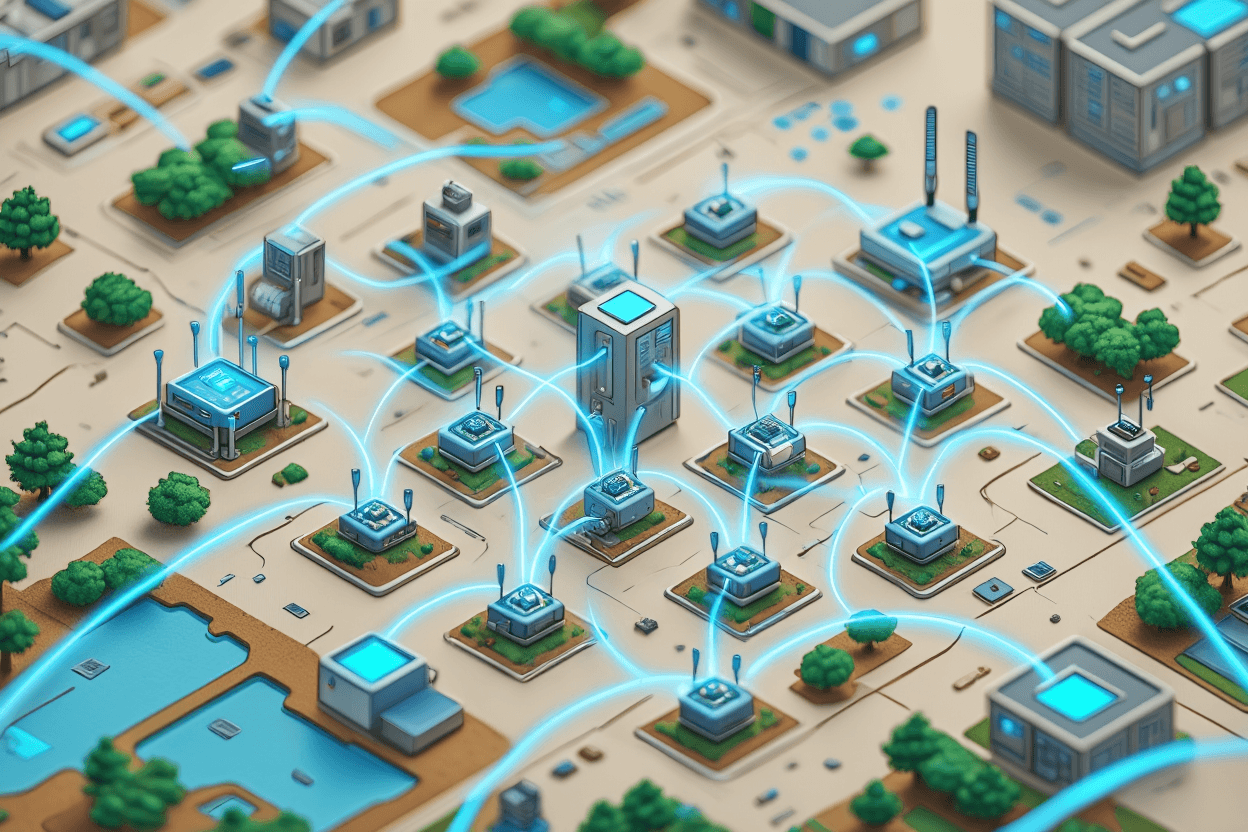
Wireless Sensor Networks (Generated with Artificial Intelligence)
Basic Components | Sensor Nodes, Gateway, Software Platform | ||||||||
|---|---|---|---|---|---|---|---|---|---|
Communication Protocols | Zigbee, LoRaWAN, Bluetooth Low Energy (BLE), Wi-Fi | ||||||||
Network Topologies | Star, Mesh, Tree | ||||||||
Application Area(s) | Industrial Automation Smart Buildings Military Applications Healthcare Environmental Monitoring Smart Agriculture | ||||||||
Basic Features | Low Power Consumption, Scalability, Flexibility, Wireless Communication, Data-Centric Architecture | ||||||||
Wireless Sensor Networks (WSNs) are network systems composed of sensor nodes distributed across a specific geographic area to continuously and autonomously monitor physical or environmental conditions. These systems collect data from various parameters such as temperature, pressure, humidity, sound, vibration, and light intensity, process it locally, and transmit it via wireless communication protocols to a central location or higher-level processor. The fundamental components of WSNs are the sensor nodes that perform measurements, one or more gateways that receive data from these nodes, and management software that processes or controls all the data. Their ability to operate in environments where establishing a wired communication infrastructure is difficult, costly, or technically impossible makes them particularly advantageous. In this regard, WSNs are regarded as one of the key technologies driving the development of the Internet of Things (IoT) ecosystem.
One of the most distinctive structural features of WSNs is their data-centric nature. In traditional networks, the identity, address, or connection points of devices are typically prioritized, whereas in WSNs the primary focus is on the data itself and the information it contains. This approach becomes a decisive factor in the design of routing, data transmission, and processing within the network. Moreover, WSNs are generally large-scale systems consisting of hundreds or even thousands of sensor nodes. This necessitates the development of efficient, energy-efficient, and scalable communication protocols suitable for large-scale operation. Factors such as energy efficiency for long-term operation, reliability, inter-node synchronization, and fault tolerance are among the central technical challenges in WSN research and applications.

Wireless Sensor Networks (Generated by Artificial Intelligence)
Wireless Sensor Networks consist of several fundamental components that work together to form a functional whole. Each of these components directly affects the overall performance, energy efficiency, lifespan, and reliability of the network. The structure of WSNs typically comprises sensor nodes, gateways, and software or management platforms.
Sensor nodes form the most basic component of the network. These are small, low-cost, low-power electronic devices designed to detect environmental or physical conditions. Each node generally has four main components:
Sensor nodes do not only collect data; they can also perform routing functions. This allows data to be transported to the gateway via multi-hop paths. Energy constraints and the small size of nodes are among the most critical design considerations for sensor nodes.
The gateway is a central component that collects data generated by sensor nodes and forwards it to higher-level systems. Gateways act as bridges between WSNs and the internet, local servers, or cloud-based platforms. These devices aggregate data from sensors, filter or reformat it as needed, and transmit it to central systems for analysis.
Compared to sensor nodes, gateways have higher processing capacity, larger memory capacity, and more robust power sources. In some designs, the gateway is responsible only for data transmission; in others, it also handles network coordination, time management, node addressing, and data integrity preservation.
The third fundamental component of Wireless Sensor Networks is the software and management layer. This platform enables the deployment, operation, monitoring, and evaluation of collected data. It allows users to observe the energy status of nodes, connection quality, and data flow. Additionally, operations such as network reconfiguration, adding or removing nodes are performed through this software.
In industrial applications, software platforms often support advanced analytics such as predictive maintenance, process optimization, anomaly detection, and condition monitoring. Thanks to cloud-based solutions, data can be stored at large scale and analyzed in real time. Custom automation and control systems for WSN applications are developed using development environments such as .NET or other specialized software frameworks.
In Wireless Sensor Networks, how nodes connect with each other and transmit data determines the network topology. The choice of topology directly affects not only the physical distribution of nodes but also the application requirements, energy efficiency, fault tolerance, coverage area, and ease of maintenance. Therefore, network architecture is a critical decision point in WSN design. The most commonly used topologies are star, mesh, and tree structures.
In star topology, all sensor nodes connect directly to a central gateway. Nodes do not communicate with each other; they only interact with the central station. The most important advantage of this approach is its simplicity in setup and management. Adding or removing nodes is straightforward, and no routing algorithms are required. However, this structure is dependent on the central node; if the gateway fails, the entire network becomes inoperative. Additionally, the coverage area is limited by the distance between sensor nodes and the gateway, making it difficult to use over large areas.
In mesh topology, nodes can communicate not only with the gateway but also with each other. This structure creates multiple paths for data to reach its destination, thereby increasing network reliability. If one node fails, data can be rerouted through alternative paths. This flexibility helps extend coverage and enhance network resilience. However, mesh topology requires complex routing algorithms, higher processing power, and consequently greater energy consumption. In large-scale WSNs, the mesh structure is widely preferred due to its high fault tolerance and flexibility.
Tree topology is a hierarchical structure that combines features of star and mesh topologies. At the top is a root node (usually the gateway or coordinator), with other nodes branching downward from it. Each node can collect data from subordinate sensors and forward it upward. This structure is energy-efficient because each node transmits data only from a specific subgroup. Additionally, the network is highly scalable; new nodes can be easily added to appropriate branches. However, a failure in the root node or upper-level branches can disrupt communication for a large subgroup.
The effectiveness and sustainability of Wireless Sensor Networks (WSNs) largely depend on the characteristics of the communication protocols used and how well they meet the network’s requirements. Communication in WSNs is typically implemented through a layered architecture; within this structure, the network layer (NWK) is responsible for routing, addressing, and security mechanisms. Upper layers regulate data transmission, while lower layers focus on physical connections and medium access control (MAC).
Protocols used in WSNs are developed considering parameters such as energy consumption, data rate, range, security, and scalability. Different application areas—for example, home automation, smart cities, healthcare systems, or agricultural technologies—require the adoption of different protocols and standards.
Zigbee is a short-range communication protocol based on the IEEE 802.15.4 standard, offering low power consumption and low data rates. It is widely used in home automation, building security, industrial control systems, and smart lighting applications. Zigbee networks consist of three main device types:
Zigbee supports mesh and tree topologies, enhancing network reliability and flexibility. Its low power consumption enables sensor nodes to have long operational lifespans.
LoRaWAN is a protocol developed to enable long-range wireless communication with low power consumption. It can provide ranges from several kilometers to tens of kilometers. Due to this capability, it is used in large-scale applications such as smart cities, agricultural monitoring, water and energy metering, logistics operations, and environmental monitoring.
LoRaWAN is based on star topology, where end nodes transmit data directly to the gateway. Although data rates are low, minimal power consumption allows nodes to operate for years without battery replacement.
Bluetooth Low Energy (BLE) is a technology that enables wireless communication over short distances (typically up to 100 meters) with low energy consumption. It consumes significantly less power than traditional Bluetooth and is therefore preferred in wearable devices, health monitoring systems, asset tracking, and short-range smart sensor applications.
BLE has been widely adopted due to its ability to establish fast connections between portable devices and its compatibility with existing mobile ecosystems. Moreover, data communication via BLE enables easy integration with smartphones and tablets.
Other standards used in WSNs include WirelessHART, 6LoWPAN (IPv6 over Low-Power Wireless Personal Area Networks), and NB-IoT (Narrowband IoT). WirelessHART is designed to enhance reliability in industrial automation processes. 6LoWPAN adapts the IPv6 protocol for low-power sensor networks, enabling integration with internet-based solutions. NB-IoT provides low-cost, energy-efficient wide-area coverage using cellular network infrastructure.
Wireless Sensor Networks (WSNs) are used across diverse sectors and research fields due to their low cost, scalability, and energy efficiency. The prevalence of these systems is increasing as data collection becomes easier and wireless technologies advance rapidly. Major application areas include:
WSNs are widely used in manufacturing facilities and industrial environments to continuously monitor the status of machines and equipment. Data on temperature, pressure, vibration, and acoustics collected via sensors form the basis for predictive maintenance applications. This enables faults to be anticipated before they occur, increases production continuity, and reduces maintenance costs. Additionally, these systems contribute to process optimization, energy efficiency, and workplace safety.
In agriculture, WSNs provide data on soil moisture, temperature, pH, nutrient content, and environmental conditions, enabling automated control of irrigation and fertilization systems. These systems help conserve water and energy while improving crop yield and quality. WSN-based solutions deployed over large areas play a significant role in adapting to climate change and developing sustainable agricultural practices.
One of the most important applications of WSNs is the collection of environmental data. They are widely used in monitoring air pollution, assessing water quality, detecting forest fires at an early stage, and tracking floods or volcanic activity. Additionally, sensor networks are employed to observe wildlife behavior and population dynamics for the conservation of biological diversity. These applications are critically important for disaster management, ecosystem health, and the development of environmental policies.
In healthcare, WSNs are primarily used for remote patient monitoring and continuous tracking of vital signs. Parameters such as heart rate, blood pressure, body temperature, or glucose levels are collected via sensors and transmitted to healthcare professionals. The management of chronic diseases, elderly care, and home-based healthcare services are supported by this technology. As a result, both the burden on healthcare systems is reduced and patients’ quality of life is improved.
WSNs also hold strategic importance in military operations and security domains. They can be used for border security, surveillance of military bases, detection of enemy targets, and tracking of movements. Additionally, sensor networks play a critical role in the early detection of chemical, biological, or radiological threats. In security applications, the low visibility, wide coverage area, and flexible deployment capabilities of multiple nodes provided by WSNs offer significant advantages.
Within building environments, WSNs are widely used to enhance energy efficiency and improve living comfort. Automated control of lighting, climate, and security systems enables optimization of energy consumption and adaptation to user needs. In smart buildings, fire and gas leak detection systems, access control, and environmental condition monitoring are all integrated through WSN-based solutions.
Wireless Sensor Networks (WSNs) offer many significant advantages compared to traditional wired network systems. These advantages include low installation costs, absence of cable infrastructure requirements, flexible deployment, and high scalability. WSNs provide practical solutions in environments where wired communication is technically or economically unfeasible, thanks to their ability to enable wireless communication among distributed nodes over large areas. Furthermore, their ease of deployment in hard-to-reach, hazardous, or inaccessible areas—such as nuclear facilities, battlefields, high mountain regions, or ocean floors—makes them indispensable for many critical applications.
In terms of scalability, the ability of hundreds or even thousands of nodes to operate together enables the implementation of large-scale data collection and analysis projects. Thanks to their flexibility, new nodes can be easily added to the network or existing nodes can be repositioned. This is one of the primary reasons WSNs are preferred in numerous fields ranging from smart cities to industrial automation.
However, there are also challenges that must be considered in the design and operation of WSNs. The most critical issue is the limited energy supply due to the fact that sensor nodes typically operate on batteries. Although low-power hardware, sleep modes, and energy-efficient communication protocols have been developed to reduce energy consumption, extending network lifetime remains a fundamental research topic.
Another challenge is the limited processing power and memory capacity of sensor nodes. These constraints make it difficult to implement complex data processing or security algorithms at the node level. Therefore, data is often transmitted to gateways or central servers for processing.
Network security is also a major concern for WSNs. Their susceptibility to wireless communication exposes them to security threats such as eavesdropping, fake data injection, or denial-of-service attacks. Consequently, mechanisms for data integrity, authentication, and encryption are of vital importance.
Finally, the dense data traffic generated by large-scale WSNs must be efficiently managed and analyzed. Data compression, data fusion, and intelligent routing algorithms play a key role in addressing this issue. Additionally, the ability of the network to adapt to dynamic conditions—such as node failures, changing environmental conditions, or mobile sensors—is another challenge that must be considered in WSN design.
Research on Wireless Sensor Networks focuses on overcoming current limitations and developing new use scenarios. Key emerging trends in the coming years include:
These trends will not only strengthen current WSN applications but also enable their use in more complex and critical tasks in the future.
Dener, Murat. “Kablosuz Algılayıcı Ağlarda Güvenli İzleme Sistemi Tasarımı.” *Journal of the Faculty of Engineering and Architecture of Gazi University* 29, no. 4 (2014): 745–54. Accessed August 23, 2025. https://dergipark.org.tr/tr/download/article-file/76534
Durukan Odabaşı, Şafak, and A. Halim Zaim. “Kablosuz Sensör Ağlar ve Güvenlik Problemleri.” İstanbul Üniversitesi, Bilgisayar Mühendisliği Bölümü. Accessed August 23, 2025. https://www.emo.org.tr/ekler/d15b84507ed8fb2_ek.pdf
Hussain, Md. Naeem, Md. Abdul Halim, Md. Yakub Ali Khan, Salah Ibrahim, and Abrarul Haque. “A Comprehensive Review on Techniques and Challenges of Energy Harvesting from Distributed Renewable Energy Sources for Wireless Sensor Networks.” *Control Systems and Optimization Letters* 2, no. 1 (2024): 15–22. doi:10.59247/csol.v2i1.60. Accessed August 23, 2025. https://ejournal.csol.or.id/index.php/csol/article/view/60
Kalaycı, Tahir Emre. “Kablosuz Sensör Ağlar ve Uygulamaları.” Conference Paper,Ege Üniversitesi, Department of Computer Engineering. Accessed August 23, 2025. https://ab.org.tr/ab09/bildiri/197.pdf
León Ávila, Bernardo, Carlos García Vázquez, Osmel Perez Baluja, Petru Cotfas, and Daniel Cotfas. “Energy Harvesting Techniques for Wireless Sensor Networks: A Systematic Literature Review.” *Energy Strategy Reviews* 57 (December 26, 2024): 101617. doi:10.1016/j.esr.2024.101617. Accessed August 23, 2025. https://doi.org/10.1016/j.esr.2024.101617
Mushtaq, Muhammad Umer, Hein Venter, Avinash Singh, and Muhammad Owais. “Advances in Energy Harvesting for Sustainable Wireless Sensor Networks: Challenges and Opportunities.” *Hardware* 3, no. 1 (2025): 1. doi:10.3390/hardware3010001. Accessed August 23, 2025. https://doi.org/10.3390/hardware3010001

Wireless Sensor Networks (Generated with Artificial Intelligence)
Basic Components | Sensor Nodes, Gateway, Software Platform | ||||||||
|---|---|---|---|---|---|---|---|---|---|
Communication Protocols | Zigbee, LoRaWAN, Bluetooth Low Energy (BLE), Wi-Fi | ||||||||
Network Topologies | Star, Mesh, Tree | ||||||||
Application Area(s) | Industrial Automation Smart Buildings Military Applications Healthcare Environmental Monitoring Smart Agriculture | ||||||||
Basic Features | Low Power Consumption, Scalability, Flexibility, Wireless Communication, Data-Centric Architecture | ||||||||
No Discussion Added Yet
Start discussion for "Wireless Sensor Networks" article
Structure and Components
Sensor Nodes
Gateway
Software and Management Platform
Network Architecture and Topologies
Star Topology
Mesh Topology
Tree Topology
Communication Protocols and Standards
Zigbee
LoRaWAN (Long Range Wide Area Network)
Bluetooth Low Energy (BLE)
Other Protocols
Application Areas
Industrial Automation and Condition Monitoring
Smart Agriculture
Environmental Monitoring
Healthcare Services
Military and Security Applications
Smart Buildings and Home Automation
Advantages and Challenges
Future Research Directions