


This article was automatically translated from the original Turkish version.
+3 More
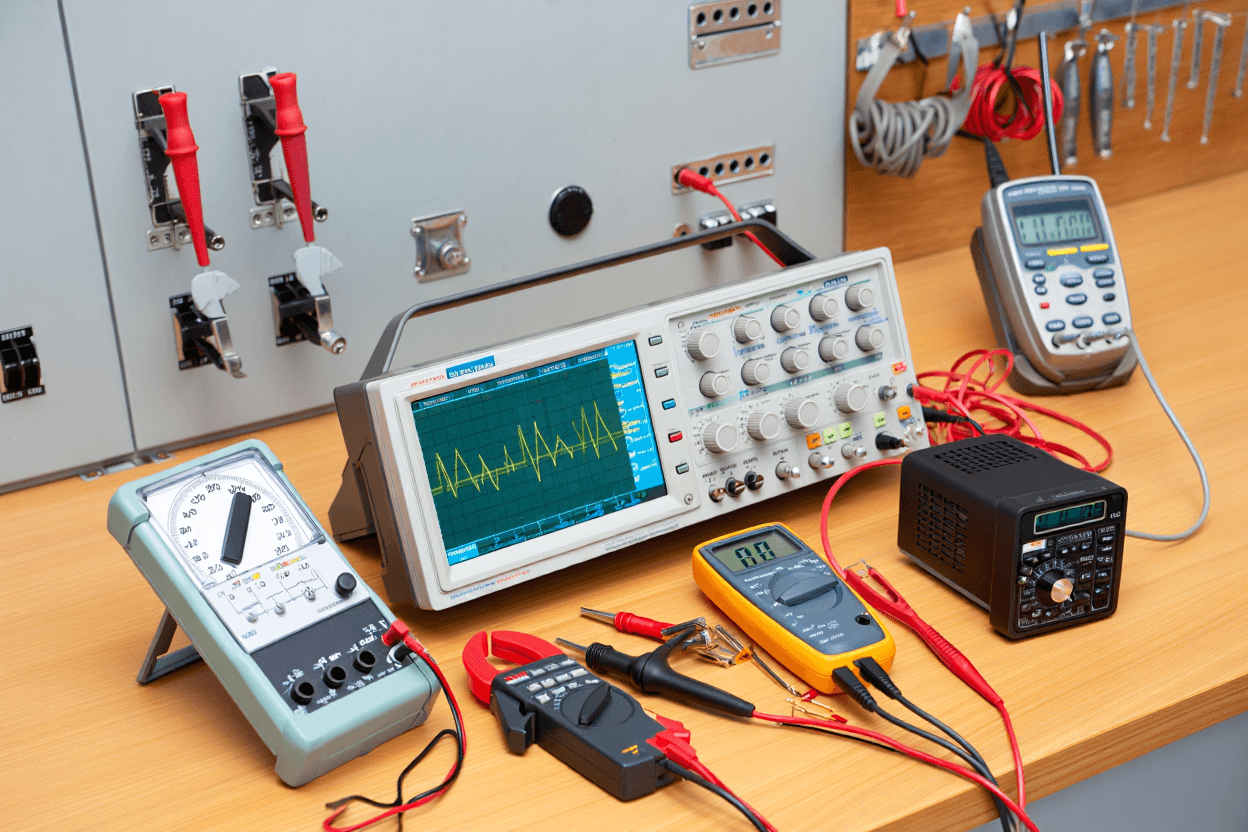
Electrical Measurement Instruments (Generated with Artificial Intelligence)
Basic Tools | Multimeter, Voltmeter, Ammeter, Oscilloscope, Wattmeter | ||||||||
|---|---|---|---|---|---|---|---|---|---|
Primary Units of Measurement | Ampere (A), Volt (V), Ohm (Ω), Watt (W), Hertz (Hz) | ||||||||
Classification(s) | Analog/Digital Indicating/Recording/Collecting Portable/Panel Type | ||||||||
Area(s) of Use | Industry Laboratory Engineering Maintenance-Repair Electronics | ||||||||
Electrical measuring instruments are devices used to determine various electrical quantities such as current, voltage, resistance, power, energy, capacitance, inductance, and frequency in electrical circuits and systems. These instruments have a wide range of applications, from industrial facilities to household electronics, and from laboratories to electronic maintenance and repair work. They are critically important for ensuring the safe, accurate, and efficient operation of electrical systems, detecting potential faults, and evaluating performance.
Measuring electrical quantities is mandatory from both technical and safety perspectives. The fundamental purposes of measurement include:
Electrical measuring instruments can be classified according to different criteria:
A multifunctional device capable of measuring multiple electrical quantities within a single housing. It includes modes for measuring voltage and current in both direct (DC) and alternating (AC) forms; for resistance measurement, it sends a test current through an internal source and calculates the value. Modern digital multimeters offer additional functions such as auto-ranging, true RMS, continuity (audible alert), diode testing, capacitance, frequency, and temperature measurement (with a thermocouple probe). Their high input impedance allows measurements without significantly loading the circuit. During use, attention must be paid to probe polarity, range selection, and compliance with the CAT safety rating (CAT II/III/IV); a common and dangerous error is accidentally connecting the probe to a voltage socket while measuring current.
Measures the potential difference between two points and is connected in parallel with the circuit. Its high internal resistance minimizes measurement error and circuit disturbance, especially in low-current or sensitive circuits. In AC measurements, different accuracy methods depending on waveform (average-responding, true RMS) can affect results; true RMS is preferred for non-sinusoidal waveforms. During measurement, selecting the correct reference point (ground, neutral, or return path) and not exceeding the upper limit are fundamental safety requirements.
Measures current flowing through a circuit by connecting it in series. It calculates current from the voltage drop across a low-value shunt resistor inside; if the wrong range is selected, the shunt may overheat. Since connecting an ammeter requires breaking the circuit, clamp-on solutions are preferred in applications where circuit interruption is unacceptable. In high-current circuits, contact tightness and contact resistance affect measurement accuracy.
Measures current without breaking the circuit by clamping around a conductor. For AC current, it operates on a transformer principle based on magnetic flux change; for DC current, it uses a Hall effect sensor. Only a single conductor should be enclosed; if phase and neutral are clamped together, the net magnetic field cancels out, resulting in a near-zero reading. In lines with high total harmonic distortion (e.g., drive-fed motors), wide-band and true RMS models are preferred.
Measures instantaneous active power by multiplying simultaneous voltage and current samples while accounting for the power factor. Direct use is possible in single-phase systems; in three-phase systems, measurements are made using the two-wattmeter method or multi-channel digital power analyzers. In power quality analyses, active power (W), reactive power (var), apparent power (VA), power factor, and phase angle are evaluated.
Measures inductance (L), capacitance (C), and resistance (R) values by applying a specific test frequency and voltage to the component. Results are often presented as series or parallel equivalent models; additional parameters such as ESR (equivalent series resistance) and dissipation factor (D) for capacitors, and quality factor (Q) for inductors, are critical for characterization. Multi-test-frequency support is preferred to observe component behavior across frequency.
Visually displays voltage signals over time; bandwidth, sampling rate, and triggering capability determine measurement accuracy. Measurements of time, amplitude, rise time, frequency, and phase difference are possible; harmonic analysis is performed via FFT using math channels. For high-voltage or differential signals, appropriate probes (x10, differential, current probe) and proper grounding are mandatory for safety.
An integrating instrument that measures total consumed electrical energy. Older electromechanical induction-disk models coexist with electronic meters capable of multi-tariff measurement, recording reactive/capacitive energy, and remote reading/reporting. Measurement accuracy classes and sealing/calibration procedures are decisive for billing in grid operations.
Measures the number of cycles per second and is used to monitor the stability of AC sources. Modern instruments provide high resolution with short gate times using reciprocal counting techniques. They offer higher accuracy than oscilloscope-based estimations in generator tuning, synchronization, and power quality monitoring.
Tests the insulation condition of cables, motor windings, and transformers under high DC voltage and reports resistance in the megaohm range. Time-dependent tests (e.g., 1 min vs. 10 min comparison) allow evaluation of polarization index and dielectric absorption. Before measurement, equipment must be de-energized and discharged; after measurement, residual charge must be safely discharged to ensure operational safety.
Determines the effectiveness of an earth electrode using the three- or four-potential drop method; clamp-on solutions are used where field constraints apply. In large facilities, soil resistivity measurements (e.g., Wenner method) provide input for new grounding designs. Low earth resistance supports safe dissipation of fault currents and proper operation of protective devices.
Continuously record and report parameters such as voltage, current, power, power factor, total harmonic distortion (THD), flicker, imbalance, and transient events (sags, swells, interruptions). They are essential tools for energy efficiency projects, load profiling, demand management, and monitoring compensation health. Long-term recording, event triggering, and communication support (e.g., Modbus/M-Bus/Ethernet) facilitate operational analysis.
Used to determine the route of infrastructure cables and detect faults such as breaks or short circuits. Simple systems trace cables using tone generators and probes; advanced instruments estimate fault distance using time-domain reflectometry (TDR). Network certification instruments for data cables, which can verify conductor layout, crossover/open faults, and length, form a separate category.
Non-contact types detect electromagnetic field changes to quickly indicate voltage presence; practical for initial verification but used only for pass/fail checks, not quantitative measurement. A good safety practice is testing the device on a known source before and after use. Contact types provide clearer indications but must be used with appropriate gloves and insulated tools.
Bell, S. *A Beginner’s Guide to Uncertainty of Measurement*. Measurement Good Practice Guide No. 11. Rev. ed. Teddington, UK: National Physical Laboratory (NPL), 2001. Accessed August 14, 2025. https://www.npl.co.uk/resources/gpgs/beginners-guide-measurement-uncertainty-gpg11.
Costa, Marcelo. “Measurement Uncertainty Improvement on Electric Current Sources Calibration Using Precision Shunts.” *Acta IMEKO* 14 (2025): 1-5. https://doi.org/10.21014/actaimeko.v14i2.1964.
Kumar, V. Jagadeesh. Principles of Electrical Measurement and Measuring Instruments. New York: Springer-Verlag, 2025.
Patan, Alper M. “Inter-Laboratory Comparison of a Digital Multimeter Measurement in Turkey.” *Scientific Reports* 13, no. 1 (2023): 19406. https://doi.org/10.1038/s41598-023-46617-8.
Tumanski, S. Principles of Electrical Measurement. 1. bs. Boca Raton, FL: CRC Press, 2006.

Electrical Measurement Instruments (Generated with Artificial Intelligence)
Basic Tools | Multimeter, Voltmeter, Ammeter, Oscilloscope, Wattmeter | ||||||||
|---|---|---|---|---|---|---|---|---|---|
Primary Units of Measurement | Ampere (A), Volt (V), Ohm (Ω), Watt (W), Hertz (Hz) | ||||||||
Classification(s) | Analog/Digital Indicating/Recording/Collecting Portable/Panel Type | ||||||||
Area(s) of Use | Industry Laboratory Engineering Maintenance-Repair Electronics | ||||||||
No Discussion Added Yet
Start discussion for "Electrical Measuring Instruments" article
Importance of Measurement
Classification
By Structure
By Display Method
By Application Location
Basic Electrical Measuring Instruments and Their Functions
Multimeter
Voltmeter
Ammeter
Clamp Meter
Wattmeter
LCR Meter
Oscilloscope
Electricity Meter
Frequency Meter
Safety Warnings
Typical Connection Diagram Explanations
Calibration and Measurement Uncertainty Notes
Special-Purpose Test and Measurement Instruments
Insulation Resistance Tester
Earth Resistance Tester
Power and Network Analyzers
Cable Locators and Testers
Voltage Detectors (Test Pens)
Other Instruments
Safety Warnings
Typical Connection Diagram Explanations
Calibration and Measurement Uncertainty Notes