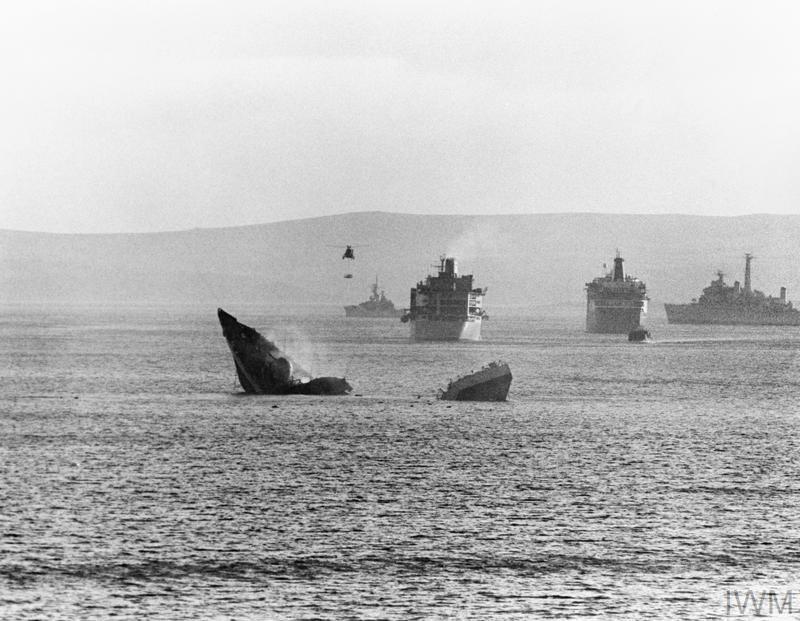


This article was automatically translated from the original Turkish version.
Other Names | Falklands War South Atlantic War | ||||||||
|---|---|---|---|---|---|---|---|---|---|
Date | 2 April – 14 June 1982 | ||||||||
Duration | 74 Days | ||||||||
Location | Falkland Islands South Georgia South Atlantic area around the South Sandwich Islands | ||||||||
Parties | United Kingdom Argentina | ||||||||
Cause of War | Sovereignty dispute over the Falkland/Malvinas Islands Argentina's invasion of the islands | ||||||||
Argentine Operations | Operation Rosario | ||||||||
British Operations | Operation Corporate | ||||||||
British Commanders | Admiral John Fieldhouse Rear Admiral Sandy Woodward Major General Jeremy Moore Brigadier Julian Thompson | ||||||||
Argentine Commanders | General Leopoldo Galtieri Admiral Jorge Anaya Rear Admiral Juan José Lombardo Brigadier General Mario Benjamín Menéndez | ||||||||
Personnel Numbers | United Kingdom approximately 28,000 personnel Argentina approximately 12,000–13,000 personnel on the islands | ||||||||
Outcome | British military victory Restoration of British de facto administration | ||||||||
Argentine Casualties | 649 dead Approximately 1,657 wounded Approximately 11,300 prisoners of war | ||||||||
British Casualties | 255 dead Approximately 775 wounded | ||||||||
Civilian Casualties | Three Falkland Islands residents died | ||||||||
Date and Place of Surrender | 14 June 1982, Stanley/Puerto Argentino | ||||||||
Signatories of the Surrender Document | Major General Jeremy Moore Brigadier General Mario Benjamín Menéndez | ||||||||
The Falklands War, known in Argentina as the Malvinas War (Guerra de las Malvinas) and in some sources as the South Atlantic War (Guerra del Atlántico Sur), was an armed conflict between Argentina and the United Kingdom over sovereignty of the Falkland Islands and associated territories in the South Atlantic.【1】 Following Argentina’s military operation on 2 April 1982 to seize control of the Falkland Islands, the United Kingdom dispatched a task force comprising naval, air, and land units; the 74-day war ended with the surrender of Argentine forces around Stanley on 14 June and the restoration of British administration on the islands.【2】
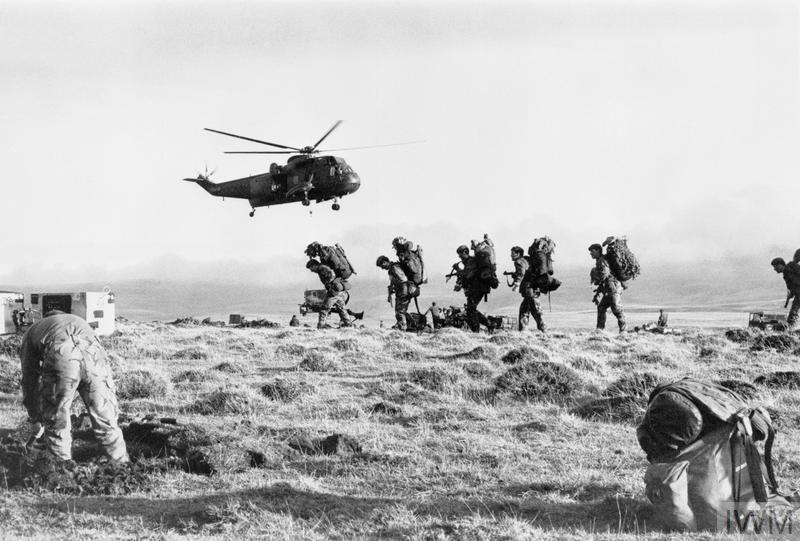
Falkland Islands, Personnel Transport Helicopter from San Carlos (Imperial War Museums)
In the fighting, 649 Argentine and 255 British military personnel, along with three Falkland civilians, lost their lives; numerous soldiers on both sides were wounded or taken prisoner.【3】 Despite its short duration, the war had long-lasting consequences for distant joint operations, the use of naval and air power, international mediation, the collapse of Argentina’s military regime, and the United Kingdom’sdefence policy; however, it did not resolve the dispute over sovereignty of the islands.【4】
The Falkland Islands, known in Spanish as Islas Malvinas, are an archipelago in the South Atlantic Ocean, located off the southeastern coast of South America. They lie approximately 350 miles (560 kilometres) from the South American mainland and about 6,700 miles (10,800 kilometres) from the United Kingdom. The archipelago, covering an area of approximately 4,700 square miles (12,173 square kilometres), consists of two main islands and over 200 smaller islands and islets. Its coastline, deeply indented with numerous bays, inlets, and narrow channels, provides a long shoreline and many natural anchorage points.【5】
The two main landmasses are East Falkland (East Falkland; in Argentine usage Isla Soledad) and West Falkland (West Falkland; Gran Malvina). These two islands are separated by the Falkland Sound (Falkland Sound; Estrecho de San Carlos), which runs in a northeast–southwest direction. East Falkland is the principal island in terms of both area and population. The capital and principal port settlement, Stanley—known as Puerto Argentino during Argentina’s 1982 occupation—is located on the eastern coast of this island. Other settlements of strategic importance during the war, including Darwin, Goose Green, San Carlos, Port San Carlos, Fitzroy, and Bluff Cove, are also on East Falkland. The principal settlements on West Falkland are Port Howard and Fox Bay, while Pebble Island lies off the northern coast. This duality in toponymy reflects the sovereignty dispute’s extension into maps and everyday geographic nomenclature.【6】
Stanley served as the administrative, communications, commercial, and transportation hub of the islands; the rural areas outside the settlement were generally referred to by the inhabitants as the “Camp.” This term encompassed not just specific villages but also farms, pastures, and scattered settlements beyond Stanley. Because the islands’ economy had long been based on sheep farming, a portion of the population lived in widely separated farmsteads. This meant that in 1982, movement of people and goods between Stanley and the rural areas relied not on a regular road network but on off-road vehicles, small aircraft, and coastal shipping.【7】
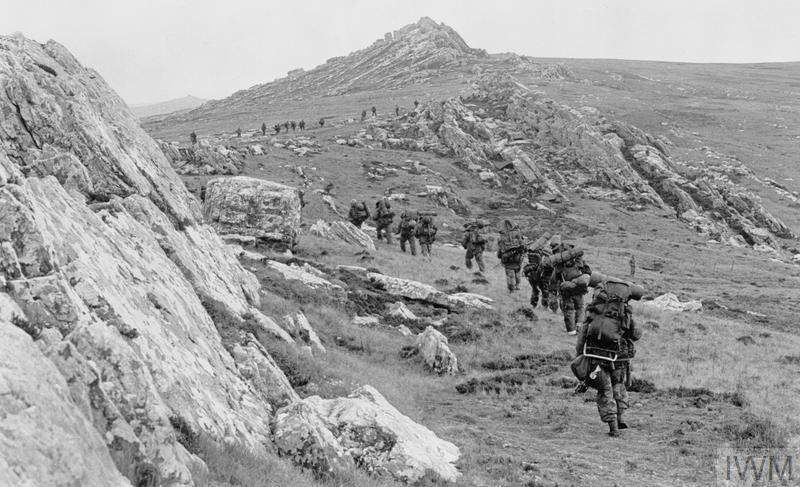
Falkland Adaları, Harriet Dağı (Imperial War Museums)
The Falkland terrain is generally treeless, open, wind-exposed, and covered with rolling tussock grasslands. The interior regions of East and West Falkland feature low hills, ridges, extensive grasslands, and water-retaining soft soils. Hills such as Mount Kent, Mount Challenger, Two Sisters, Mount Harriet, Mount Longdon, Mount Tumbledown, and Wireless Ridge rise to the west of Stanley and dominate the approaches to the capital from the west and southwest. Further south, Lafonia is a lower, more open peninsula connected to the northern part of East Falkland by a narrow land bridge. In British sources, the terrain is described as “windy and largely hilly tussock,” while pre-war military assessments noted the ground as both waterlogged and stony, with limited natural cover.【8】
These physical conditions created a greater barrier to mobility than the islands’ surface area alone might suggest. In 1982, there was no developed road network connecting settlements, and vehicles other than tracked and light four-wheel-drive vehicles had poor off-road mobility. Transporting heavy weapons, ammunition, food, and other supplies by land became difficult; military units were largely dependent on foot movement, helicopters, and sea resupply. While the open terrain enhanced observation, it also made concealment difficult, the wet and stony ground hindered trench digging, and units were forced to concentrate on specific ridges, passes, and existing tracks. Thus, the Falkland geography decisively influenced both Argentina’s reliance on relatively static defensive positions and the British land forces’ methods of advance and resupply.【9】
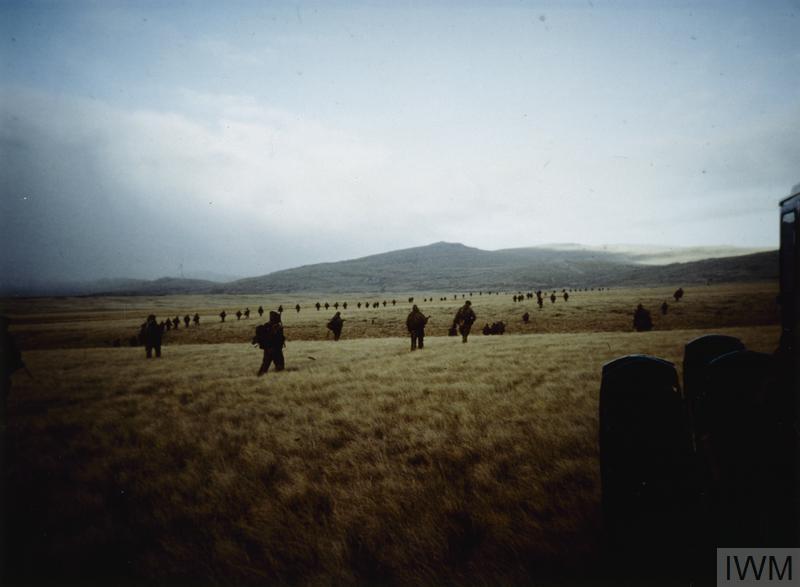
Falkland Adaları, Teal Ilnet (Imperial War Museum)
The Falkland Islands are not part of the same geographic unit as South Georgia and the South Sandwich Islands. South Georgia is a separate, mountainous, and glaciated island located approximately 800 miles east-southeast of the Falklands; the South Sandwich Islands are a volcanic island chain extending further southeast. Nevertheless, all three island groups were treated together under the heading “South Atlantic” in 1982 due to overlapping sovereignty claims, British administrative arrangements, and military operational areas. Argentina’s official Rattenbach Report also defined the Falklands/Malvinas, South Georgia, and the South Sandwich Islands as distinct archipelagos but classified them as components of the same strategic region.【10】
The strategic importance of the islands stemmed not only from their proximity to Argentina. The Falkland Islands were situated near key sea routes connecting the Atlantic and Pacific Oceans, including the Drake Passage, the Strait of Magellan, and access to Antarctica. According to the Rattenbach Commission’s Argentina-centric assessment, the islands’ location could enable the establishment of bases to exert an effective presence over communication between the South Atlantic and the Pacific and to support Antarctic activities.【11】
However, the most immediate military consequence of geography in 1982 was the vast disparity in supply distances: Argentina’s mainland was only a few hundred kilometres from the islands, whereas the United Kingdom had to transport troops, ships, aircraft, fuel, and munitions over thousands of kilometres. Thus, the islands’ remoteness, terrain, lack of roads, sheltered bays, and dispersed settlement patterns determined not only the environment in which the war was fought but also the nature of the operations themselves.
The sovereignty dispute over the Falkland Islands did not arise from a single discovery or occupation event but from the collision of different historical and legal elements: competing claims of discovery, brief settlements, interstate treaties, colonial administration, succession arguments, and the principle of self-determination. The identity of the first European to sight the islands is debated. Argentine narratives highlight Amerigo Vespucci’s 1502 voyage, Estêvão Gomes’s 1520 expedition, or Francisco de Camargo’s 1540 explorations, while the British narrative relies on John Davis’s 1592 voyage. The first documented encounter was made by the Dutch sailor Sebald de Weert in 1600, who sighted the islands and named them the “Sebald Islands.” The first recorded landing was made by the English sailor John Strong on 27 January 1690; Strong named the channel between the two main islands “Falkland” in honour of Anthony Cary, Viscount Falkland, First Lord of the Admiralty.【12】
Active disputes over sovereignty began in the second half of the 18th century. The French navigator Louis-Antoine de Bougainville established the first permanent settlement on East Falkland at Port Louis in 1764 and named the archipelago Îles Malouines after the port of Saint-Malo from which the sailors came. Unaware of the French settlement, Britain asserted a claim over West Falkland in 1765 and established a garrison at Port Egmont the following year. Spain, arguing that the islands lay within its sphere of influence in South America, protested the French settlement; France, in return for compensation, ceded Port Louis to Spain in 1767. The settlement was renamed Puerto de la Soledad and placed under the administration of the General Captaincy of Buenos Aires. Thus, for a time, Spanish and British settlements coexisted simultaneously on East and West Falkland, respectively.【13】
The Spanish forces’ removal of the British garrison at Port Egmont in June 1770 brought Britain and Spain to the brink of war. A compromise reached in January 1771 allowed Britain to return to Port Egmont; however, neither side abandoned its sovereignty claim. Britain withdrew from Port Egmont in 1774, prioritising developments in North America and the cost of maintaining the garrison; however, it left behind a plaque affirming King George III’s sovereignty claim. Spain removed the plaque the following year and became the sole de facto administrator of the islands from 1774 to 1811. Spain’s primary aim during this period was to prevent British mariners and whalers and sealers from establishing permanent bases on the islands. After Spain withdrew its garrison in 1811, the islands remained without regular state administration for approximately ten years.【14】
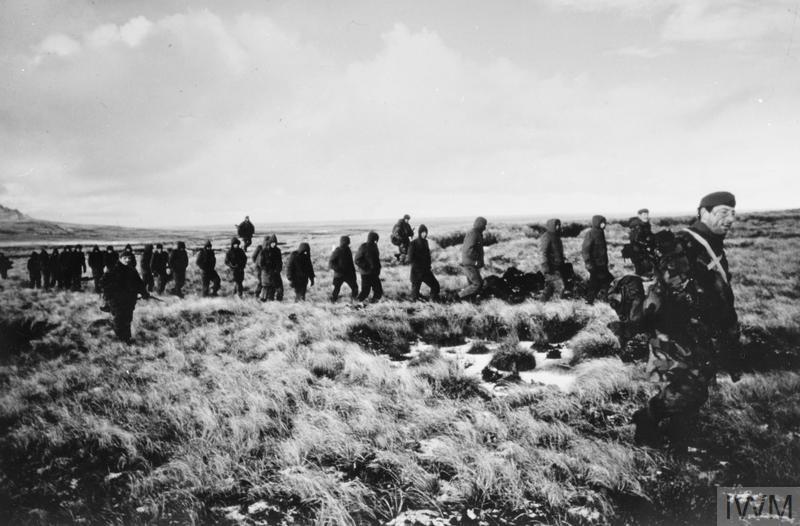
Argentine Prisoners Being Removed from Mount Tumbledown (Imperial War Museums)
The United Provinces of the Río de la Plata, born from the struggle for independence from Spanish rule, claimed to be the successor to Spain’s territorial holdings in the region. American-born Colonel David Jewett raised the flag of the United Provinces at Puerto Soledad in November 1820, declaring sovereignty on behalf of the Buenos Aires government. In the 1820s, Luis Vernet, a Hamburg-born merchant granted fishing, livestock, and land concessions, established a settlement of approximately 120–200 people on East Falkland and was appointed political and military administrator of the islands on 10 June 1829. Britain formally protested this appointment in November 1829, reiterating its non-renunciation of its 18th-century claims. Vernet’s attempts to enforce Buenos Aires’s fishing regulations against foreign sealers provoked a conflict with the United States. In December 1831, the American warship USS Lexington arrived at Puerto Soledad, destroyed military installations, seized part of the settlement’s property, and took numerous individuals into custody. This intervention significantly weakened the Buenos Aires government’s authority on the islands.【15】
Britain exploited the resulting power vacuum by sending HMS Clio and HMS Tyne to the region. On 2 January 1833, HMS Clio’s commanding officer, Captain John James Onslow, arrived at Puerto Soledad and demanded that Argentine naval officer José María Pinedo, commander of the ARA Sarandí, lower the Argentine flag. Pinedo, facing overwhelming force, avoided conflict; the Sarandí departed the islands with its crew, prisoners, and some settlers. Contrary to the common narrative that all civilians were removed, some settlers remained. Britain placed a naval officer in Puerto Soledad in January 1834, appointed Richard Moody as governor in 1842, and by 1843–1845 transformed the Falkland Islands into a royal colony with a governor, legislative council, and executive council. Argentina, however, regarded the 1833 intervention as an illegal occupation carried out by force and never abandoned its sovereignty claim.【16】
Argentina’s legal argument rested primarily on state succession and the principle of uti possidetis juris: it claimed that the islands, previously administered by Spain through the Viceroyalty of the Río de la Plata, passed to the United Provinces and subsequently to Argentina upon independence. This claim was supported by the 1820 sovereignty declaration, Vernet’s settlement, the 1829 administrative appointment, and ongoing protests after 1833. Britain, by contrast, based its claim on its settlement at Port Egmont, its 1774 declaration of sovereignty, its assertion that it never formally renounced this right, and its continuous administration established after 1833. Over time, Britain’s position came to centre on effective, open, and uninterrupted administration and the right of the islanders to determine their own political future. However, both historical arguments contained contentious points: Britain’s presence at Port Egmont was brief and unrefreshed for nearly sixty years, and Argentina’s administration between 1820 and 1832 was limited and intermittent. The British Prime Minister, the Duke of Wellington, acknowledged in 1829 that “it is not clear that we have any real title to the sovereignty of these islands,” indicating that even within British administrative circles, the initial historical grounds for Britain’s claim were debated. The dispute was never submitted to the International Court of Justice or any other binding international tribunal for a ruling on the merits.【17】
After the Second World War, the dispute acquired new legal and diplomatic dimensions within the process of decolonisation. Argentina brought the issue before the United Nations Special Committee on Decolonisation in 1964. The UN General Assembly’s Resolution 2065 (XX) of 16 December 1965 acknowledged the existence of a sovereignty dispute between the Argentine and British governments and called on both parties to resolve it peacefully without delay. The resolution did not rule in favour of Argentina’s claim nor set a deadline for the transfer of sovereignty. However, the issue was framed within the context of decolonisation, and negotiations were urged to consider the “interests” of the population rather than their “wishes.” This phrasing laid the foundation for subsequent disagreements: Argentina emphasised territorial integrity and the end of colonial status, while the United Kingdom increasingly foregrounded the islanders’ wishes and their right to self-determination.【18】
Negotiations between the two governments began in 1966. Britain initially proposed freezing the dispute for at least thirty years, after which the islanders would choose between British and Argentine sovereignty. Argentina rejected this proposal. In March 1967, Britain formally indicated for the first time that it might be prepared to transfer sovereignty, provided the islanders’ interests were safeguarded. In August 1968, a draft agreement reached at the official level envisaged Britain recognising “Argentina’s sovereignty over the islands” as part of the final solution. However, this recognition was contingent on Argentina providing guarantees acceptable to London that the islanders’ interests would be protected. The draft’s disclosure provoked strong reactions in the islands, the British Parliament, and the press; Argentina’s refusal to accept a clause explicitly linking the transfer to the islanders’ wishes meant the agreement never came into effect.【19】
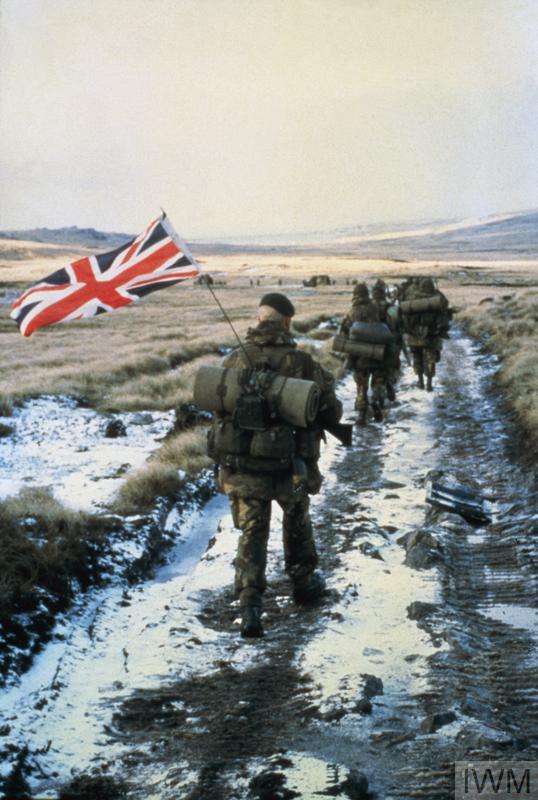
The British 45th Commando Brigade Is Advancing Toward Port Stanley (Imperial War Museums)
Despite the impasse on sovereignty, communication agreements were signed in 1971 under a “sovereignty umbrella” formula that allowed practical cooperation without either side relinquishing its legal claims. Air and sea links were established between Argentina and the islands; a document known as the “white card” was accepted to allow islanders to travel freely in Argentina; arrangements were made for postal, telegraphic, telephone, educational, health, and tax matters. Argentina constructed a temporary air corridor in 1972 and initiated regular air links with the mainland. These developments strengthened the islands’ connection to the outside world but also increased their dependence on Argentina for transport, fuel, and some basic services. The UN General Assembly’s Resolution 3160 (XXVIII) of 1973 called for accelerated negotiations; although the idea of joint sovereignty or condominium briefly surfaced in 1974, it did not lead to a lasting proposal.【20】
From 1975 onwards, the linkage of economic resources to sovereignty talks heightened tensions. Britain’s establishment of a commission under Lord Edward Shackleton to investigate the islands’ economic potential was viewed by Argentina as a unilateral resource exploitation initiative. In February 1976, an Argentine intelligence agent fired warning shots at the unarmed British research vessel RRS Shackleton, approximately 78 miles south of Stanley, attempting to halt it. In the same year, the Argentine navy secretly established a military-scientific station on South Thule in the South Sandwich Islands. The British vessel HMS Endurance identified this presence in December 1976 and Britain protested; however, the station was not forcibly removed and remained operational until 1982.【21】
The new negotiation framework accepted in April 1977 covered the future political relations of the Falkland Islands, South Georgia, and the South Sandwich Islands, the sovereignty issue, and economic cooperation in the South-west Atlantic. Negotiations were to proceed without harming either party’s sovereignty claims, and the islanders were to be kept informed throughout. However, none of the options—sovereignty transfer, lease, joint administration, scientific cooperation, or maritime jurisdiction—found common ground acceptable to Argentina, the British government, the British Parliament, and the islanders. The failure to make progress in the 1978 and 1979 meetings highlighted the fundamental impasse of the negotiation period since 1965: Argentina expected negotiations to culminate in a transfer of sovereignty, while British governments could not commit to such a transfer without the islanders’ approval.【22】
A change in the upper echelons of Argentina’s military regime in December 1981 directly affected the course of the Falklands dispute. General Leopoldo Fortunato Galtieri assumed the presidency on 22 December, replacing Roberto Eduardo Viola, and retained command of the Army. The other members of the Military Junta were Navy Commander Admiral Jorge Isaac Anaya and Air Force Commander Brigadier General Basilio Arturo Ignacio Lami Dozo. Anaya, in particular, had long viewed the use of force on the sovereignty issue as a viable option; his close relationship with Galtieri increased the Navy’s influence in the decision-making process. The appointment of Nicanor Costa Méndez as foreign minister also indicated that negotiations would be pursued with a more aggressive timetable and rhetoric. During this period, the islanders’ opposition to the “re-rental” formula—sovereignty transfer followed by leasing the islands back to Britain—hardened, and Britain’s decision to withdraw HMS Endurance from the region was interpreted in Buenos Aires as evidence that Britain’s commitment to the South Atlantic was weakening.【23】
The institutional consideration of the military option began on 5 January 1982. The Junta, concluding that no tangible progress had been made in negotiations since 1965, decided to adopt a more assertive diplomatic stance and to investigate the feasibility of seizing the islands by force if Britain continued to delay negotiations. On 12 January, a secret working commission composed of General Osvaldo Jorge García, Rear Admiral Juan José Lombardo, and Brigadier General Sigfrido Martín Plessl was established. Its task was to examine how military force could be employed, both politically and militarily, should negotiations fail. However, Admiral Anaya had already, prior to the Junta’s decision, given Lombardo specific instructions in mid-December 1981 to investigate the possibility of seizing the islands. Thus, although the military option was initially presented as an alternative pressure tool to diplomacy, it was already being actively planned within the Navy before the official decision was made.【24】
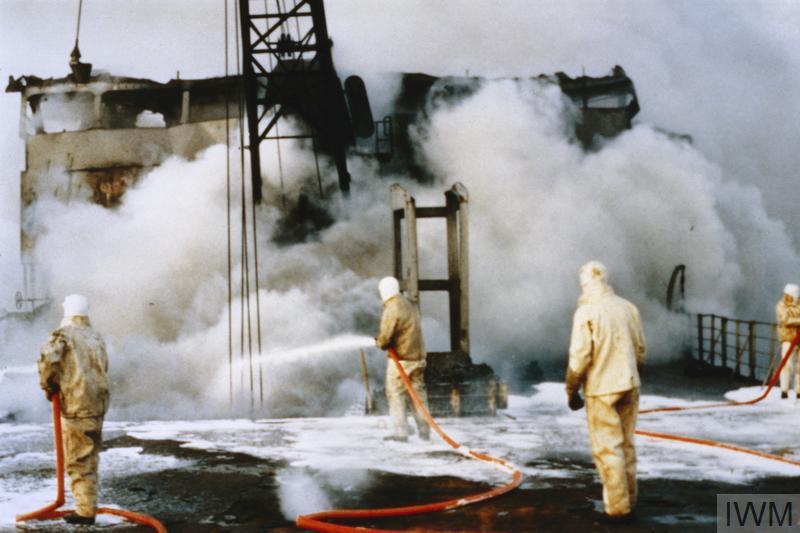
Intervention at the Fire on the RFA Sir Galahad in Fitzroy Following the Argentine Air Attack (Imperial War Museums)
On 27 January, the Argentine government proposed to Britain that sovereignty negotiations be conducted through a permanent commission meeting monthly and tasked with resolving the dispute within a reasonable timeframe. The parties met in New York on 26–27 February and agreed on a general framework for the commission; however, no progress was made on the issue of sovereignty transfer. Immediately after the joint communiqué was issued, on 1 March, the Argentine Ministry of Foreign Affairs issued a unilateral statement declaring that if negotiations failed to yield results quickly, Argentina reserved the right to terminate the process and freely choose the method most favourable to its interests. London interpreted this statement as an implicit threat of force. Nevertheless, most diplomatic and intelligence assessments reaching Britain assumed that Argentina would seek to pressure negotiations throughout 1982 rather than act immediately. Although warnings about a possible military intervention existed, they were not regarded as definitive evidence of imminent preparations for an invasion.【25】
Secrecy facilitated Argentina’s concealment of its preparations from Britain but also hampered its own planning process. The working commission operated with only a few assistants; necessary coordination between the Ministry of Foreign Affairs, the Joint General Staff, intelligence units, and logistical organisations was not established. Initial drafts assumed the operation would not occur before 9 July 1982; later estimates placed the readiness of forces for 15 May. The plan envisioned an amphibious assault with overwhelming force, minimal bloodshed, the capture of Port Stanley and its airfield, the establishment of a military administration, and the withdrawal of the majority of forces within five days. Only a small garrison to support the military governor would remain on the islands. The plan’s foundation was the assumption that Britain would not mount a major military response and that negotiations would resume after the occupation. The prolonged defence of the islands, the potential for a naval blockade, Britain’s nuclear submarines, the United States’ stance, and the possibility of Chile exploiting the conflict were not examined in sufficient detail.【26】
The event that accelerated developments occurred on South Georgia, approximately 1,300 kilometres east of the Falkland Islands. The Argentine businessman Constantino Davidoff had signed a contract with the Edinburgh-based Christian Salvesen company to dismantle abandoned whaling facilities on the island. Davidoff’s team failed to notify British authorities in Grytviken during their first visit to Leith in December 1981, prompting a diplomatic protest. In March 1982, Davidoff informed the British Embassy in Buenos Aires that he would employ 41 workers for four months in Leith; the Argentine Navy vessel Bahía Buen Suceso arrived at the port on 19 March. The workers’ landing without completing entry procedures, the raising of an Argentine flag, the sound of gunfire, and the destruction of some warning signs transformed the incident from a commercial venture into something more. The identity of those who raised the flag and whether any active-duty military personnel were among the landers later became contentious. British Antarctic Survey personnel reported the incident to Falkland Governor Rex Hunt, while the Argentine side maintained that the team consisted solely of civilians employed by a private company.【27】
Bahía Buen Suceso departed Leith on 21 March; however, some workers remained behind. Britain responded by sending HMS Endurance with 22 Royal Marines to prepare for the evacuation of the workers. In response, the Argentine Military Committee decided on 23 March to send the Bahía Paraíso under the command of Alfredo Astiz with “Alpha Group” to Leith to prevent the forced removal of the workers. Britain proposed that the workers simply proceed to Grytviken to complete entry procedures; Argentina interpreted this as recognition of British administration over the islands and rejected the proposal. Thus, what began as a dispute over migration and port procedures evolved into a military confrontation testing both sides’ sovereignty claims. Argentina’s subsequent official investigation found no evidence that Davidoff’s group had been deliberately provoked by either side; however, it noted that the Navy had used the incident to consider establishing a permanent scientific station on South Georgia.【28】
On 24 March, the Military Committee confirmed that the workers would not withdraw and that the marines aboard the Bahía Paraíso would protect them. At the same meeting, the earliest possible date for the previously planned Falklands operation, scheduled for May or July, was determined. On the evening of 26 March, the options of continuing negotiations, referring the matter to the United Nations Security Council, and seizing the islands were considered. After a brief assessment, the third option was accepted. Foreign Minister Costa Méndez supported the decision, believing that negotiations could begin immediately after the occupation. The operation’s objectives were to strengthen Argentina’s position on South Georgia, prevent Britain from reinforcing the islands, restart sovereignty negotiations, and enhance Buenos Aires’s bargaining power. The operation date was set for the night of 1 April, with authority to delay to 2 or 3 April depending on weather and sea conditions.【29】
The decision was driven primarily by the sovereignty claim, the perception that negotiations had stalled, and concerns that Britain would reinforce the region. However, the military regime’s internal problems were also a factor. High inflation, foreign debt, unemployment, public outrage over human rights abuses, and growing social opposition to the regime since 1976 had eroded the Junta’s legitimacy. The official Argentine assessment recorded that the idea of creating a “significant event” to revive the National Reorganization Process had influenced the decision. However, reducing the invasion to a mere attempt to divert public attention from domestic turmoil ignores the long-standing sovereignty dispute, earlier plans for the use of force, and the accelerating impact of the South Georgia crisis.【30】
In Argentine documents, the operation was initially designated “Azul”; however, in the narrative of the amphibious force and subsequent military historiography, it became known as the “Rosario Operation.” The Amphibious Task Force 40, commanded by Rear Admiral Walter O. Allara, included landing forces under the command of Rear Admiral Carlos Büsser. The core of the force consisted of the 2nd Marine Battalion under Commander Alfredo Weinstabl, amphibious commandos, tactical divers, and a unit from the 25th Infantry Regiment. Troops were transported on the Cabo San Antonio, Almirante Irízar, and Isla de los Estados, while the destroyers Hércules and Santísima Trinidad and the corvettes Drummond and Granville provided naval support. The submarine Santa Fe was assigned reconnaissance and transport duties for the tactical divers. The ships departed their bases on 28 March; severe weather conditions in the South Atlantic forced a 24-hour delay in the landing date. The plan’s fundamental directive was to end resistance through overwhelming force and avoid casualties wherever possible.【31】
The first Argentine units landed around 00:30 on 2 April approximately four kilometres south of Mullet Creek—designated Puerto Enriqueta in Argentine plans. Amphibious commandos advanced toward the Royal Marines barracks at Moody Brook; however, British forces had already evacuated the site and gathered around the Governor’s residence. Approximately three hours later, tactical divers disembarked from the Santa Fe near Cape Pembroke and prepared the way for the main landing in York Bay. The 2nd Marine Battalion and elements of the 25th Infantry Regiment, landing from the Cabo San Antonio, seized the airfield and advanced toward Stanley from the east. Naval Party 8901, consisting of approximately 68 personnel, along with local volunteers, offered limited but organised resistance, particularly around the Governor’s residence. The commander of the Argentine commando unit attempting to enter the building, Capitán de Corbeta Pedro Edgardo Giachino, was seriously wounded and later died in hospital; two Argentine soldiers were also wounded. There were no British fatalities.【32】
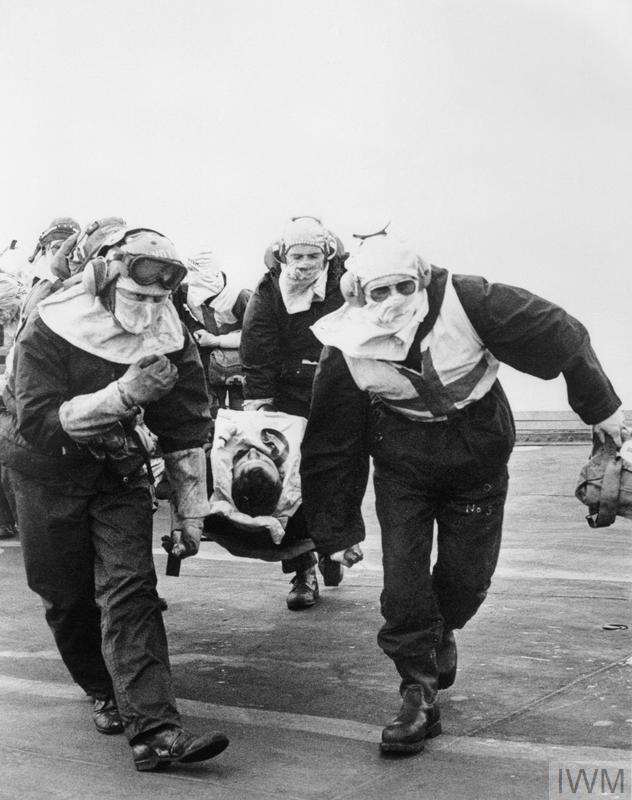
HMS SHEFFIELD Gemisinden Bir Yaralı Revire Götürülüyor (Imperial War Museums)
Faced with the overwhelming imbalance of forces, Governor Rex Hunt concluded that continuing resistance would endanger the civilian population and ordered the forces to lay down their arms. Sources differ slightly on the exact time of surrender: Argentina’s official record dates the ceasefire and surrender at 09:15, while the British operational account places it at approximately 09:25. After obstacles on the airfield runway were removed, an air bridge was established from the mainland at 07:00, and new troops and supplies began arriving throughout the day. The original plan had intended for the bulk of the landing force to return to their ships the same night; however, news that Britain was preparing a large naval force to retake the islands halted the re-embarkation process. Thus, the initial plan of a brief occupation to initiate diplomatic bargaining transformed into a prolonged war requiring the defence of the islands.【33】
The official Argentine post-war assessment summarised the disconnect between the initial phase of the operation and subsequent preparations with the statement: “But once the islands were occupied, no plan was ever made for how they would be defended.” This situation demonstrated that the capture of Stanley with minimal losses did not in itself constitute a strategic success. The units selected for the occupation were well-prepared and clearly assigned their tasks; however, the course of action to be taken if Britain returned with naval and air power, the size of the garrison, the protection of supply lines, and the relationship between diplomacy and military action were never clearly defined.
One day after the Falklands operation, fighting began on South Georgia. The Argentine task group, composed of the Bahía Paraíso and the ARA Guerrico, demanded the surrender of British personnel at Grytviken on the morning of 3 April. The 22 Royal Marines under Lieutenant Keith Mills refused. A Puma helicopter carrying Argentine forces was severely damaged by fire and forced to land on the opposite shore of the bay. Subsequently, the Guerrico, entering the narrow bay, was hit by light arms and anti-tank rockets; its Exocet launchers and gun systems were damaged. As the corvette began firing from a distance and Argentine marines advanced behind British positions, Mills assessed that his objective had been achieved and further resistance would cause unnecessary casualties, leading him to surrender. The engagement ended at 13:22 Argentine time. Three Argentine personnel were killed and seven wounded; one helicopter was rendered unusable and the Guerrico sustained damage. The official Argentine report recorded no British casualties, while detailed British accounts note that Corporal Nigel Peters was wounded.【35】
The 22 Royal Marines and 13 civilians at Grytviken were taken prisoner; a 40-man unit under Lieutenant Guillermo Luna remained at Grytviken, while Alfredo Astiz and approximately ten soldiers were left at Leith. Thus, within 2–3 April, both the Falkland Islands and South Georgia came under Argentine control. Both operations largely achieved their aim of minimising the opposing side’s military losses; however, the fighting on South Georgia proved far more costly than expected. More importantly, the Argentine government had designed the occupation as a limited military-political tool to force Britain into sovereignty negotiations; it had not prepared a comprehensive war plan anticipating Britain’s willingness to launch a large-scale operation to retake the islands and the necessary forces and logistical arrangements required to do so.【36】
The British government learned of Argentina’s impending landing on 31 March 1982 through a definitive intelligence report. First Sea Lord Admiral Sir Henry Leach informed the government that it was now too late to prevent the occupation but that the islands could be retaken if two aircraft carriers, sufficient escort vessels, amphibious landing craft, and a commando brigade were dispatched. The Cabinet discussed military and diplomatic options on the morning of 2 April and reconvened at 19:30 the same day to approve the dispatch of a task force to the South Atlantic. This decision was based not on a detailed operational plan but on the resolve to oppose Argentina’s fait accompli: ships were scheduled to sail within three days, but the strategy to be employed upon arrival had not yet been finalised. The British military operation to retake the Falkland Islands was named “Operation Corporate.”【37】
The government based its justification for military intervention on two fundamental principles: the right of the islanders to determine their own political future and the refusal to accept a change in sovereignty achieved by the use of armed force. The House of Commons convened in an emergency session on Saturday, 3 April. Prime Minister Margaret Thatcher defined the government’s objective as “re-establishing British administration” and declared in her speech, “We cannot allow the democratic rights of the Islanders to be wiped out by Argentina’s territorial ambitions.” Michael Foot, leader of the main opposition Labour Party, also criticised Argentina’s military regime and supported the protection of the islanders’ rights. Although no formal vote was held to authorise the dispatch of the task force, broad consensus emerged among the major parties in Parliament. However, this support did not mean that all MPs favoured entering the war; the deployment of forces was initially seen as a pressure tool that could strengthen diplomacy.【38】
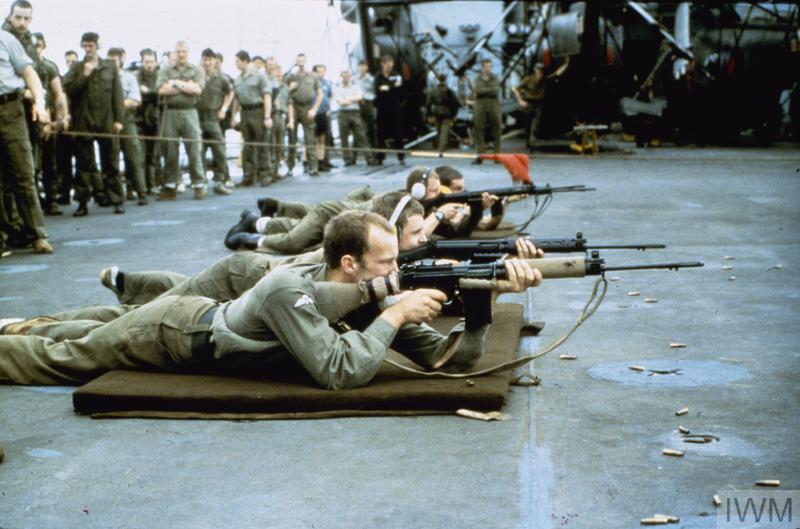
Kraliyet Deniz Piyadeleri İçin Düzenlenen Silah Eğitimi (Imperial War Museums)
The occupation triggered a serious political crisis within the British government. Due to the failure to evaluate warnings in time and the abandonment of the islands’ defences, Foreign Secretary Lord Peter Carrington, along with Sir Humphrey Atkins and Richard Luce from the Foreign Office, resigned on 5–6 April. Defence Secretary John Nott also offered his resignation, but Thatcher refused to accept it. Carrington was replaced by Francis Pym, who had previously served as Defence Secretary. To manage the daily crisis, the South Atlantic Sub-Committee OD(SA), subordinate to the Defence and Overseas Policy Committee, was established on 6 April. This “War Cabinet,” chaired by Thatcher, consisted of Home Secretary William Whitelaw, Foreign Secretary Pym, Defence Secretary Nott, and Cecil Parkinson. Chief of the Defence Staff Admiral Sir Terence Lewin served as the principal military adviser, and Attorney General Sir Michael Havers provided legal guidance. OD(SA) met at least once daily throughout the war, holding 67 meetings, and exercised political control over the operation primarily through adherence to rules of engagement, target selection, and authorisation for the use of force.【39】
At the top of the military command chain was Admiral Sir John Fieldhouse, Commander-in-Chief Fleet, based at Northwood, who commanded Task Force 317. The aircraft carrier battle group in the South Atlantic was commanded by Rear Admiral John “Sandy” Woodward, the amphibious task group by Commodore Michael Clapp, and the landing forces by Brigadier Julian Thompson, commander of the 3rd Commando Brigade. The group tasked with retaking South Georgia was placed under the command of Captain Brian Young. Nuclear submarines, due to their political and military significance, remained under the command of the Submarines Command at Northwood rather than Woodward. The command boundaries among naval, amphibious, and land groups were initially unclear; although Woodward was the most senior operational commander, Clapp’s and Thompson’s forces were organised as separate task groups. When the decision was made to send the 5th Infantry Brigade, command of all land forces on the islands was given to Major General Jeremy Moore.【40】
The formation of the task force represented one of the most extensive and rapid overseas military mobilisations in Britain since the Second World War. The nuclear submarines HMS Spartan and HMS Splendid departed on 1 April; they were followed by HMS Conqueror. Ships participating in the Springtrain exercises near the Strait of Gibraltar—Antrim, Glamorgan, Glasgow, Coventry, Brilliant, Arrow, and Plymouth—were ordered to head south. The aircraft carriers HMS Hermes and HMS Invincible in Portsmouth were made ready for sea within four hours. HMS Hermes was undergoing a refit, and both amphibious landing ships—Fearless and Intrepid—had been at risk of decommissioning under the 1981 Defence Review. Thus, naval assets recently slated for reduction or retirement became central to Operation Corporate. HMS Hermes and HMS Invincible departed Portsmouth on 5 April amid large crowds lining the coast.【41】
The core of the initial landing force was Brigadier Thompson’s 3rd Commando Brigade. The brigade’s 40th, 42nd, and 45th Royal Marine Commandos were reinforced with the 2nd and 3rd Parachute Battalions, a Rapier air defence battery, Royal Artillery units, engineering and logistical elements, and Scimitar and Scorpion tracked reconnaissance vehicles. The initial strength of the reinforced brigade was approximately 3,500 personnel; with the addition of the 2nd Parachute Battalion, the total land forces and support elements departing for the operation rose to approximately 4,600. As it became clear that the Argentine garrison was larger than expected, the deployment of the 5th Infantry Brigade under Brigadier Tony Wilson was approved on 2 May. This force of approximately 3,961 personnel consisted of the 2nd Scots Guards, 1st Welsh Guards, 1/7th Gurkha Rifles, 4th Field Artillery Regiment, engineering, helicopter, and logistical units. However, the Guards battalions had not received specialised amphibious training; the use of Gurkhas had also been debated in London due to potential political reactions in unrelated countries.【42】
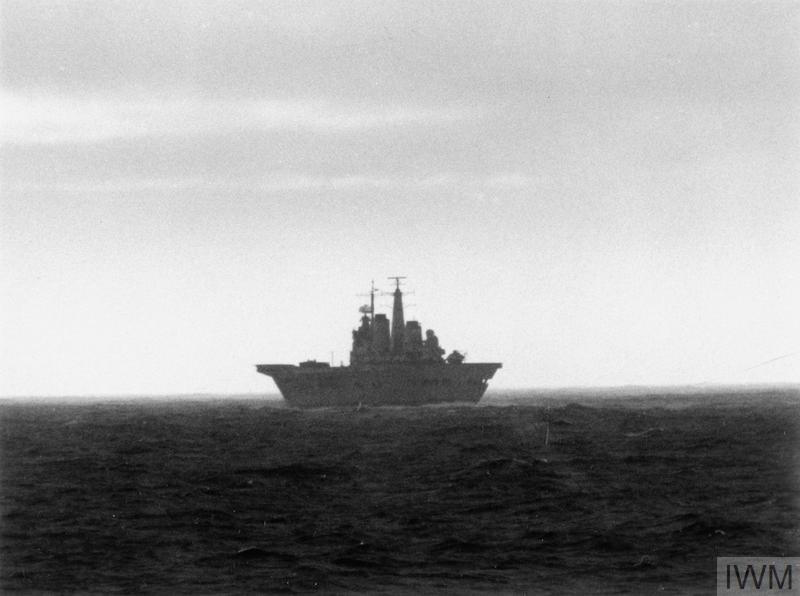
İngiliz Uçak Gemisi HMS Invicible (Imperial War Museums)
The Royal Navy lacked the capacity to transport troops, vehicles, fuel, and munitions over the approximately 13,000-kilometre distance to the operational area using its own ships. Therefore, the “Ships Taken Up From Trade” system was implemented, involving the requisitioning of commercial vessels. The passenger liner SS Canberra was converted into a troop transport, Uganda into a hospital ship, and the container ships Atlantic Conveyor and Atlantic Causeway into aircraft and helicopter carriers. Queen Elizabeth 2 transported the majority of the 5th Infantry Brigade to the South Atlantic; Ro-Ro ships Elk, Baltic Ferry, and Nordic Ferry were used for vehicle and munitions transport. In the first two weeks, approximately 39,000 tonnes of military cargo were transported by road to ports, and 44 special train services were organised. This mobilisation demonstrated that the war was conducted not only by warships but also by shipyard workers, railways, the merchant fleet, civilian crews, and military depots across the country.【43】
Britain’s forward staging and supply base became Ascension Island, approximately 3,300 nautical miles north of the Falkland Islands. Although British territory, the island’s airfield and fuel facilities were largely operated by the United States. Wideawake Airfield, with a runway exceeding 3,000 metres, transformed from a facility serving only three weekly flights into a major forward base capable of handling numerous Hercules and VC10 transport flights daily, and hosting Nimrod maritime patrol aircraft, Victor tankers, and Vulcan bombers. Ships hastily loaded in Britain were reorganised here; troops received training, and munitions and spare parts were distributed. The staggered departure of the aircraft carrier group and the amphibious force made the re-loading process on Ascension indispensable to the operation’s success. However, dependence on a single remote base created immense pressure on fuel, drinking water, accommodation, aircraft parking, and port facilities.【44】
The core of Britain’s naval force consisted of the 24,000-tonne HMS Hermes and the 16,000-tonne HMS Invincible. At the outset of operations, there were 12 Sea Harriers on Hermes and eight on Invincible; this number increased with subsequent reinforcements. During the operation, eight destroyers, 15 frigates, the amphibious ships Fearless and Intrepid, logistical landing ships, Royal Navy auxiliary vessels, and numerous merchant ships were deployed. Five nuclear attack submarines and one diesel-electric submarine used for special forces transport participated in the operation. The total displacement of Britain’s destroyers was approximately 140,700 tonnes—about three times the total displacement of Argentina’s surface fleet. However, Britain’s air defence was far from flawless. The effective Sea Wolf system against low-flying aircraft and missiles was only available on a few ships; the long-range Sea Dart struggled against low-altitude targets; and the Sea Cat system on many ships, being a first-generation, manually guided weapon, had limited effectiveness.【45】
Argentina’s Navy’s largest vessel was the 16,000-tonne aircraft carrier ARA Veinticinco de Mayo. Its air group consisted of A-4Q Skyhawk attack aircraft, S-2 Tracker maritime patrol aircraft, and Sea King helicopters. Another major component of the fleet was the former American cruiser General Belgrano, which had survived the Pearl Harbor attack. Two Type 42 destroyers—Hércules and Santísima Trinidad—were equipped with Sea Dart air defence systems and MM38 Exocet anti-ship missiles. These were supported by three French A69 corvettes and various older destroyers and frigates. The total displacement of Argentina’s thirteen major surface vessels was approximately 51,200 tonnes. Although the inventory included four submarines, only the old Santa Fe and the modern German Type 209-class San Luis were operational; the San Luis’s fire control computer malfunction required manual torpedo calculations. Argentina’s fleet was smaller and older than Britain’s, but its Exocet-equipped ships and diesel submarines posed a serious threat in coastal waters.【46】
Argentina’s most significant numerical advantage lay in its air force. Its combat inventory included approximately 12 Mirage III, 25 Israeli-made Dagger, 38 A-4B/C Skyhawk, seven Canberra bombers, and 45 Pucará aircraft. Naval Aviation contributed four Super Étendard, eight A-4Q Skyhawk, ten Aermacchi MB-339, five S-2 Tracker, and two P-2 Neptune aircraft. However, Argentina possessed only five air-launched AM39 Exocet missiles; most attacks against ships had to rely on unguided bombs. Neither the Mirage nor the Dagger aircraft had aerial refuelling capability; only two KC-130 tankers could support a limited number of aircraft, primarily the Skyhawks and Super Étendards. Due to the insufficient length and maintenance facilities of Stanley’s runway, most high-speed fighter aircraft had to take off from mainland bases such as Río Grande, Río Gallegos, San Julián, and others. The 700–1,000-kilometre approach flight meant that Dagger aircraft could remain in the target area for only a few minutes. Thus, Argentina’s numerical superiority in aircraft was significantly constrained by range, navigation, target identification, and time on target.【47】
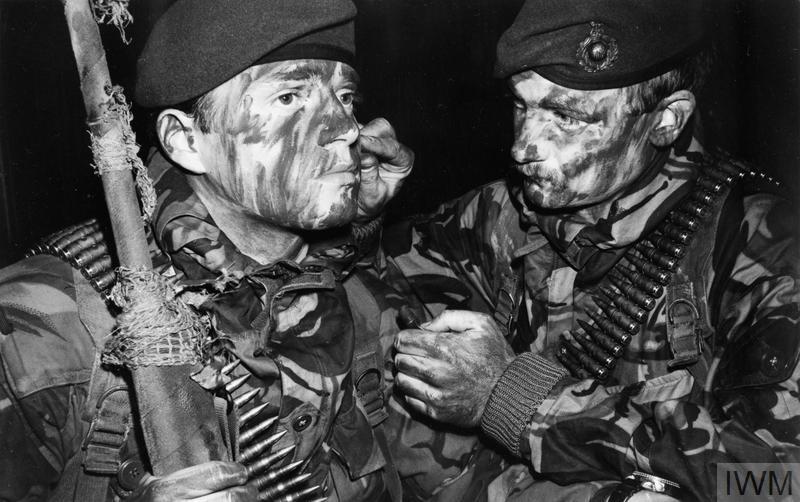
San Carlos Çıkarmasına Hazırlanan İngiliz Askerleri (Imperial War Museums)
The Argentine land forces on the islands, initially conceived as a small occupation garrison, rapidly expanded following Britain’s deployment of its task force. Brigadier General Mario Benjamín Menéndez assumed command as military governor and commander of the Falkland Garrison on 7 April. By the end of April, the Argentine personnel on the islands numbered approximately 13,000. The combat infantry strength across eight infantry regiments was between 5,000 and 6,000; the remaining forces consisted of artillery, air defence, engineering, transport, air force, marine, and other support units. A significant portion of the forces consisted of young men fulfilling their one-year compulsory military service. The Marines and some special units were considered well-trained and professional, but many conscripts sent from Argentina’s temperate or hot regions lacked appropriate clothing, shelter, and field training for the islands’ cold, wet, and marshy conditions. Therefore, numerical superiority did not translate into equal combat effectiveness across all units.【48】
Argentina’s command structure failed to integrate the capabilities of the three services into a single operational plan. Menéndez’s joint garrison command was primarily composed of Army personnel, while the mainland-based naval and air attack forces belonged to separate command chains. A joint operational plan clearly defining roles, responsibilities, and relationships between forces was never prepared. The naval and air force elements on the islands remained “consulted” units during planning; it cannot be said that Menéndez exercised effective and continuous operational command over them. The absence of a joint operations centre, incompatible communication systems, and each service’s independent use of its aircraft complicated decisions requiring coordination and speed. Menéndez’s simultaneous responsibilities as military governor and garrison commander also created time and priority conflicts.【49】
Therefore, the paper balance of forces was not one-sided. Britain held advantages in open-sea operations, nuclear submarines, electronic systems, professional land forces, and global logistical organisation; however, it had to protect a 13,000-kilometre supply line, approach the islands with a limited number of aircraft carriers and landing ships without losing them, and conduct operations during the South Atlantic winter. Argentina, on the other hand, enjoyed proximity to the mainland, a greater number of combat aircraft, pre-emptively captured defensive positions, and a numerically large garrison; however, it suffered from serious deficiencies in joint command, training, logistics, airfield infrastructure, and long-term naval operations. Britain’s initial assessments in mid-April regarded the Argentine air threat as “medium,” underestimating the impact of aerial refuelling and the determination of pilots in low-altitude attacks. Thus, the war’s outcome depended not on initial force numbers but on how each side utilised its distinct advantages and weaknesses in naval, air, and land operations.【50】
Diplomatic contacts that began before the Argentine landing were transferred to the United Nations Security Council on 2 April 1982. When the Security Council President’s appeal on 1 April for both sides to refrain from using or threatening force proved ineffective, Britain requested that Argentina’s operation be characterised as a violation of international peace. The Security Council adopted Resolution 502 on 3 April, demanding the immediate cessation of hostilities, the withdrawal of all Argentine forces from the Falkland Islands, and the peaceful resolution of the dispute. The resolution was adopted by ten votes in favour, with Panama voting against; China, Spain, Poland, and the Soviet Union abstained.【51】
The language of the resolution explicitly characterised Argentina’s military action as an “invasion” but did not formally designate Argentina as an “aggressor state” or establish a collective sanctions mechanism. Nevertheless, Resolution 502 created a significant diplomatic asymmetry between the two sides: Argentina was required to abandon the military situation it had created, while Britain’s sovereignty claim was not endorsed, and negotiations on the underlying dispute were left open. London used the resolution as an international legal basis for its claim of legitimate defence, while Buenos Aires argued that the first two provisions required Britain’s naval advance to be halted as well. Thus, while the resolution defined the diplomatic framework of the war, it failed to compel Argentina’s withdrawal.【52】
Simultaneously with military preparations, Britain turned to economic pressure. Military exports to Argentina were halted, Argentine assets were frozen on 3 April, and imports of Argentine goods were banned from the night of 6 April. The value of frozen assets was initially estimated at approximately $1.5 billion, but it was later determined that approximately $900 million had been effectively blocked due to transfers from London to New York at the start of the crisis. The ten members of the European Community adopted a decision on 10 April to halt arms sales to Argentina and imports outside existing contracts; sanctions took effect on 17 April and were initially applied for four weeks. Canada, Australia, and New Zealand also adopted similar measures regarding imports, exports, credit, and military equipment. Argentina’s largely self-sufficiency in food and fuel prevented commercial sanctions from becoming decisive quickly; the main pressure was on the highly indebted country’s ability to secure new credit and refinance existing debts.【53】
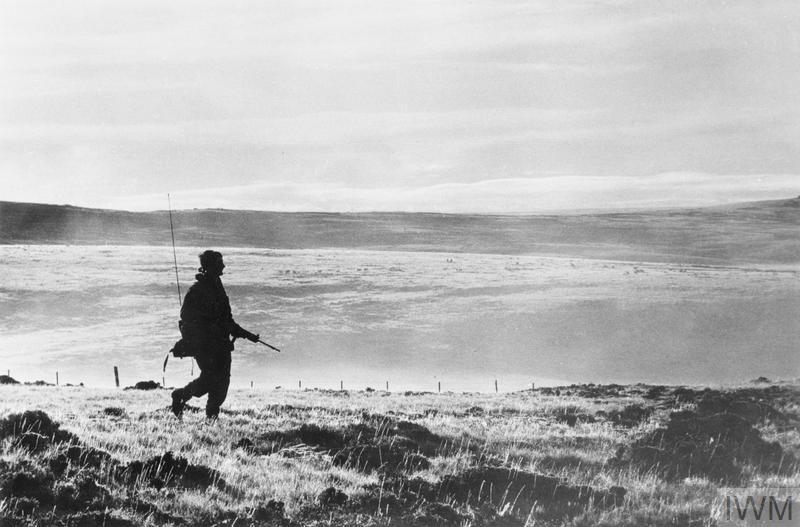
San Carlos Yakınlarında Devriye Gezen Bir Kraliyet Deniz Piyadesi (Imperial War Museums)
The United States, although traditionally neutral on the sovereignty issue, declared it would not accept the resolution of the dispute by force. Under President Ronald Reagan, officials prioritising European relations advocated supporting Britain, while those responsible for Latin American policy sought to preserve Argentina’s recently developed military and political ties. This duality was reflected in Secretary of State Alexander Haig’s mediation initiative, launched on 6 April. Haig visited London on 8 April and Buenos Aires the next day, conducting shuttle diplomacy between the two governments. His initial draft proposed the withdrawal of Argentine and British forces, the prohibition of new forces in a defined area around the islands, the establishment of a temporary administration by neutral states, and the commencement of new negotiations on the final status. The participation of representatives from Britain and Argentina in the temporary administration was also considered.【54】
The fundamental disagreement in the talks concerned the political outcome of the interim arrangement. London insisted that the islanders’ wishes should be decisive and that no arrangement should pre-determine the sovereignty issue. Buenos Aires believed that withdrawal of military forces could only be accepted if guaranteed that sovereignty would ultimately be transferred to Argentina. Haig’s final package, presented on 27 April, did not envisage the immediate restoration of the previous British administration; it proposed a special interim administration with limited representation from both countries and negotiations on the final outcome without predetermined results. Although the British government objected to several provisions of the text, it was prepared to consider it as a basis for negotiations if Argentina accepted it. The Argentine Military Junta, however, rejected the proposal on 27 April because it did not guarantee the transfer of sovereignty; the reply sent to Washington on 29 April stated that the package failed to meet Argentina’s demands.【55】
While Haig’s initiative continued, Argentina appealed to the Organisation of American States on 19 April to activate the Inter-American Treaty of Reciprocal Assistance (TIAR or Rio Treaty). The consultative body of foreign ministers met on 26 June and adopted a resolution on 28 April expressing political support for Argentina’s sovereignty claim and expressing dissatisfaction with the European Community’s economic sanctions. However, the resolution did not foresee any joint military intervention or binding economic sanctions against Britain. The United States, Chile, Colombia, and Trinidad and Tobago abstained. This outcome demonstrated that Latin American governments supported Argentina’s Malvinas claim but distinguished between supporting Argentina’s sovereignty and endorsing its use of force or bearing concrete costs on its behalf.【56】
After Argentina rejected the American proposal, the Reagan administration distanced itself from its neutral mediation position on 30 April. Haig publicly announced Argentina’s rejection of the American plan, while Washington suspended new export credits, arms sales, and certain economic concessions; it also announced that Britain’s requests for military equipment would be positively considered. However, a general import embargo was not imposed, and Washington continued to emphasise that a negotiated political settlement would be necessary regardless of the military outcome. Thus, the change on 30 April signified not the United States’ adoption of Britain’s sovereignty position but its support for its NATO ally against a situation created by the use of force.【57】
As Haig’s initiative ended, Peruvian President Fernando Belaúnde Terry developed a new compromise plan. The seven-point draft, developed between Haig and Belaúnde on 1–2 May, included an immediate ceasefire, mutual withdrawal of forces, temporary administration of the islands by third countries, recognition of the existence of a sovereignty dispute, consideration of the islanders’ views and interests, establishment of a contact group composed of Brazil, Peru, the Federal Republic of Germany, and the United States, and reaching a definitive agreement by 30 April 1983. Argentina objected to the inclusion of the United States in the contact group and to phrases describing the islanders’ position; words such as “wishes,” “views,” “interests,” and “aspirations” were themselves contentious regarding their implications for future negotiations. The plan had not yet been formally presented to Britain or accepted by London. The news of the sinking of the ARA General Belgrano on 2 May strengthened anti-American sentiment within the Junta, and the Argentine government abandoned efforts to continue an initiative involving the United States.【58】
The diplomatic burden then shifted to United Nations Secretary-General Javier Pérez de Cuéllar. Talks under his auspices began on 8 May. The common ground of the drafts included simultaneous ceasefire and withdrawal of forces, the establishment of a temporary United Nations administration, the preservation of both parties’ rights and sovereignty claims, and the commencement of time-limited negotiations for a final solution. Argentina proposed 31 December 1982 as the target date for completing negotiations. London approached acceptance of a UN administrator but opposed the complete suspension of the islands’ elected legislative and executive bodies, the exclusion of the islanders from the interim administration, and the creation of a political vacuum if the UN administration ended without an agreement.【59】
The parties also failed to agree on the inclusion of South Georgia and the South Sandwich Islands in the interim agreement, the extent of Britain’s withdrawal of its task force, the timing of lifting economic sanctions and maritime exclusion zones, and the rights of Argentine citizens to settle and acquire property on the islands, as well as references to previous UN General Assembly resolutions. Argentina wished to initiate a ceasefire without fully relinquishing its military presence on the islands and to link negotiations to decolonisation resolutions supporting its sovereignty claim. Britain refused to accept a ceasefire as an independent stage that would delay Argentina’s withdrawal and insisted on explicitly stating that the final outcome was not predetermined. Although Pérez de Cuéllar prepared a final compromise text on 20 May, Buenos Aires failed to respond in time. On 21 May, the Secretary-General informed the Security Council that his initiative had failed, as Britain’s forces were already beginning the San Carlos landing.【60】
On 26 May, the Security Council unanimously adopted Resolution 505. The resolution reaffirmed Resolution 502, called on the Secretary-General to renew his good offices, immediately establish contact with the parties to negotiate mutually acceptable ceasefire conditions, and make arrangements for UN observers if necessary. It also anticipated that Pérez de Cuéllar would submit an interim report within seven days. However, the resolution introduced no new withdrawal schedule, sanctions, or enforcement mechanism. As hostilities continued and the parties’ minimum conditions remained unchanged, the resolution failed to provide a new diplomatic opening.【61】
European reactions, while forming a common political line, were not uniformly resolute. French President François Mitterrand ordered an arms embargo on Argentina and supported Britain in the Security Council; however, this support did not imply recognition of Britain’s sovereignty claim. The Federal Republic of Germany joined the European Community sanctions but more openly expressed concern about military escalation, particularly after the sinking of the General Belgrano. Italy, with a large Argentine community and significant economic interests, and Ireland, with historical disputes with Britain, were less enthusiastic about extending sanctions. Canada, Australia, and New Zealand provided Britain with the most consistent diplomatic support. Japan voted positively on Resolution 502 but avoided binding economic measures due to its commercial relations with Argentina.【62】
Attitudes in Latin America also revealed diversity beneath the surface of a unified “continental solidarity.” Venezuela was one of the most open supporters of Argentina, while Peru and Colombia pursued successive peace initiatives. Brazil and Mexico, while sympathetic to Argentina’s historical sovereignty claim, did not endorse the use of force and avoided actions that would jeopardise their economic relations with Britain. The second resolution adopted on 29 May under the Rio Treaty condemned Britain, called on the United States to cease its support for Britain, and urged member states to provide individual or collective assistance to Argentina. The resolution, opposed by the United States, Chile, Colombia, and Trinidad and Tobago, did not translate into any joint military or economic action. Regional support remained limited to diplomatic statements, limited material aid, and support for Argentina’s positions in international organisations.【63】
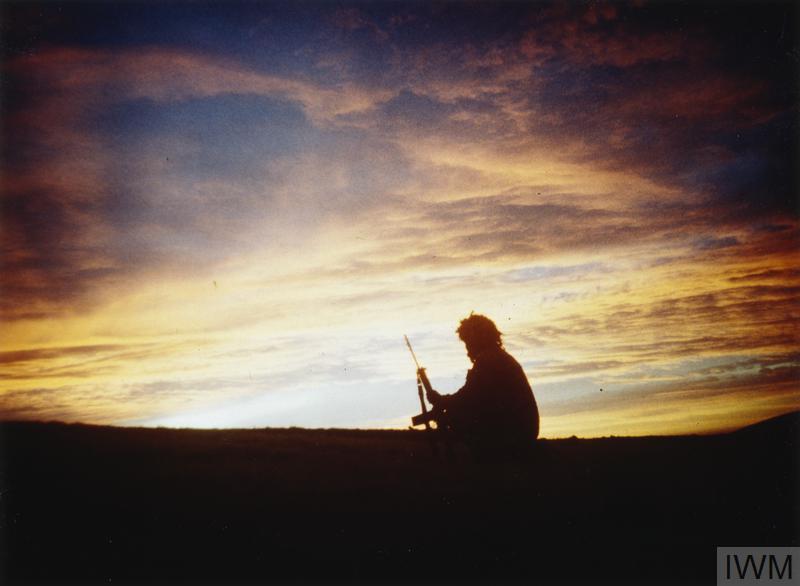
Sunset at Windy Gap (Imperial War Museums)
Chile was the main exception to this general picture. The Augusto Pinochet regime officially maintained neutrality and abstained in the first OAS resolution; however, it viewed Argentina as a threat to its own security due to the Beagle Channel dispute. Consequently, contacts with Britain were kept secret. Argentina’s air movements monitored by Chilean radars were communicated to Britain; reconnaissance and communication capabilities were provided; and Chilean military pressure on the border kept some elite Argentine units tied down on the mainland. Britain, in return, offered Chile assistance with Hunter and Canberra aircraft, radar, and other military equipment. The secrecy of this cooperation was linked to Chile’s position in Latin America and Britain’s desire to avoid the appearance of an open alliance with the Pinochet regime.【64】
The Soviet Union sought to exploit Argentina’s anti-Western rhetoric; it accused Britain of colonialism, criticised American influence in Latin America, and monitored the South Atlantic with satellites, aircraft, and intelligence ships. Nevertheless, it did not veto Resolution 502, affirmed the need for Argentina’s forces to withdraw, and did not pursue a formal military alliance with the Junta. Argentina’s anti-communist nature, Moscow’s relations with leftist movements in the region, and the lack of unified pro-Argentina sentiment among non-aligned countries limited Soviet support. Although the Argentine government sought political support through Cuba and the Non-Aligned Movement, these contacts did not generate any assistance that altered the military or diplomatic balance of the war.【65】
The failure of diplomatic efforts in April and May stemmed less from a lack of proposals than from the irreconcilable minimum acceptable outcomes of the two sides. Argentina sought to link military withdrawal to an irreversible process toward sovereignty transfer; Britain insisted on withdrawal as a precondition and sought to guarantee the islanders’ political will and leave the final outcome open. As military pressure increased, the space for compromise narrowed rather than expanded: London viewed the halt of approaching operations as rewarding the occupation, while Buenos Aires saw withdrawal as a defeat that could trigger the Junta’s collapse. The Rattenbach Report, prepared after the war, noted that the limited objective of the operation was expressed by the phrase “ocupar para negociar”—“occupy to negotiate”—but that the political goal was never clearly defined and that significant opportunities presented by Resolution 502, the Haig plan, the Peru initiative, and Britain’s 17 May proposal were not utilised.【66】
As Britain’s task force approached the South Atlantic, it progressively narrowed the operational area. The Exclusion Zone, effective from 12 April 1982, covered an area with a 200-nautical-mile radius from the approximate centre of the islands and designated Argentine warships and naval auxiliaries within this zone as legitimate targets. The Total Exclusion Zone, effective from 11:00 GMT on 30 April, extended the application to military or civilian ships and aircraft supporting the occupation and declared Stanley Airfield closed. However, the zone’s boundaries were not a line beyond which Argentine forces outside were immune from attack. The British government had already informed the task force on 23 April that Argentine warships, submarines, and military aircraft posing a threat outside the exclusion zone could also be targeted. This distinction formed the military and political context of the 2 May attack on the General Belgrano.【67】
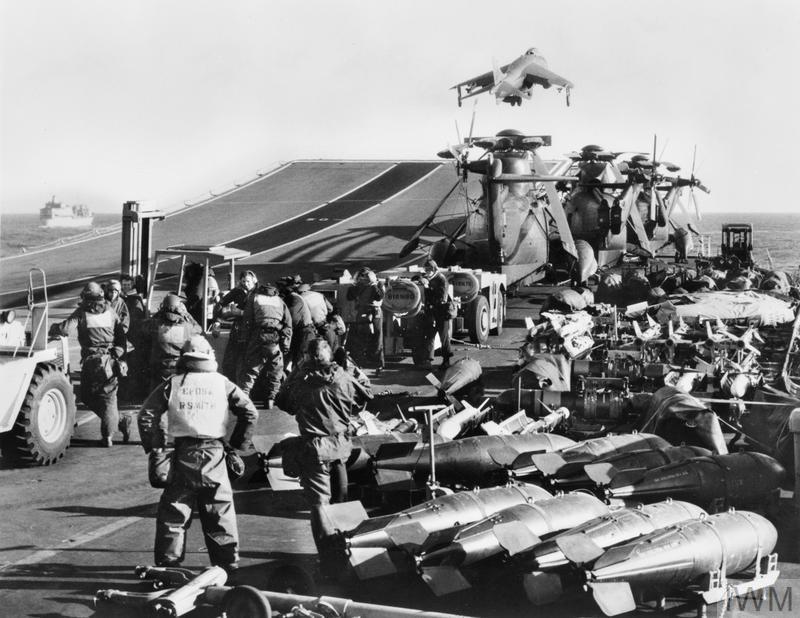
HMS HERMES Gemisinde Uçuş Güvertesi Operasyonları (Imperial War Museums)
The first significant operation before large-scale naval and air combat occurred on South Georgia. On the morning of 25 April, the Argentine submarine ARA Santa Fe, surfaced approximately five nautical miles north of the entrance to Cumberland Bay, was detected by a Wessex helicopter from HMS Antrim. Two Mk II depth charges dropped by the Wessex exploded near the submarine; a Mk 46 torpedo launched by HMS Brilliant’s Lynx helicopter passed beneath the target, and HMS Endurance and HMS Plymouth’s Wasp helicopters continued the attack with AS.12 guided missiles. Severely damaged, the Santa Fe reached the pier at King Edward Cove but lost its operational capability. This engagement became the first successful anti-submarine operation conducted solely by helicopters. On the same day, the first British force of 79 personnel landed; under bombardment from HMS Antrim and HMS Plymouth, the forces advanced to Grytviken and accepted the surrender of the Argentine garrison at approximately 17:15. The unit at Leith also surrendered the next day, and South Georgia returned to British control.【68】
The general offensive around the Falklands began on 1 May with the first Black Buck operation, a Vulcan bomber strike from Ascension Island on Stanley Airfield. A chain of 18 Victor aerial refuelling sorties was required to deliver and retrieve the single Vulcan. The Vulcan dropped 21 1,000-pound bombs from an altitude of approximately 2,400 metres in a criss-cross pattern along the runway. One bomb created a large crater on the runway; however, the airfield was not rendered completely unusable, and C-130 Hercules resupply flights resumed after repairs. Nevertheless, the possibility of the runway being used by heavier and faster fighter aircraft was significantly reduced. On the same morning, nine Sea Harriers attacked targets around Stanley, and three Sea Harriers struck Goose Green airfield; in the afternoon, warships subjected Stanley positions to naval gunfire. This activity created the impression in Argentine command that a landing was underway, drawing air forces into combat. The Argentine counter-attack, involving Mirage III, Dagger, Canberra, and Skyhawk aircraft, became the first air battles of the war. The Sea Harrier’s low-altitude manoeuvrability and the AIM-9L Sidewinder missile’s all-aspect capability provided a clear advantage over the Mirage and Dagger aircraft, which, due to fuel range limitations, could remain in the target area for only a few minutes.【69】
The most significant naval encounter occurred on 2 May. The Argentine Navy planned to squeeze Britain’s task force from two directions: the aircraft carrier ARA Veinticinco de Mayo group to the north and the cruiser ARA General Belgrano with two escort destroyers to the south. The wind conditions required for the Veinticinco de Mayo to launch its A-4Q Skyhawks ceased, and the exact location of the British forces could not be confirmed; the attack was postponed, and the Argentine task groups were ordered to return to their previous positions. This intelligence did not reach the British command chain in time. To the south, HMS Conqueror continued to track the General Belgrano and the destroyers ARA Hipólito Bouchard and ARA Piedra Buena. The British War Cabinet, considering the risk of losing contact and the possibility of the cruiser group resuming its offensive, authorised attacks on Argentine warships outside the exclusion zone.
Conqueror fired three Mk VIII torpedoes at the General Belgrano, which was steaming westward and outside the Total Exclusion Zone, from a distance of 1,400 yards; two torpedoes struck the cruiser. The submarine commander, Christopher Wreford-Brown, although equipped with newer Tigerfish torpedoes, chose the older Mk VIII, in service since 1932, as more suitable for penetrating the cruiser’s armour and torpedo defence belt. The cruiser sank shortly thereafter. The fact that the attack occurred outside the exclusion zone and while the ship was turning away from Britain sparked intense debate. Within Britain’s decision-making mechanism, however, the threat was assessed not by the ship’s current heading but by Argentina’s previous attack orders, the cruiser group’s firepower, and the risk of Conqueror losing contact.【70】
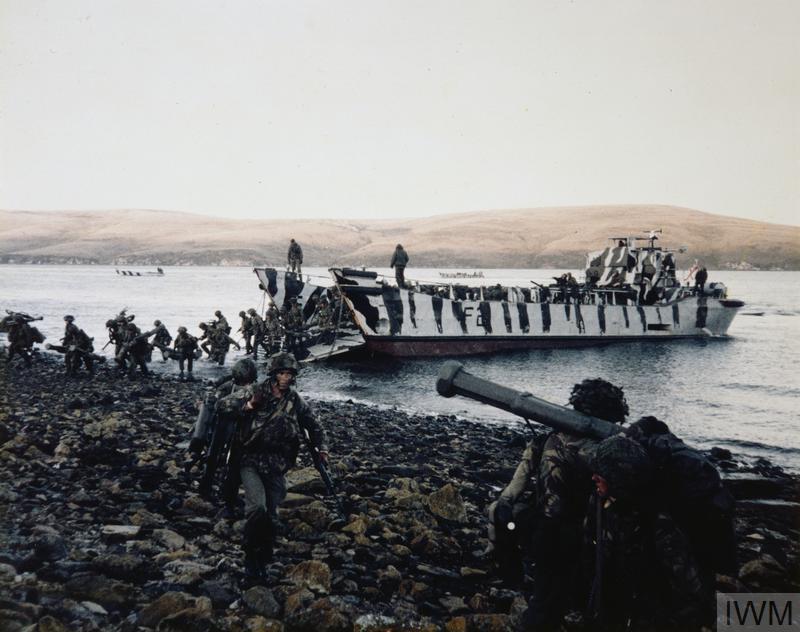
San Carlos Çıkarmalarından Bir Kare (Imperial War Museums)
General Belgrano’s sinking had the most immediate military consequence: Argentina withdrew its major surface vessels to shallow waters near the coast, away from the submarine threat. The Veinticinco de Mayo and its escorts did not directly engage Britain’s task force for the remainder of the war. However, the Argentine submarine ARA San Luis continued to operate around the Falklands, forcing Britain into extensive anti-submarine operations. On 11 May, the San Luis fired a torpedo at HMS Alacrity as it passed through the Falkland Sound; however, a malfunction in the weapon’s guidance system prevented a hit. Thus, although Argentina’s surface fleet was effectively neutralised, the submarine threat remained.
Britain’s naval superiority did not reduce the air threat. On 4 May, two Dassault-Breguet Super Étendards, launched from Río Grande, took on fuel from a KC-130 tanker and approached the task force, each launching an AM39 Exocet missile. One missile fell into the sea; the other struck HMS Sheffield at 14:03. The warhead did not detonate; however, the missile’s body ignited fuel and combustible materials on board, causing fires that quickly became uncontrollable. HMS Glasgow had detected the attack earlier; however, the warning was not fully received on the Sheffield, some crew members were absent from the operations room, and the radar contact was mistaken for a Mirage attack and not taken seriously, preventing timely defensive measures. When the fire disabled the main water system, the ship was abandoned; Sheffield sank on 10 May while under tow. The incident demonstrated the consequences of relying solely on shipboard radar for defence against low-flying missiles and the lack of airborne early warning in the task force.【71】
The fundamental factor shaping the air war was geography. Most Argentine aircraft took off from Río Grande, Río Gallegos, San Julián, and other Patagonian bases, consuming most of their fuel on the outbound and return flights to reach the Falklands. The inability of the Mirage III and Dagger aircraft to conduct aerial refuelling made it difficult for them to remain in the target area for more than a few minutes. Although A-4 Skyhawk and Super Étendard units could utilise KC-130 tankers, the limited number of tankers and coordination requirements restricted sortie production. British aircraft, however, could operate from carriers closer to the operational area and leveraged the Sea Harrier’s low-altitude manoeuvrability and the AIM-9L missile’s technical superiority.
Argentine pilots’ extreme low-altitude approaches, sometimes just a few metres above sea level, shortened the detection time for ship radars and narrowed the effective engagement range of air defence missiles. However, this method also reduced the time available to set the fuses on dropped bombs. Argentina’s post-war official assessment determined that approximately 60% of the bombs that hit British ships failed to detonate; the available munitions had not been adequately prepared for either naval targets or the very low-altitude attack profiles used. The assessment also revealed that there had been virtually no joint training between the Argentine Air Force and Naval Aviation for naval targets before the war and that low-altitude ship attack techniques were only introduced through limited exercises after the conflict began.【72】
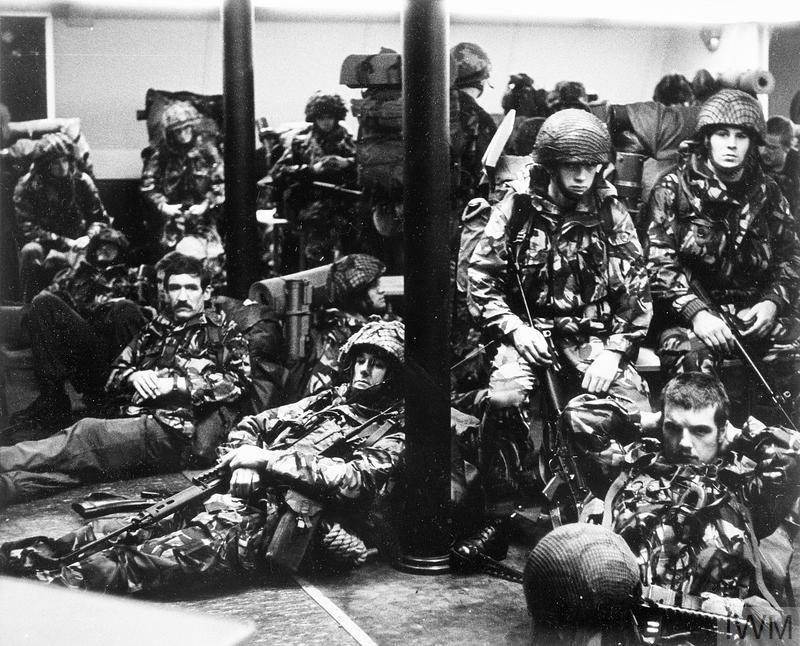
Paratroopers of the 2nd Parachute Battalion Waiting on the NORLAND Ferry Before the Landings at San Carlos (Imperial War Museums)
Britain’s air defence also had significant limitations. The absence of fixed-wing airborne early warning aircraft made it difficult to detect low-flying aircraft and Super Étendards carrying Exocets before they launched their missiles. Aircraft carriers, fearing their loss would jeopardise the entire operation, were kept east of the Falklands; as a result, Sea Harriers could remain over the landing area for only a short time. The mountainous terrain created radar shadows and blind spots around San Carlos, and each of the Sea Dart, Sea Wolf, Sea Cat, Rapier, and Blowpipe systems had varying effectiveness against different altitudes and approach angles. Sea Dart forced Argentine aircraft to fly lower, but this made it harder for ships to track them with radar and long-range missiles.【73】
In mid-May, British forces shifted their focus to degrading Argentina’s naval logistics and air power on the islands. On 9 May, the Argentine trawler Narwal, identified as gathering intelligence, was neutralised by Sea Harrier bombing and gun attacks. On the night of 11 May, HMS Alacrity, while passing through the Falkland Sound, detected and sank the ARA Isla de los Estados, which was transporting vehicles and fuel from Stanley to Port Howard. On 16 May, the transport ships Río Carcarañá and Bahía Buen Suceso were rendered unusable by air attacks. These interventions significantly restricted not only Argentina’s supply from the mainland to the islands but also coastal shipping between East and West Falkland.【74】
The most effective action against Argentine aircraft on the islands was the raid on the Calderón Air Base on Pebble Island on 14–15 May. Forty-five SAS personnel and a Royal Artillery forward observer were landed on the southern coast of the island by three Sea King helicopters. During the raid, HMS Glamorgan illuminated the airfield with star shells and provided artillery support. A total of 11 aircraft—six IA-58 Pucará, four T-34C Mentor, and one Short Skyvan—along with ammunition and fuel depots, were destroyed or rendered unusable. The entire unit was recovered by helicopters around 09:30. The raid reduced the local air power threatening the ships north of the Falkland Sound and demonstrated to Argentine forces that British special forces could operate within the islands’ interior.【75】
When the landing began at San Carlos Water on 21 May, the centre of gravity of the air-naval war shifted. Due to the Exocet threat, aircraft carriers were kept to the east, leaving the protection of the landing fleet largely to the escort ships in the strait. The outer defence ring consisted of Sea Harrier combat air patrols, the second ring of a Type 42 destroyer armed with Sea Dart and a Type 22 frigate armed with Sea Wolf forming a “missile trap,” and the inner ring of shipboard guns and short-range missiles. The landing and supply ships concentrated in the narrow anchorage were protected by small-calibre guns, Sea Cat, Rapier batteries being landed, and infantry fire. Due to continuous attacks, San Carlos Water quickly became known among British personnel as “Bomb Alley.”
The first Argentine aircraft, using the terrain of West Falkland for cover, entered the strait in the afternoon. HMS Antrim sustained heavy damage from a 1,000-pound bomb that failed to detonate; HMS Broadsword and HMS Brilliant were hit by gunfire. Two bombs struck HMS Argonaut, but both failed to detonate; the ship was nonetheless immobilised. Later in the day, A-4Q Skyhawks from Argentine Naval Aviation attacked HMS Ardent repeatedly. The frigate sustained seven bomb hits; its weapons and command systems were disabled; after the crew abandoned ship, it burned throughout the night and sank. Argentine aircraft conducted approximately 45 attack sorties and lost 10 aircraft, yet focused their attacks on escort ships rather than landing ships. Consequently, despite heavy ship damage, the landing of troops, munitions, and supplies was not halted.【76】
On 23 May, HMS Antelope was hit by two 1,000-pound bombs from four A-4B Skyhawks; both bombs failed to detonate immediately. During an attempt by a bomb disposal team to neutralise one of the bombs, an explosion triggered a rapidly spreading fire. The munitions depot exploded throughout the night, and Antelope sank the next morning. The incident demonstrated that unexploded bombs posed a serious threat not only during the attack but also hours later. To prevent Argentina from learning that bombs frequently failed to detonate, British command restricted media reporting on the issue after this date.【77】
25 May was the second critical day of the air-naval battle. HMS Coventry and HMS Broadsword, positioned north-west of San Carlos, coordinated their Sea Dart and Sea Wolf systems. The first wave of low-flying A-4Bs was engaged by Broadsword’s Sea Wolf system; however, Coventry’s turn to adjust its firing angle crossed the line of sight between the two ships and prevented the missile launch. Coventry was hit by three bombs and sank rapidly, capsizing at 19:24.
On the same day, two Super Étendards launched from Río Grande targeted the task force’s eastern position and fired the remaining two AM39 Exocet missiles. British ships’ intense radar jamming decoys diverted the missiles from their initial targets; however, both missiles subsequently found the HMS Atlantic Conveyor, which had no defence system. The fire on the ship could not be controlled. Along with the Atlantic Conveyor, three Chinook and six Wessex helicopters, 4,500 sets of tents, and runway and fuel supply materials for the forward Harrier base were lost. Only one Chinook and one Wessex, flying separately, survived. The loss of the helicopters directly affected the land forces’ movement plans, forcing the majority of personnel and supplies to be transported by foot or sea.【78】
A total of 28 Sea Harriers and 14 RAF Harrier GR.3s were sent to the South Atlantic during the war. Sea Harriers flew over 1,100 combat air patrols and 90 strike support missions; Harrier GR.3s conducted 125 ground attack and tactical reconnaissance sorties. This intense activity prevented Argentine aircraft from operating continuously over the Falklands; however, British forces could not establish complete and continuous air superiority during the San Carlos days. According to post-war calculations, 10 Skyhawks and 9 Daggers were lost between 21 and 25 May. British claims during the conflict were significantly higher; rapid-moving aircraft were simultaneously targeted by ships, Sea Harriers, and ground air defence systems, leading to a single loss being credited to multiple weapon systems.【79】
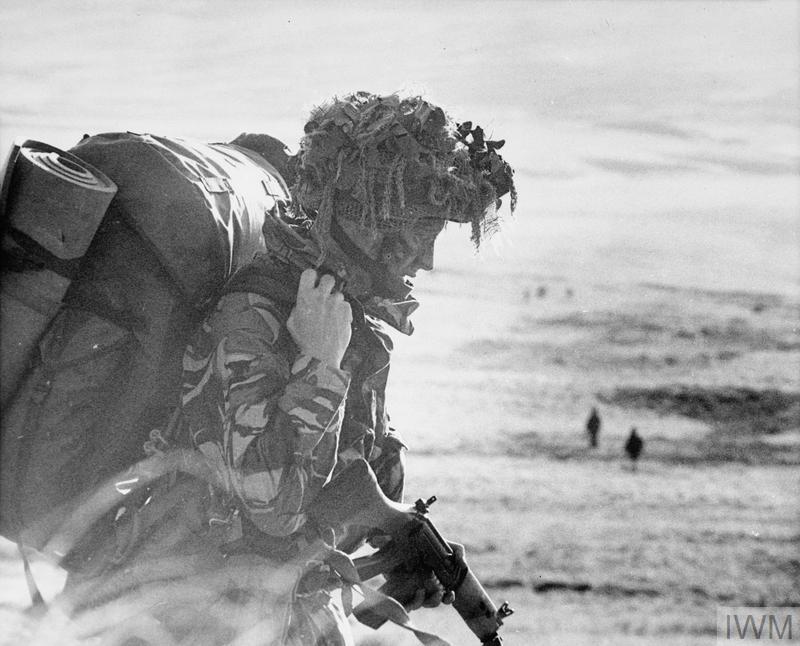
Bir İngiliz Paraşütçüsü (Imperial War Museums)
After the attacks on San Carlos subsided, Argentine air power continued to be used against British troop movements and sea transport. On 8 June, when movement was detected around Fitzroy and Bluff Cove, four Mirage III were sent for distraction, and eight A-4B Skyhawks and six Daggers were assigned attack missions. The Daggers hit HMS Plymouth with four bombs; none detonated, but fires and damage occurred. Skyhawks flying low into Port Pleasant struck the RFA Sir Galahad and RFA Sir Tristram landing ships. Most of the Rapier systems in the area were not yet operational, there was no surface escort, and the nearest Sea Harrier patrol was chasing the Daggers attacking Plymouth. The fire on Sir Galahad rapidly got out of control, rendering the ship unusable; Sir Tristram also sustained heavy damage. This attack, occurring after San Carlos, demonstrated that the air threat, although weakened, could still be effective against unprotected transport ships.【80】
Naval gunfire support continued until the end of the war. British destroyers and frigates conducted night bombardments of positions around Stanley, directly supporting land operations. In response, the Argentine Navy developed an original system to launch its MM38 Exocet missiles from land. The system, designed by naval engineer Lieutenant Julio Pérez and two civilian technicians, consisted of launch ramps removed from A69-class corvettes, a generator, wheeled carriers, and four telephone exchange switches to time the launches. Deployed at night near Stanley, this system, after several unsuccessful attempts, struck HMS Glamorgan on the morning of 12 June. Glamorgan, firing 261 shells in support of the Two Sisters battle, passed through the southwest corner of the Exocet danger area on its return route when the missile was detected. The ship’s sharp turn prevented the missile from striking the hull directly; the Exocet hit the edge of the flight deck and ignited a fire in the hangar. The crew managed to extinguish the fire and keep the ship’s engines operational. This was the last successful attack against a British ship during the war.【81】
The overall outcome of the naval and air operations was a struggle for superiority in which neither side fully utilised all its capabilities. Nuclear submarines removed Argentina’s major surface fleet from the operational area, providing Britain with the ability to protect its sea lines of communication and deliver its landing force to the islands. Sea Harriers, aircraft carriers, and shipboard air defence systems prevented Argentina from establishing complete air superiority; however, the lack of airborne early warning, the distant positioning of carriers, and the radar-inhospitable geography of San Carlos left British ships severely vulnerable. Argentine aviation, despite problems with range, joint command, target selection, and munition fuses, inflicted heavy blows on the British fleet but could not halt the landing and resupply operations. Thus, Britain achieved decisive superiority at sea and a partial but sufficient local and functional superiority in the air to sustain land operations.【82】
Britain’s land operation to retake the islands, initiated on the morning of 21 May 1982 with the Sutton Operation, entered a new phase with an amphibious landing on the western coast of East Falkland at San Carlos Water. Brigadier Julian Thompson’s 3rd Commando Brigade exploited the fact that Argentine forces were concentrated around Stanley and the terrain’s difficulty for observation from the sea. The first wave consisted of the 40th Royal Marine Commando and the 2nd Parachute Battalion; the 45th Commando and 3rd Parachute Battalion followed; the 42nd Commando was held in reserve initially. The Special Boat Service (SBS) units intervened against Argentine observation posts at Fanning Head before the main landing. With approximately 5,000 troops landed during the day, the British established a beachhead that caught the Argentine command unprepared at the tactical level.【83】
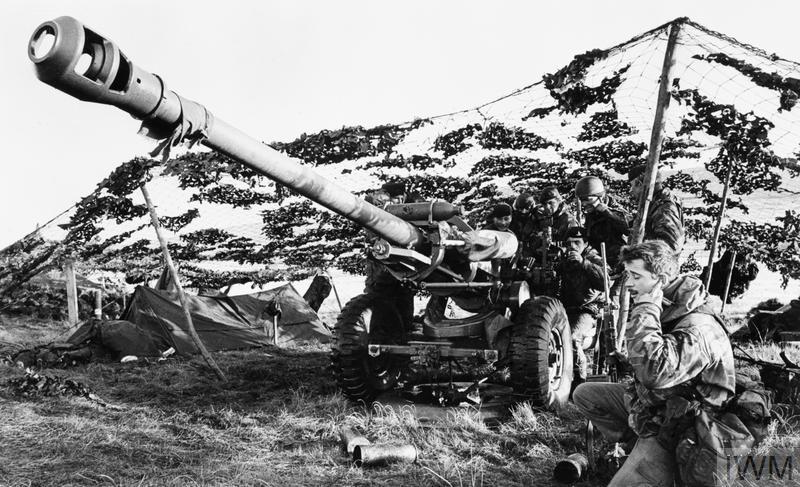
Light 105 mm Gun Belonging to the 29th Commando Regiment Attached to the Royal Artillery Corps (Imperial War Museums)
The positioning of the units aimed to protect the beachhead from both a land assault from the direction of Stanley and from the Darwin–Goose Green axis. The 2nd Parachute Battalion advanced toward the Sussex Mountains to close off the southern approach, while the 40th Commando established positions around the Verde Mountains; the 3rd Parachute Battalion secured the Port San Carlos area, and the 45th Commando protected the supply and field hospital facilities at Ajax Bay. Artillery batteries, light air defence systems, vehicles, ammunition, and food were unloaded as quickly as possible. Priority was given to deploying Rapier air defence batteries; however, swampy ground, electronic equipment failures, and air attacks limited the initial effectiveness of the systems. While the naval and air battles raged in the bay, land units were often required to simultaneously assist in unloading ships, moving supplies to scattered storage areas, and preparing defensive positions.【84】
Once the beachhead was secure, the speed of the operation became a matter of debate. Thompson’s initial objective was to establish a solid base area capable of receiving reinforcements; however, the headquarters in London wanted visible progress before a diplomatic ceasefire could be implemented. The fact that Major General Jeremy Moore, the overall commander of land forces, had not yet arrived in the area complicated strategic direction during these initial days. Stanley was approximately 80 kilometres to the east, and the terrain between the two centres lacked a significant road network. Bogs, stony ridges, deep rivers, and rapidly changing weather conditions severely restricted motorised movement to roads and tracked vehicles.【85】
Air transport capacity was also lower than planned. Transporting a single artillery battery’s guns and ammunition to forward positions required approximately seventy Sea King helicopter sorties. The loss of three Chinooks along with many Wessex helicopters due to the sinking of the Atlantic Conveyor forced a significant portion of the units to advance on foot. The only surviving Chinook, ZA718, designated “Bravo November,” was used beyond its normal capacity throughout the operation. However, reliance solely on helicopters for advance was unsustainable, as limited transport capacity would shift priority from artillery, ammunition, and supplies to troop movement. British land operations thus became a combination of sea-based coastal resupply, limited air transport, and long-distance foot marches.【86】
The settlements of Darwin and Goose Green, approximately 25 kilometres south of San Carlos, were not on the direct route to Stanley. However, the Argentine forces stationed there threatened the southern flank of the beachhead, blocked British access to the Lafonia peninsula, and reinforced the impression of a static operation. The Argentine force at Goose Green, commanded by Lieutenant Colonel Ítalo Ángel Piaggi, consisted of elements of the 12th Infantry Regiment, units from the 25th Infantry Regiment, air force personnel, artillery, and air defence units. The 114 civilians in the area had been held in the Goose Green community centre since 1 May; this situation significantly complicated the prospect of subjecting the settlement to heavy fire. What was initially considered a limited raid transformed into a full-scale assault under the orders of 2nd Parachute Battalion commander Lieutenant Colonel Herbert “H” Jones.【87】
The 2nd Parachute Battalion began its advance from the vicinity of Camilla Creek House on the night of 27 May and launched its assault in the early hours of 28 May. After overcoming forward positions around Burntside House and Boca House, the British encountered stronger resistance on Darwin Ridge, supported by machine guns, mortars, and field artillery. Inadequate reconnaissance, limited artillery ammunition, and dependence on air support subject to weather conditions forced the battalion to fight in fragmented small units. Jones was killed while attempting to break the resistance on Darwin Ridge with a direct assault and was posthumously awarded the Victoria Cross. However, the course of the battle did not change with a single attack; overcoming Argentine positions required sustained infantry manoeuvres combined with the coordinated use of mortars, artillery, and anti-tank weapons throughout the day.【88】
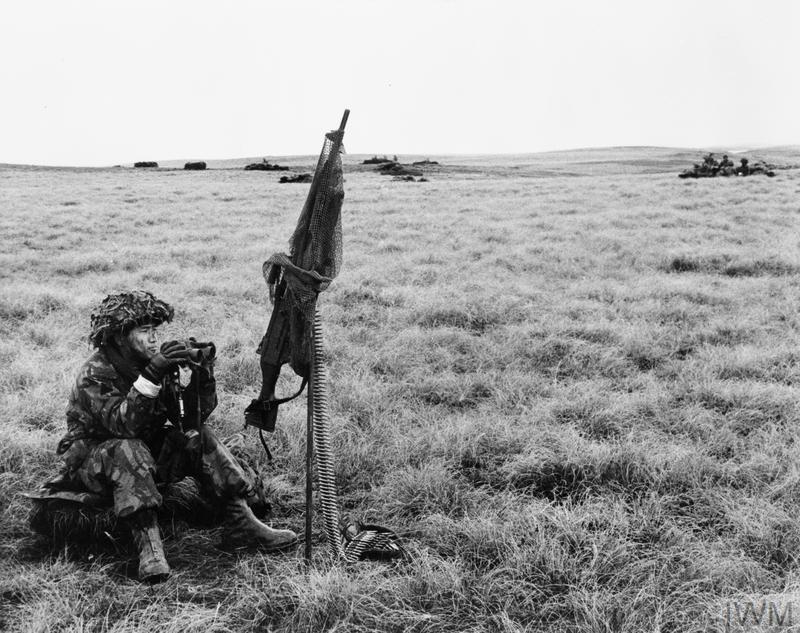
İngiliz Makineli Tüfekçi Nöbet Tutuyor (Imperial War Museums)
Command passed to Major Chris Keeble, who shifted from repeated frontal assaults to encircling the flanks of the Argentine defence and establishing fire superiority. British units crossed Darwin Ridge and converged around Goose Green, cutting off the Argentine forces’ escape routes. Improved weather conditions provided limited Harrier support, and artillery fire directed at the defences reduced the defenders’ freedom of movement. After Keeble’s call for surrender, Piaggi accepted the surrender of his forces on 29 May. The capture of Goose Green secured the southern flank of the San Carlos beachhead and boosted British morale; however, the duration and intensity of the battle also invalidated the assumption that Argentine garrisons would disintegrate without serious resistance.【89】
Major General Moore assumed effective command of the land forces on 30 May and, in his operation order dated 1 June, set the primary objective as the capture of Stanley. The advance was planned along two main axes. The 3rd Commando Brigade would advance via Teal Inlet and Estancia House toward the high ground north and west of Stanley—Mount Kent, Mount Challenger, Mount Longdon, Two Sisters, and Mount Harriet. The 5th Infantry Brigade would move from east of Goose Green to Fitzroy and Bluff Cove and attack the line of Mount Tumbledown, Mount William, and Sapper Hill to the southwest of Stanley. The 40th Commando was left behind to protect San Carlos as a supply base.【90】
The advance along the northern axis formed one of the most distinctive phases of the British operation. The 42nd Commando’s advance elements were transported by helicopter to the vicinity of Mount Kent on 30–31 May; clashes had previously occurred between British special forces patrols and Argentine commando units in the area. The 45th Commando and 3rd Parachute Battalion advanced largely on foot. Soldiers had to traverse boggy terrain, endure snow mixed with rain, and battle strong winds while carrying backpacks weighing over 50 kilograms, weapons, and ammunition. The Royal Marines called this march “yomp,” while the paratroopers termed it “tab.” During these marches, residents of Douglas and Teal Inlet provided the units with shelter, hot food, local knowledge, tractors, and trailers. Civilian vehicles partially compensated for the shortage of military transport vehicles, especially in transporting heavy weapons and ammunition.【91】
The Argentine reconnaissance screen in front of the advance was cleared through small but intense clashes. A 19-man British unit attached to the Mountain and Arctic Warfare Cadre attacked an Argentine special forces patrol sheltering in a wooden building at Top Malo House on 31 May. After the building was hit by anti-tank rockets and machine-gun fire, the Argentine patrol was forced to exit and was neutralised after a brief engagement. This operation opened one of the approach routes to Mount Kent; British patrols subsequently penetrated as far as between Mount Longdon and Murrell River to determine the location and strength of the defence around Stanley.【92】
The 5th Infantry Brigade, arriving at San Carlos on 1 June, consisted of the Scots Guards, Welsh Guards, and 1/7th Gurkha Rifles. The brigade had not trained extensively with the 3rd Commando Brigade, had joined the expeditionary force later, and had been left without adequate communication and transport equipment. The 2nd Parachute Battalion’s airlift to Fitzroy on 2 June instantly moved the British forward line approximately 50 kilometres east; however, there was insufficient land and air transport capacity to support the other units, which had to be transported by sea to Bluff Cove. After the air attack on 8 June, Moore reorganised the forces on the southern axis; the pace of the offensive slowed, and the deployment of units and the division of responsibilities between the two brigades were re-examined.【93】
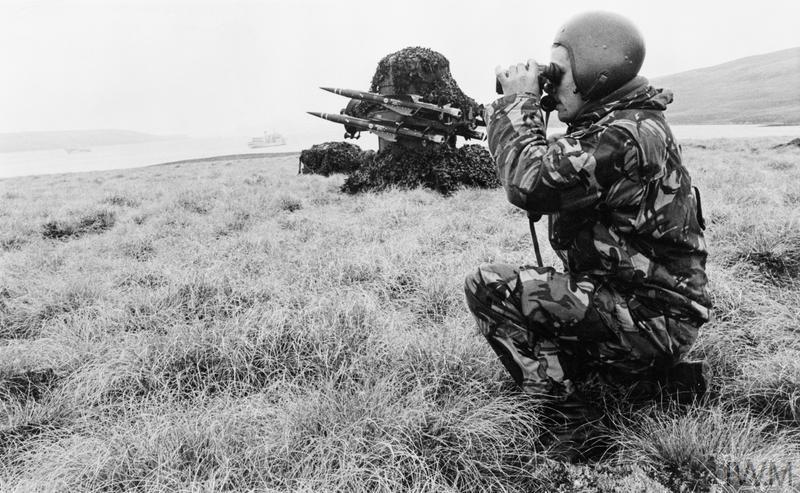
Arjantin Uçaklarını Gözetleyen Bir Rapier Füze Bataryası (Imperial War Museums)
The Argentine defence around Stanley was based on a roughly 48-kilometre outer line extending from west to east. However, the number of troops was insufficient to maintain continuous coverage of the entire perimeter, so the defence relied on isolated strongpoints on dominant elevations. These positions were reinforced with heavy machine guns, mortars, minefields, and field artillery; however, the connections between them were weak, and mobile reserves for counterattacks were limited. The British command assessed that advancing along a single narrow corridor would expose units to enfilading fire and decided to capture all key elevations west of Stanley in succession. The offensive was delayed until the night of 11 June to allow artillery ammunition to be transported to forward depots. Moore initially requested 1,000 shells per gun; due to transport difficulties, he reduced this to approximately 500; by the end of the final battles, some batteries had only a few shells remaining.【94】
The first general offensive was launched on the night of 11–12 June against Mount Longdon, Two Sisters, and Mount Harriet. The 3rd Parachute Battalion under Lieutenant Colonel Hew Pike attacked the rocky positions defended primarily by B Company of the 7th Infantry Regiment. Initially advancing silently, the battalion came under intense machine-gun, sniper, and artillery fire after triggering mines and firing signal flares. Rocky outcrops separated the attacking columns, and defensive positions placed in natural crevices made it difficult to pinpoint the source of fire. Sergeant Ian McKay was killed while attacking a machine-gun position that halted the battalion’s advance and was posthumously awarded the Victoria Cross. After approximately ten hours of close combat, the elevation was captured; however, the battalion suffered heavy casualties and could not advance toward Stanley in daylight.【95】
To the south of Mount Longdon, the 45th Commando under Lieutenant Colonel Andrew Whitehead attacked Two Sisters. The core of the Argentine defence consisted of B Company of the 6th Infantry Regiment and reinforcing units from the 4th Infantry Regiment. Commando companies advanced from the west and east ridges of the elevation; strong winds, rocky terrain, and heavy machine-gun fire prevented the simultaneous execution of the attacks. However, initiative by small-unit commanders and the forward adjustment of artillery fire gradually pushed back the defence. By the morning of 12 June, British units had gained control of the two main summits of Two Sisters.【96】
The 42nd Commando’s assault on Mount Harriet was a large-scale reconnaissance and deception-based encirclement manoeuvre. Lieutenant Colonel Nick Vaux, recognising that the Argentine defence expected an attack from the west, moved the main force around from the south and directed it toward the rear of the elevation. Fire from the frigate Yarmouth on the western slope helped divert the defenders’ attention. British advance elements infiltrated undetected to within approximately 150 metres of some positions; then, close combat began, supported by over a thousand artillery, mortar, and ship shells. The positions of the 4th Infantry Regiment fell one by one until the morning. The relatively low British casualties in capturing Mount Harriet demonstrated the superiority of detailed reconnaissance, night training, and indirect approaches over direct frontal assaults.【97】
The second general offensive began on the night of 13–14 June. The main battle occurred on Mount Tumbledown between the 2nd Scots Guards and the Argentine 5th Marine Battalion. The Argentine marines were positioned in well-prepared stone defences, supported by field artillery and mortars. Strong winds, darkness, and rugged terrain frequently severed communication between the Guards companies. The Left Flank Company, advancing from the west, had to capture some stone shelters with grenades, rifle fire, and bayonet charges. The assault columns led by Major John Kiszely advanced along the ridge while other companies threatened the Argentine reinforcements’ and withdrawal routes. After hours of close combat, most of Tumbledown fell into British hands, and the marines were ordered to withdraw toward Stanley.【98】
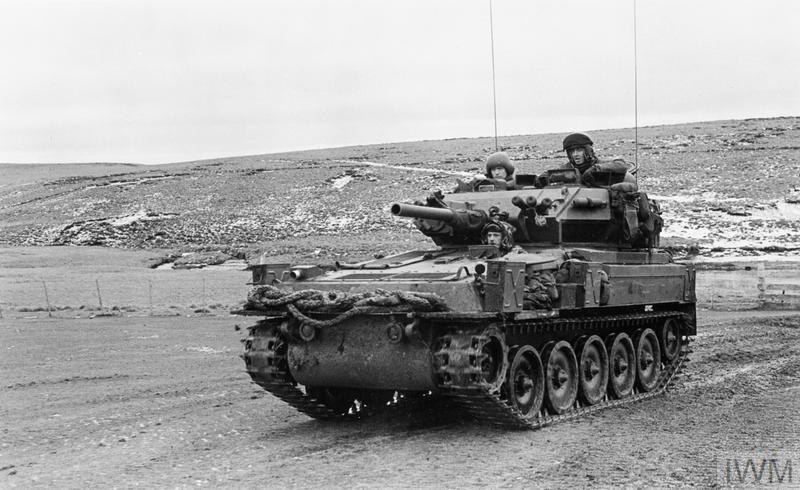
Kara Muharebelerinde Kullanılan Bir Scorpion Hafif Tankı (Imperial War Museums)
While the battle on Tumbledown continued, the 2nd Parachute Battalion attacked Wireless Ridge. Unlike the limited artillery support at Goose Green, this operation was supported by two artillery batteries, mortars, naval gunfire, and light armoured vehicles of the Blues and Royals—Scorpion and Scimitar. Instead of stealthy infiltration, a deliberate concentration of firepower was established; the positions of the 7th Infantry Regiment were broken down by phased assaults, and counterattacks from Moody Brook were repelled. The Gurkhas advancing toward Mount William to the east of Tumbledown encountered only limited resistance as Argentine forces began to withdraw. With the abandonment of Sapper Hill, the outer defences west of Stanley were severed. When British units reached the outskirts of the settlement, the Argentine forces no longer had the capacity to establish a coherent defensive line.【99】
The outcome of the land operations cannot be explained solely by differences in the military qualities of the two armies. British units held clear advantages in night combat, small-unit tactics, artillery-infantry coordination, and initiative at the lower command levels; however, shortages in helicopters, ground vehicles, and ammunition transport capacity repeatedly brought the operation to a halt. Argentina’s defence, dependent on widely dispersed static positions, lacked sufficient mobile reserves, suffered from poor coordination between command levels, and had training deficiencies in some units, preventing it from seizing the initiative. Nevertheless, the resistance at Goose Green, Mount Longdon, and Tumbledown demonstrated that the 5th Marine Battalion, commando units, artillery, and the 25th Infantry Regiment were neither unprepared nor devoid of the will to fight. The collapse of the defence around Stanley on the morning of 14 June was the result of Argentina’s inability to effectively utilise its diverse, differently trained units within a single operational framework.【100】
On the morning of 14 June 1982, the collapse of the defence on Wireless Ridge, Mount Tumbledown, and Mount William left the Argentine garrison in Stanley trapped between the sea and British land forces. As Argentine units withdrew from the high ground in disorganised groups toward Stanley, British artillery fire was initially directed at the retreating forces but was then halted to prevent unnecessary destruction of the defeated units. At 15:05 Zulu, it was reported that the Argentine command was ready for talks; from 15:30, British units were ordered to fire only in legitimate self-defence. Contrary to the popular narrative of a “white flag over Stanley,” the only white flag seen at the time belonged not to the Argentine headquarters but to a civilian’s house.【101】
The channel allowing direct contact between the two sides was the civilian health and communications network operating in Stanley. The British had established regular contact since 5 June with Argentine Navy Lieutenant Melbourne Hussey via this network but had not received an official response to initial calls. During the final battles, local physician Alison Bleaney encouraged Hussey to initiate talks to prevent further loss of life among soldiers and civilians. On 14 June, Hussey informed the British at approximately 13:00 local time that he wished to discuss ceasefire conditions. Captain Michael Rose of the 22nd Special Air Service Regiment and Royal Marine Lieutenant Rod Bell, who spoke Spanish, were flown by helicopter to Stanley’s football pitch and began negotiations with the Argentine delegation at approximately 15:30 in the Secretariat building.【102】
Major General Mario Benjamín Menéndez, concluding that the defence of Stanley could not be sustained, had previously informed President General Leopoldo Galtieri by telephone that the high ground, mobile reserves, and sufficient ammunition had been lost. Galtieri initially insisted on continuing the fight; however, Menéndez soon received authority to initiate negotiations. Argentina’s divided command structure among the Army, Navy, and Air Force cast doubt on Menéndez’s authority to make decisions on behalf of all forces. The British delegation insisted that the surrender cover not only the forces in Stanley but all Argentine personnel on East Falkland, West Falkland, and surrounding islands. Menéndez, after obtaining approval from other force commanders, accepted this scope.【103】
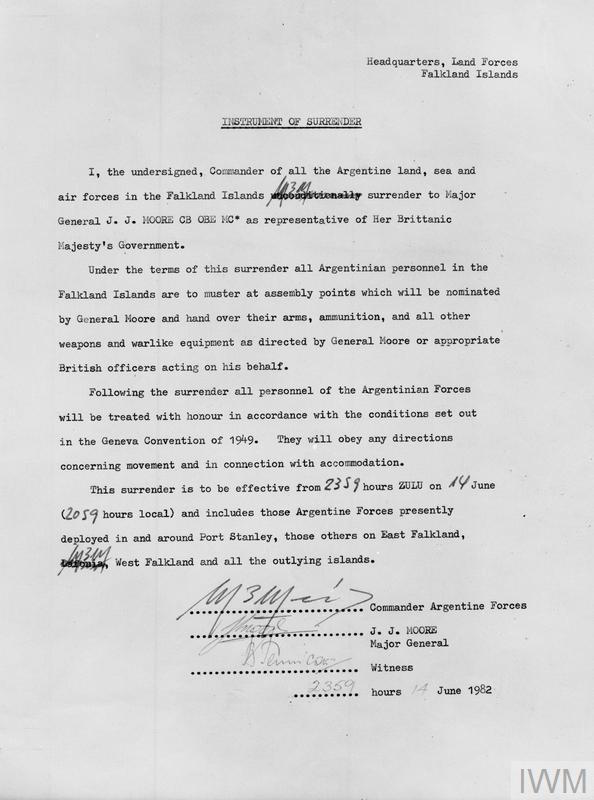
Official Signed Document Announcing Argentina's Surrender (Imperial War Museums)
The initial British draft used the phrase unconditional surrender with honour. At Menéndez’s objection, the word unconditionally was crossed out; this change is clearly visible on the surviving copy of the document. The removal of the word did not narrow the legal and military scope of the surrender: all personnel were required to proceed to designated assembly areas, surrender their weapons and ammunition, and leave military vehicles and equipment under British control. The document also stipulated that the surrendered personnel would be treated “in accordance with the conditions set out in the 1949 Geneva Convention.”
Major General Jeremy Moore arrived in Stanley at approximately 19:30 local time after a delayed helicopter journey due to heavy snowfall. Although the document was signed after midnight, to prevent future disputes over date and time zone, it was made effective from 23:59 Zulu on 14 June 1982 (20:59 local time). Menéndez signed on behalf of the Argentine forces, and Moore signed on behalf of the British government. The signing process was kept deliberately low-profile, with no press present and no victory ceremony held. Moore reported to London at 02:00 Zulu that all Argentine forces on East and West Falkland had surrendered with their weapons and equipment.【105】
Following the signing of the surrender document, soldiers began assembling at a designated area south of Stanley airport, weapons were piled in a separate area, and information on minefields was provided to British engineering units. As the 74-day occupation ended, British forces imposed curfews to prevent incidents between Argentine soldiers and islanders and to reduce the risk of looting. The garrison at Port Howard on West Falkland was brought under control on 15 June; the unit on Pebble Island also surrendered without resistance. However, the eleven-person Argentine unit on South Thule, approximately 2,000 kilometres south-east of the Falkland Islands, did not surrender until 20 June. Thus, although land combat ended on 14 June, it took six more days for Britain to eliminate Argentina’s last military position in the South Atlantic.【106】
The number of surrendered personnel varies across sources due to differences in counting dates and classification systems. The British Ministry of Defence’s December 1982 assessment recorded a total of 11,400 prisoners of war; another military history study recorded 11,484, and a later official figure gave the final count as 11,848. Therefore, it is more cautious to state that approximately 11,500 personnel were taken prisoner at the time of the garrison’s surrender. Despite differing totals, all records show that Britain was forced to feed, house, medically screen, and transport a prisoner population larger than its own land forces within a short time.【107】
Long-term detention of prisoners on the islands was not feasible. The temporary collection area at San Carlos, prepared for Goose Green prisoners, could accommodate only a few hundred people; the number following the general surrender was dozens of times greater. There were insufficient buildings, tents, water, and sanitation facilities under the southern hemisphere’s winter conditions. The loss of the Atlantic Conveyor and its 4,500 sets of tents worsened the situation. It was determined that the Argentine garrison had only three days’ worth of food remaining, and many soldiers suffered from inadequate nutrition, cold, exhaustion, and war wounds requiring medical attention. The British authorities’ decision to house some prisoners on ships, while different from a standard prisoner-of-war camp, was deemed acceptable by the International Committee of the Red Cross under the prevailing conditions.【108】
The early repatriation of prisoners was a matter intersecting military, legal, and diplomatic concerns. On one hand, pilots, special forces personnel, and intelligence officers were not to be allowed to return to active duty; prisoners were considered a limited pressure tool to compel Argentina to accept the complete end of hostilities. On the other hand, holding tens of thousands of prisoners imposed obligations under the 1949 Third Geneva Convention regarding food, clothing, shelter, medical care, and security. Deteriorating weather conditions and Britain’s own limited food and shelter resources made mass repatriation a necessity.【109】
The majority of prisoners taken at Goose Green were transported by the ferry Norland to Montevideo, the capital of neutral Uruguay, before the general surrender. After Stanley’s surrender, approximately 5,000 prisoners were loaded onto the Canberra, and 1,000 onto the Norland. The International Committee of the Red Cross secured guarantees of safe passage from Argentina for the two unarmed and unescorted ships on 18 June. The transfer of approximately 400 sick and wounded to Argentine hospital ships from Stanley was also part of this arrangement. The successive use of large passenger ships for military transport, hospital, and prisoner-of-war duties was one of the operation’s unusual logistical features.【110】
By 20 June, 10,250 Argentines had been sent back to their country via Stanley and Ajax Bay. In the islands, 593 “special category” prisoners were retained; these included Menéndez, senior officers, intelligence personnel, and technical experts. Thirty-five Argentine engineering personnel were granted conditional release to reveal mine locations and neutralise booby-trapped munitions; approximately 200 enlisted men also remained temporarily on the islands. The release of the only British prisoner of war held by Argentina, Harrier pilot Lieutenant Jeffrey Glover, on 6 July removed one of the last major obstacles to the release of the remaining Argentine personnel. All special category prisoners were repatriated by 14 July.【111】
Subsequent consolidated figures on human losses indicate that 649 Argentine military personnel were killed and over 1,000 were wounded. In the British task force, including Royal Navy Auxiliary Fleet and merchant fleet civilian crews, 255 personnel were killed; 777 were wounded. Additionally, three Falkland civilians lost their lives. Together, these figures show that the war resulted in the deaths of 904 personnel from both sides and 907 people including the three islanders.【112】
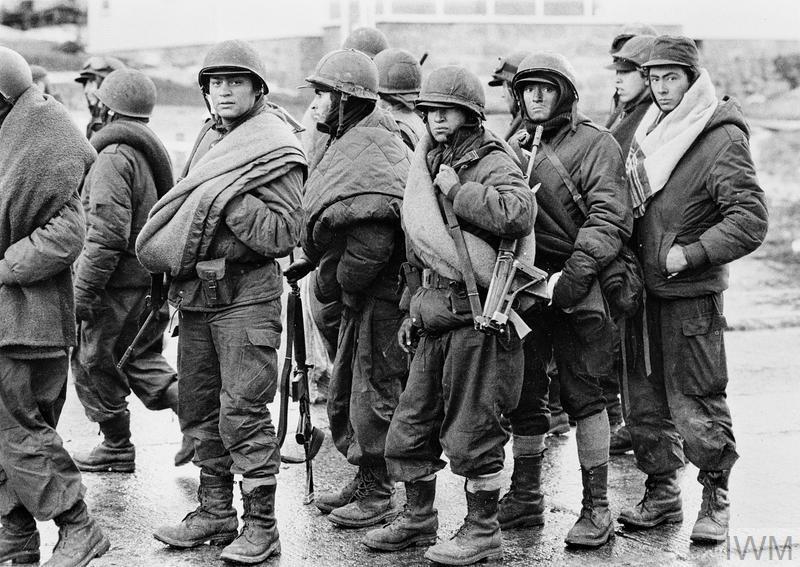
Argentine Prisoners (Imperial War Museums)
Argentina’s initial official calculations differed from the later total of 649. The Rattenbach Report’s 1983 casualty table listed 168 dead and 27 missing for the Army, 381 dead and 10 missing for the Navy, and 17 dead and 38 missing for the Air Force. Thus, a total of 641 personnel were categorised as “dead or missing” across the three service commands. The same table recorded 1,046 Army, 116 Navy, and 46 Air Force personnel wounded, totalling 1,208. The eight-person discrepancy between the later consolidated figure of 649 and the report’s 641 highlights the need to specify the reporting date and the personnel categories included in the statistics.【113】
Civilian deaths on the Falkland Islands were extremely limited but not entirely prevented. Doreen Bonner, Mary Goodwin, and Susan Whitley were killed when their house in Stanley was hit by British fire. The fact that no islanders were killed during the Argentine seizure of the islands on 2 April and that subsequent land battles were largely conducted outside populated areas reduced civilian casualties. However, the reach of artillery into Stanley revealed how fragile the boundary was between friendly fire and civilian areas during the final days of the war.【114】
The survival rate of the wounded demonstrated that the war’s overall toll was not determined solely by the effects of weapons. Over 90% of British wounded survived; many were operated on within the first six hours. Field medical posts, the forward surgical facility at Ajax Bay, the hospital ship Uganda, helicopter evacuations, and VC10 aircraft transporting the wounded to the United Kingdom formed a linked medical chain. However, burns, cold-related injuries, mine explosions, and ship sinkings sometimes delayed the identification and notification of casualties to families.【115】
Material losses were heavy for both sides. Britain lost four warships, one landing ship from the Royal Navy Auxiliary Fleet, and one merchant vessel; eight warships and two auxiliary fleet vessels sustained varying degrees of damage. In addition to naval and air losses, Argentina lost 44 aircraft and helicopters and two long-range early warning radars on the islands; six operational helicopters were later incorporated into British service. However, determining the direct financial cost of the war remains difficult. The Rattenbach Commission explicitly noted that it could not produce a “true and precise” total because the Argentine service commands calculated losses, procurement, and emergency rearmament costs using different criteria.【116】
The end of the Falklands War is generally accepted as 14 June 1982, as organised land resistance and the main conflict between the parties ended on that day. However, the surrender of the South Thule garrison on 20 June, the repatriation of the majority of prisoners by the same date, and the completion of the evacuation of special category prisoners on 14 July demonstrate that the military end of the war did not coincide with its administrative and legal conclusion. Without a peace treaty, this situation closed the combat phase of the conflict but did not resolve the sovereignty dispute.【117】
The Falklands War significantly strengthened the political position of Margaret Thatcher’s government in the United Kingdom. In the early days of the occupation, the government faced severe criticism for leaving the islands undefended and failing to recognise Argentina’s intentions in time; the military victory changed the nature of this debate. Thatcher declared after the war that Britain was “no longer a nation in retreat”, linking the victory to overcoming economic and military decline. The “Falklands effect” in public opinion contributed to the Conservative Party’s success in the 1983 general election. However, the magnitude of this effect is debated: some assessments suggest the Conservatives’ increase in vote share reached as much as six percentage points, while others attribute the government’s rise more to economic recovery. In this sense, the war was not the sole cause of Thatcher’s political success but a powerful symbol that identified her leadership with decisiveness and national will.【118】
The outcome in Argentina was the opposite. After the surrender was announced, demonstrations against the military regime were held in Buenos Aires and other cities; the nationalist mobilisation that had supported the Junta before the war gave way to demands for accountability for the defeat. Some demonstrators questioned the military’s decision to send conscripts against professional British units, while some war veterans threw their medals on the ground and shouted anti-dictatorship slogans. Leopoldo Fortunato Galtieri, within days of the surrender, lost support within the armed forces and was forced to resign; Admiral Jorge Isaac Anaya was also removed from his post. With General Reynaldo Bignone assuming the presidency on 1 July 1982, political parties were allowed to resume activities, and a timetable for the transition to civilian rule was initiated.【119】
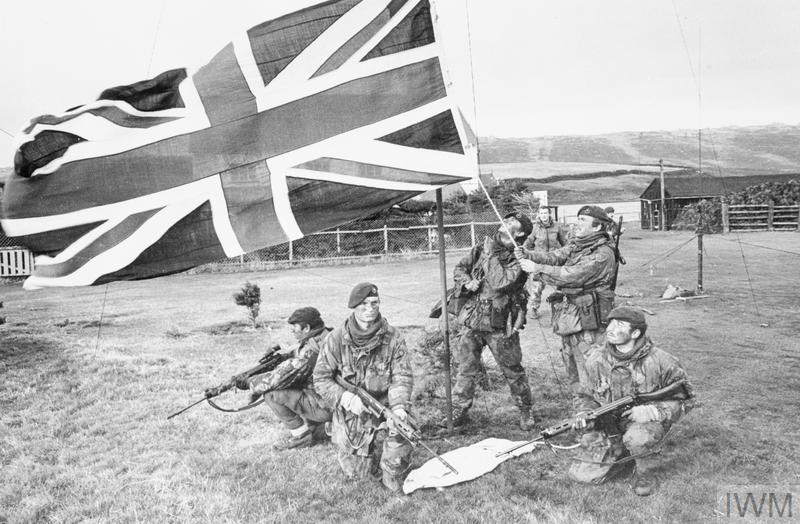
Savaş Sonrası İngilizler, Hakimiyet Sembolü Olarak Bölgeye Bayraklarını Dikiyorlar (Imperial War Museums)
The defeat did not single-handedly cause the collapse of Argentina’s military regime. The Junta had already largely lost legitimacy before the war due to heavy foreign debt, high inflation, unemployment, and social protests. The nationalist fervour during the early weeks of the war temporarily masked this crisis, but the defeat irreversibly damaged the military’s claim to govern the country and protect national interests. The exposure of unpreparedness in the battles, logistical failures, and mistreatment of soldiers by some officers further eroded the armed forces’ institutional credibility. Thus, the war is regarded as a turning point that accelerated the existing regime crisis and made the military’s continued rule impossible.【120】
The Radicales Unión Ciudadana, led by Raúl Alfonsín, won the elections on 30 October 1983 with approximately 52% of the vote; the Peronist candidates received approximately 40%. Alfonsín’s assumption of office on 10 December 1983 symbolised not only the end of military rule but also the restoration of the political order that had been interrupted by coups throughout the 20th century. The new government sought to reduce the armed forces’ political influence, investigate crimes committed during the Junta, and resolve the Beagle Channel dispute with neighbouring Chile peacefully. Alfonsín defined the Falklands occupation as “an illegal act by an illegitimate government in a legitimate cause”, distinguishing Argentina’s sovereignty claim from the Junta’s decision to wage war. This distinction became the fundamental approach of Argentine politics during the democratic era.【121】
Argentina’s social memory of the war was shaped around this distinction. The “Malvinas cause” was preserved as a legitimate and historical claim to sovereignty, while the 1982 war increasingly came to be portrayed as an irresponsible military venture by the dictatorship. In the dominant narrative, civilians and conscripts were positioned as innocent victims deceived by the Junta, while military leaders were identified as the primary culprits of the war. The widespread use of the phrase los chicos de la guerra—“the children of the war”—helped bring visibility to the hardships faced by young soldiers but also carried the risk of reducing their diverse experiences, initiatives, and war memories to a single narrative of victimhood.【122】
The return of approximately 13,000 Argentine personnel who fought on the islands faced serious problems. The military regime, fearing that veterans would speak about poor planning and conditions in the units, pressured many to remain silent about their experiences. The reception of veterans varied by region: in Patagonian towns near the conflict zone, such as Puerto Madryn, crowds welcomed returning soldiers, while in large cities like Buenos Aires, many veterans were only greeted by their families and close circles. The rapid collapse of the dictatorship, the football World Cup, and the economic crisis caused returning veterans to fade from the public agenda.【123】
Transitioning to civilian life, psychological trauma, unemployment, educational disruption, and social stigmatisation reinforced each other. Some employers viewed veterans as unstable or prone to violence, and many former soldiers had to conceal their participation in the war when applying for jobs. The state took a long time to develop a comprehensive reintegration programme in health, education, housing, and employment. The Social Assistance Law No. 23.109, adopted in 1984, was not fully implemented until 1988. In response to this delay, veterans formed their own associations to fight for pensions, healthcare, public recognition, and investigations into the mistreatment they suffered during the war. Reports of suicides became an important part of the war’s social memory, but due to differing definitions of veterans and incomplete records, precise numbers must be treated with caution.【124】
How the war was remembered in Argentina also became a subject of political struggle. The Alfonsín era, seeking to distance itself from the dictatorship’s nationalist rhetoric, reduced the public visibility of the war; subsequent governments revived the sovereignty claim. 2 April was reinstated as a national day of remembrance during Fernando de la Rúa’s presidency. During the presidencies of Néstor Kirchner and Cristina Fernández de Kirchner, the memory of the war was linked both to human rights abuses and the victimisation of conscripts and to an anti-imperialist narrative of sovereignty. Thus, four main memory frameworks developed in Argentina, overlapping but not fully reconciled: the narrative of national cause and heroism, the narrative of the Junta’s adventure and victimisation, the narratives based on veterans’ own war experiences, and the military-technical historical approach.【125】
In the United Kingdom, victory celebrations initially failed to adequately address the long-term problems of veterans. The war’s short duration, the fact that soldiers had time to prepare during their long sea voyage, and the widespread public support upon their return contributed to initially low rates of psychiatric casualties. However, later studies revealed delayed trauma symptoms. A 1991 study, comparing Falklands veterans from one infantry unit with a control group of non-deployed soldiers, found that approximately half of the veterans reported symptoms falling within the post-traumatic stress disorder cluster; 22% met all diagnostic criteria. Claims that the suicide rate among British veterans exceeded the number of those killed in the war have not been substantiated due to the lack of reliable and comparable data.【126】
The commemoration of war losses took different symbolic forms in the two countries. British soldiers’ families were offered the choice of repatriating the bodies to the United Kingdom or burying them in the Falkland Islands; most families chose repatriation. The Blue Beach Military Cemetery at San Carlos became the primary memorial site for British soldiers whose families wished them to remain on the islands. The Darwin Cemetery near Goose Green, where Argentine soldiers were buried, was consecrated in February 1983; the first large visit by Argentine relatives occurred in 1991. The Liberation Monument in Stanley was inaugurated on 14 June 1984, the second anniversary of the surrender. The South Atlantic Fund, established in Britain, raised £15.25 million from over 400,000 donations before closing in 1992 and distributed £16.6 million, including investment returns.【127】
The war created a lasting transformation in the political identity of the Falkland Islanders. The experience of occupation and recapture strengthened the population’s ties to the United Kingdom and deepened their distrust of Argentine administration. A special regulation issued after the war granted the islanders full British citizenship. The new constitution, effective from 18 April 1985, guaranteed the people’s right to determine their own future; the term “Camp,” referring to Stanley and the rural areas, became separate electoral constituencies. South Georgia and the South Sandwich Islands were administratively separated from the Falkland Islands.【128】
The reconstruction programme changed the development trajectory of the islands, which before the war had a declining population and an economy heavily dependent on wool exports. The official estimate prepared in November 1982 projected that war, garrison, infrastructure, and economic development expenditures would reach approximately £3.84 billion by 1988. Of this total, approximately £1.79 billion was allocated to the direct cost of the war, £2 billion to the garrison, and only £30.5 million to economic development. Nevertheless, the Falkland Islands Development Agency supported the transfer of farms from absentee landowners to local producers; within six years, the proportion of agricultural land under local ownership rose from 24% to 73%. This transformation significantly weakened the large, externally managed farm system that had previously defined the islands’ social structure.【129】
The key turning point in the islands’ economic independence was fishing licences. The Falkland Islands Temporary Conservation and Management Zone came into effect on 1 February 1987. In the first year, revenue from 220 licences amounted to £14 million; the cost of the patrol vessel and aircraft was approximately £4 million. Per capita gross domestic product more than doubled between 1986 and 1987 and nearly doubled again the following year. The island government’s revenue, which was approximately £6 million in 1985–1986, was estimated at £35 million for 1988–1989. By November 1988, the governor could report that the islands no longer required direct financial aid from the United Kingdom. Thus, fishing revenue not only provided economic prosperity but also weakened the pre-war belief that the Falkland Islands could not survive without cooperation with the Argentine mainland.【130】
Security policy transformed the islands into an increasingly militarised structure known as the “Falkland Fortress.” The garrison, initially planned to be approximately 1,800 personnel to protect the 1,800 civilians, was estimated to reach 4,200. By October 1982, the land garrison had increased to 4,778 personnel and was later reduced to 3,400. The first phase of the strategic air base at Mount Pleasant was completed in May 1985, and the second runway was finished in spring 1986. Thanks to rapid reinforcement capability, the land garrison was reduced to approximately 1,900 personnel and the naval force to 550 by April 1987. The military presence, while providing security and economic activity for the local population, created a disproportionate impact on housing, public services, transport, and social life relative to the population size. The long-term failure to clear minefields remains one of the most visible legacies of the war on the islands’ geography.【131】
The war severed diplomatic relations but did not end Argentina’s sovereignty claim. The Alfonsín government maintained the dispute on the agenda through the United Nations, while Britain refused to make sovereignty a subject of discussion. Talks in Bern in 1984 failed due to this disagreement. With Carlos Menem’s rise to power in 1989, a more pragmatic approach was adopted. Talks in Madrid in 1989 and 1990 accepted the “sovereignty umbrella” formula: any negotiation or agreement between the parties would not imply renunciation of their legal claims over the Falkland, South Georgia, and South Sandwich Islands. Through this method, commercial and consular relations were restored, confidence-building measures regarding the prior notification of military activities were adopted, and full diplomatic relations were resumed on 19 February 1990.【132】
Argentina’s 1994 Constitution’s First Transitional Provision defined sovereignty over the Falkland, South Georgia, and South Sandwich Islands and surrounding maritime areas as “legitimate and imprescriptible”. The same provision made the peaceful recovery of these territories in accordance with international law and respect for the islanders’ way of life a permanent national objective. Thus, the use of armed force was replaced by constitutional and diplomatic methods; however, the sovereignty claim remained an unchanging element of state policy under democratic governments.【133】
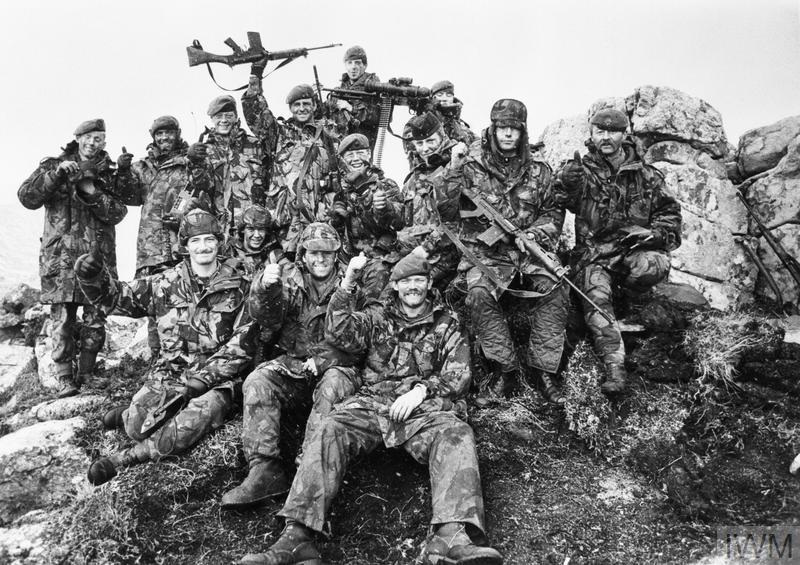
British Soldiers Celebrating the Surrender of Argentina (Imperial War Museums)
The strengthened separate political identity of the islanders after the war was clearly evident in the political status referendum held on 10–11 March 2013. Of the 1,518 votes cast, 1,517 were valid; 1,513 voters, or 99.8% of the valid votes, supported maintaining the Falkland Islands’ status as a British Overseas Territory. The turnout was 92%, and only three voters voted “no.” The United Kingdom and the island government interpreted the result as a clear expression of the right to self-determination, while Argentina rejected the referendum, refusing to recognise the islanders as an independent third party in the sovereignty dispute. Therefore, the referendum clarified the positions of the two sides but did not alter the framework of the United Nations’ call for negotiations between the two governments or resolve the sovereignty dispute.【134】
The legacy of the war continues to live on in the commemorative cultures each side has built around different dates. In Argentina, 2 April has become the day of remembrance for the sovereignty claim and those who died in the war; in the Falkland Islands, 14 June is observed as “Liberation Day.” The same war is remembered in Argentina as the collapse of the dictatorship, the victimisation of young soldiers, and national sovereignty; in the United Kingdom, as a military victory, the commemoration of losses, and national self-confidence; and among the islanders, as the experience of occupation, security, and the right to determine their own future. Nevertheless, joint commemorative events by former British and Argentine soldiers demonstrate that personal reconciliation is not entirely blocked by political disagreement. Thus, although armed conflict ended on 14 June 1982, the war’s political, social, and emotional consequences continue to shape the identities of subsequent generations and the sovereignty debate.【135】
Argentina. Military Junta. Commission for the Analysis and Evaluation of Responsibilities in the South Atlantic Conflict. *Informe Rattenbach (Rattenbach Report). Buenos Aires, 1983. Accessed July 16, 2026.https://www.casarosada.gob.ar/pdf/InformeRattenbach/01-InformeFinal.pdf.
Aydınlı, Fuat. "Türk Basınında Falkland Adaları Savaşı." Master's thesis, Bandırma Onyedi Eylül Üniversitesi, 2023. Advisor: Prof. Dr. İsmail Şahin. Accessed July 16, 2026.https://acikerisim.bandirma.edu.tr/yayin/1818050
Committee of Privy Councillors. *Falkland Islands Review*. Cmnd. 8787. London: Her Majesty's Stationery Office, 1983. Margaret Thatcher Foundation. Accessed July 16, 2026.
Doğru, Tuğrul Erdem. "İngiltere-Arjantin ilişkileri: Falkland Savaşı." Master's thesis, Hatay Mustafa Kemal Üniversitesi, 2019. Advisor: Dr. Öğr. Üyesi Haydar Çoruh. Accessed July 16, 2026.https://tez.yok.gov.tr/UlusalTezMerkezi/TezGoster?key=jNRDC1RLfVd4_T7x7ZXmmRhg0t4jojP6SbmwhEyFZDh8pTpxbspJxeLd_ENI45lI
Duarte, Érico Esteves, ed. *The Falklands/Malvinas War in the South Atlantic*. Cham: Palgrave Macmillan, 2021. Accessed July 16, 2026.https://doi.org/10.1007/978-3-030-65566-2.
Freedman, Lawrence. The Official History of the Falklands Campaign. Volume 1, The Origins of the Falklands War. London: Routledge, 2005.
Freedman, Lawrence. The Official History of the Falklands Campaign. Volume 2, War and Diplomacy. London: Routledge, 2005.
Imperial War Museums. "30 Photographs From The Falklands War." Accessed July 16, 2026.https://www.iwm.org.uk/history/cold-war/falklands-conflict/30-photographs-falklands-conflict.
Imperial War Museums. "The Instrument of Surrender for All Argentine Forces on the Falkland Islands" (Photograph). Ministry of Defence Collection, Catalogue no: FKD 2301. Accessed July 16, 2026.
Mira, Guillermo, and Fernando Pedrosa, ed. *Revisiting the Falklands-Malvinas Question: Transnational and Interdisciplinary Perspectives*. London: University of London Press, 2020. Accessed July 16, 2026.https://uolpress.co.uk/book/revisiting-the-falklands-malvinas-question/.
Nott, John. "The Falklands Campaign: The Lessons." Cabinet Memorandum, C(82) 43, December 13, 1982. CAB 129/215 f393, Cabinet Papers, The National Archives (TNA), Kew. Margaret Thatcher Foundation. Accessed July 16, 2026.
Reisman, W. Michael. "The Struggle for the Falklands." *Yale Law Journal* 93, no. 2 (1983): 287–317. Accessed July 16, 2026.https://openyls.law.yale.edu/server/api/core/bitstreams/b8b44f00-4c64-4bc6-8f49-acc570ab3bf9/content
Tato, María Inés, Peter Stanley, Luis Esteban Dalla Fontana, and Rob McLaughlin. *Falklands/Malvinas 1982: A War of Two Sides*. Abingdon: Routledge, 2023. Accessed July 16, 2026.https://www.academia.edu/98082489/Falklands_Malvinas_1982_A_War_of_Two_Sides.
United Nations General Assembly. Resolution 2065 (XX). "Question of the Falkland Islands (Malvinas)". 20th Session (1965), 1966. Accessed July 16, 2026.
United Nations Security Council. Resolution 502 (1982) [S/RES/502 (1982)]. April 3, 1982. Accessed July 16, 2026.
United Nations Security Council. Resolution 505 (1982) [S/RES/505 (1982)]. "Question Concerning the Situation in the Region of the Falkland Islands (Islas Malvinas)". May 26, 1982. Accessed July 16, 2026.https://digitallibrary.un.org/record/34458?ln=en&v=pdf
Van der Bijl, Nick. Victory in the Falklands. Barnsley: Pen & Sword Military, 2007.
Wieland, Alexander R., ed. *Foreign Relations of the United States, 1981–1988, Volume XIII, Conflict in the South Atlantic, 1981–1984*. General Editor: Adam M. Howard. Washington: United States Government Publishing Office, 2015. Accessed July 16, 2026.https://history.state.gov/historicaldocuments/frus1981-88v13
[1]
María Inés Tato, Peter Stanley, Luis Esteban Dalla Fontana ve Rob McLaughlin, Falklands/Malvinas 1982: A War of Two Sides (Abingdon: Routledge, 2023), 1–2, erişim tarihi: 16 Temmuz 2026, https://www.academia.edu/98082489/Falklands_Malvinas_1982_A_War_of_Two_Sides.
[2]
Lawrence Freedman, The Official History of the Falklands Campaign, cilt 2, War and Diplomacy (Londra: Routledge, 2005), 3–12, 540–564.
[3]
Christine Anderson ve María R. Osuna Alarcón, “Information Resources on the Falkland–Malvinas Conflict,” içinde Revisiting the Falklands–Malvinas Question: Transnational and Interdisciplinary Perspectives, ed. Guillermo Mira ve Fernando Pedrosa (Londra: University of London Press, 2021), 253, erişim tarihi: 16 Temmuz 2026, https://uolpress.co.uk/book/revisiting-the-falklands-malvinas-question/.
[4]
Érico Esteves Duarte, “Introduction,” içinde The Falklands/Malvinas War in the South Atlantic, ed. Érico Esteves Duarte (Cham: Palgrave Macmillan, 2021), 1–13, erişim tarihi: 16 Temmuz 2026, https://doi.org/10.1007/978-3-030-65566-2.
[5]
Nick van der Bijl, Victory in the Falklands (Barnsley: Pen & Sword Military, 2007), 1.
[6]
María Inés Tato vd., Falklands/Malvinas 1982: A War of Two Sides, x–xii, 2.
[7]
Van der Bijl, Victory in the Falklands, 2–3.
[8]
Van der Bijl, Victory in the Falklands, 1; Lawrence Freedman, War and Diplomacy, 66.
[9]
Freedman, War and Diplomacy, 44, 66–67.
[10]
Argentina, Junta Militar, Comisión de Análisis y Evaluación de las Responsabilidades en el Conflicto del Atlántico Sur, Informe Final (Informe Rattenbach) (Buenos Aires, 1983), 1–2, erişim tarihi 16 Temmuz 2026, https://www.casarosada.gob.ar/pdf/InformeRattenbach/01-InformeFinal.pdf.
[11]
Argentina, Junta Militar, Comisión de Análisis y Evaluación, Informe Final, 1–2.
[12]
Lawrence Freedman, The Official History of the Falklands Campaign, cilt 1, The Origins of the Falklands War (Londra: Routledge, 2005), 2–3, erişim tarihi 16 Temmuz 2026, https://api.pageplace.de/preview/DT0400.9781135775902_A23808298/preview-9781135775902_A23808298.pdf.
[13]
Freedman, The Origins of the Falklands War, 3–4.
[14]
Freedman, The Origins of the Falklands War, 4–5.
[15]
Freedman, The Origins of the Falklands War, 5–6.
[16]
Freedman, The Origins of the Falklands War, 6–7.
[17]
Freedman, The Origins of the Falklands War, 7–9.
[18]
United Nations General Assembly, Karar 2065 (XX), “Question of the Falkland Islands (Malvinas),” 16 Aralık 1965, 87, erişim tarihi 16 Temmuz 2026, https://digitallibrary.un.org/record/203558?ln=en&v=pdf.
[19]
Committee of Privy Counsellors, Falkland Islands Review, Cmnd. 8787 (Londra: Her Majesty’s Stationery Office, 1983), 5–7, Margaret Thatcher Foundation, erişim tarihi 16 Temmuz 2026, https://www.margaretthatcher.org/document/109481.
[20]
Committee of Privy Counsellors, Falkland Islands Review, 7–9.
[21]
Committee of Privy Counsellors, Falkland Islands Review, 9–17.
[22]
Committee of Privy Counsellors, Falkland Islands Review, 17–20.
[23]
Committee of Privy Councillors, Falkland Islands Review, Cmnd. 8787 (Londra: Her Majesty’s Stationery Office, 1983), 33–40.
[24]
Argentina, Junta Militar, Comisión de Análisis y Evaluación de las Responsabilidades del Conflicto del Atlántico Sur, Informe Final (Informe Rattenbach) (Buenos Aires, 1983), 25–29.
[25]
Committee of Privy Councillors, Falkland Islands Review, 35–47.
[26]
Argentina, Junta Militar, Informe Final (Informe Rattenbach), 25–41.
[27]
Committee of Privy Councillors, Falkland Islands Review, 48–54; Argentina, Junta Militar, Informe Final (Informe Rattenbach), 42–51.
[28]
Argentina, Junta Militar, Informe Final (Informe Rattenbach), 42–51, 64–65.
[29]
Argentina, Junta Militar, Informe Final (Informe Rattenbach), 51–60.
[30]
Argentina, Junta Militar, Informe Final (Informe Rattenbach), 59–60.
[31]
Argentina, Junta Militar, Informe Final (Informe Rattenbach), 60–62; Nick Van der Bijl, Victory in the Falklands (Barnsley: Pen & Sword Military, 2007), 17–21.
[32]
Argentina, Junta Militar, Informe Final (Informe Rattenbach), 60–62; Van der Bijl, Victory in the Falklands, 21–26.
[33]
Argentina, Junta Militar, Informe Final (Informe Rattenbach), 60–62; Van der Bijl, Victory in the Falklands, 24–26.
[35]
Argentina, Junta Militar, Informe Final (Informe Rattenbach), 62–64; Van der Bijl, Victory in the Falklands, 26–30.
[36]
Argentina, Junta Militar, Informe Final (Informe Rattenbach), 64–67.
[37]
Lawrence Freedman, The Official History of the Falklands Campaign, cilt 2, War and Diplomacy (Londra: Routledge, 2005), 3, 13–14, 40–42.
[38]
Margaret Thatcher, Avam Kamarası konuşması, 3 Nisan 1982, aktaran Freedman, Official History of the Falklands Campaign, 2:16–18.
[39]
Freedman, Official History of the Falklands Campaign, 2:14–21.
[40]
Freedman, Official History of the Falklands Campaign, 2:25–27.
[41]
Freedman, Official History of the Falklands Campaign, 2:40–46.
[42]
Freedman, Official History of the Falklands Campaign, 2:42–44, 176–180.
[43]
Freedman, Official History of the Falklands Campaign, 2:44–46, 176–180.
[44]
Freedman, Official History of the Falklands Campaign, 2:52–54.
[45]
Érico Esteves Duarte ve Luís Rodrigo Machado, “Between Coercive Diplomacy and Malvinas Fortress: Argentina’s Maritime Operations in the Falklands/Malvinas War,” içinde The Falklands/Malvinas War in the South Atlantic, haz. Érico Esteves Duarte (Cham: Palgrave Macmillan, 2021), 61–65, erişim tarihi 16 Temmuz 2026, https://doi.org/10.1007/978-3-030-65566-2_3.
[46]
Duarte ve Machado, “Between Coercive Diplomacy and Malvinas Fortress,” 57–60.
[47]
Duarte ve Machado, “Between Coercive Diplomacy and Malvinas Fortress,” 59–65.
[48]
Freedman, Official History of the Falklands Campaign, 2:66–69, 478.
[49]
Argentina, Junta Militar, Informe Final (Informe Rattenbach), 198–204.
[50]
Freedman, Official History of the Falklands Campaign, 2:57–69; Duarte ve Machado, “Between Coercive Diplomacy and Malvinas Fortress,” 51–53, 74–77.
[51]
United Nations Security Council, Resolution 502 (1982), S/RES/502 (1982), 3 Nisan 1982, par. 1–3, erişim tarihi: 16 Temmuz 2026, https://digitallibrary.un.org/record/34455?v=pdf.
[52]
Freedman, The Official History of the Falklands Campaign, 2:33–40.
[53]
Freedman, The Official History of the Falklands Campaign, 2:80–86.
[54]
Freedman, The Official History of the Falklands Campaign, 2:106–120.
[55]
Freedman, The Official History of the Falklands Campaign, 2:121–151; Comisión de Análisis y Evaluación de las Responsabilidades del Conflicto del Atlántico Sur, Informe final, 91–107.
[56]
Freedman, The Official History of the Falklands Campaign, 2:95–98.
[57]
Freedman, The Official History of the Falklands Campaign, 2:148–151, 325–333.
[58]
Freedman, The Official History of the Falklands Campaign, 2:271–276.
[59]
Freedman, The Official History of the Falklands Campaign, 2:293–299.
[60]
Freedman, The Official History of the Falklands Campaign, 2:319–322.
[61]
United Nations Security Council, Resolution 505 (1982), S/RES/505 (1982), 26 Mayıs 1982, par. 1–5, erişim tarihi: 16 Temmuz 2026, https://digitallibrary.un.org/record/34458?ln=en&v=pdf.
[62]
Freedman, The Official History of the Falklands Campaign, 2:84–86, 421–425.
[63]
Freedman, The Official History of the Falklands Campaign, 2:95–98, 432–434.
[64]
Freedman, The Official History of the Falklands Campaign, 2:334–341.
[65]
Freedman, The Official History of the Falklands Campaign, 2:432–435.
[66]
Comisión de Análisis y Evaluación de las Responsabilidades del Conflicto del Atlántico Sur, Informe final, 163–165.
[67]
Lawrence Freedman, The Official History of the Falklands Campaign, cilt 2, War and Diplomacy (Londra: Routledge, 2005), 70–75, 218–220.
[68]
Freedman, Official History, cilt 2, 208–212.
[69]
Freedman, Official History, cilt 2, 229–241.
[70]
Freedman, Official History, cilt 2, 242–251.
[71]
Freedman, Official History, cilt 2, 252–259.
[72]
Argentina, Junta Militar, Comisión de Análisis y Evaluación de las Responsabilidades del Conflicto del Atlántico Sur, Informe Final (Informe Rattenbach) (Buenos Aires, 1983), par. 611, 617–622.
[73]
John Nott, “The Falklands Campaign: The Lessons,” Kabine Memorandumu, C(82) 43, 13 Aralık 1982, CAB 129/215 f393, Cabinet Papers, The National Archives (TNA), Kew, Margaret Thatcher Foundation, erişim tarihi 16 Temmuz 2026, https://www.margaretthatcher.org/document/127253, 19–21.
[74]
Freedman, Official History, cilt 2, 361–365.
[75]
Freedman, Official History, cilt 2, 366–370.
[76]
Freedman, Official History, cilt 2, 393–402.
[77]
Freedman, Official History, cilt 2, 403–409.
[78]
Freedman, Official History, cilt 2, 411–416.
[79]
Nott, “Falklands Campaign,” 19–21; Freedman, Official History, cilt 2, 414–416.
[80]
Freedman, Official History, cilt 2, 505–519.
[81]
Nick Van der Bijl, Victory in the Falklands (Barnsley: Pen & Sword Military, 2007), 140–141, 189; Freedman, Official History, cilt 2, 526–528.
[82]
Freedman, Official History, cilt 2, 357–370, 393–416; Argentina, Junta Militar, Informe Final, par. 614–622.
[83]
Lawrence Freedman, The Official History of the Falklands Campaign, cilt 2, War and Diplomacy (Londra: Routledge, 2005), 393–402; John Nott, “The Falklands Campaign: The Lessons,” Kabine Memorandumu, C(82) 43, 13 Aralık 1982, 8–9.
[84]
Freedman, Official History, cilt 2, 397–402.
[85]
Freedman, Official History, cilt 2, 461–469.
[86]
Freedman, Official History, cilt 2, 463–476.
[87]
Freedman, Official History, cilt 2, 468–478.
[88]
Freedman, Official History, cilt 2, 478–487.
[89]
Freedman, Official History, cilt 2, 486–493.
[90]
Freedman, Official History, cilt 2, 494–499; Nott, “Falklands Campaign,” 9–10.
[91]
Freedman, Official History, cilt 2, 498–503.
[92]
Freedman, Official History, cilt 2, 500–504.
[93]
Freedman, Official History, cilt 2, 505–522; Nott, “Falklands Campaign,” 10–11.
[94]
Freedman, Official History, cilt 2, 523–528.
[95]
Freedman, Official History, cilt 2, 528–534.
[96]
Freedman, Official History, cilt 2, 534–536.
[97]
Freedman, Official History, cilt 2, 536–539.
[98]
Freedman, Official History, cilt 2, 540–549.
[99]
Freedman, Official History, cilt 2, 549–554; Nott, “Falklands Campaign,” 11–12.
[100]
Argentina, Junta Militar, Comisión de Análisis y Evaluación de las Responsabilidades del Conflicto del Atlántico Sur, Informe Final (Informe Rattenbach) (Buenos Aires, 1983), par. 609; Freedman, Official History, cilt 2, 494–496, 523–554.
[101]
Lawrence Freedman, The Official History of the Falklands Campaign, cilt 2, War and Diplomacy (Londra: Routledge, 2005), 555–559; Nick van der Bijl, Victory in the Falklands (Barnsley: Pen & Sword Military, 2007), 220–222.
[102]
Van der Bijl, Victory in the Falklands, 221–224; Freedman, Official History, cilt 2, 558–560.
[103]
Argentina, Junta Militar, Comisión de Análisis y Evaluación de las Responsabilidades del Conflicto del Atlántico Sur, Informe Final (Informe Rattenbach) (Buenos Aires, 1983), par. 680–684; Freedman, Official History, cilt 2, 559–560.
[105]
Freedman, Official History, cilt 2, 560–562; Imperial War Museums, “Instrument of Surrender.”
[106]
Van der Bijl, Victory in the Falklands, 226–227; Freedman, Official History, cilt 2, 561–563.
[107]
John Nott, “The Falklands Campaign: The Lessons,” Kabine Memorandumu, C(82) 43, 13 Aralık 1982, 28; Van der Bijl, Victory in the Falklands, 227; Freedman, Official History, cilt 2, 567.
[108]
Nott, “Falklands Campaign,” 28; Freedman, Official History, cilt 2, 565–567.
[109]
Freedman, Official History, cilt 2, 565–567; Nott, “Falklands Campaign,” 28.
[110]
Freedman, Official History, cilt 2, 566–568.
[111]
Van der Bijl, Victory in the Falklands, 227; Freedman, Official History, cilt 2, 567–568.
[112]
Guillermo Mira ve Fernando Pedrosa, ed., Revisiting the Falklands–Malvinas Question: Transnational and Interdisciplinary Perspectives (Londra: University of London Press, 2020), 253, erişim tarihi 16 Temmuz 2026, https://uolpress.co.uk/book/revisiting-the-falklands-malvinas-question/; Nott, “Falklands Campaign,” 27.
[113]
Argentina, Junta Militar, Informe Final, par. 735.
[114]
Van der Bijl, Victory in the Falklands, 219, 228; Freedman, Official History, cilt 2, 673.
[115]
Nott, “Falklands Campaign,” 27.
[116]
Nott, “Falklands Campaign,” 18; Freedman, Official History, cilt 2, 567; Argentina, Junta Militar, Informe Final, par. 736.
[117]
Van der Bijl, Victory in the Falklands, 226–227; Freedman, Official History, cilt 2, 563, 568.
[118]
Freedman, Official History, cilt 2, 620–622, 711, dn. 1.
[119]
Aydınlı, “Türk Basınında Falkland Adaları Savaşı,” 97–100.
[120]
Mira ve Pedrosa, ed., Revisiting the Falklands–Malvinas Question, 9–10.
[121]
Freedman, Official History, cilt 2, 598–599.
[122]
Mira ve Pedrosa, ed., Revisiting the Falklands–Malvinas Question, 11–14.
[123]
Duarte, ed., Falklands/Malvinas War, 117–123.
[124]
Duarte, ed., Falklands/Malvinas War, 128–140.
[125]
Mira ve Pedrosa, ed., Revisiting the Falklands–Malvinas Question, 11–17.
[126]
Freedman, Official History, cilt 2, 728–732.
[127]
Freedman, Official History, cilt 2, 570–572.
[128]
Freedman, Official History, cilt 2, 576–580, 620.
[129]
Freedman, Official History, cilt 2, 578–583.
[130]
Freedman, Official History, cilt 2, 604–608.
[131]
Freedman, Official History, cilt 2, 583–590.
[132]
Freedman, Official History, cilt 2, 598–611; Duarte, ed., Falklands/Malvinas War, 188–193.
[133]
Mira ve Pedrosa, ed., Revisiting the Falklands–Malvinas Question, 186–187.
[134]
Mira ve Pedrosa, ed., Revisiting the Falklands–Malvinas Question, 185–189, 213.
[135]
Duarte, ed., Falklands/Malvinas War, 139–140; Mira ve Pedrosa, ed., Revisiting the Falklands–Malvinas Question, 11–14, 213.

Other Names | Falklands War South Atlantic War | ||||||||
|---|---|---|---|---|---|---|---|---|---|
Date | 2 April – 14 June 1982 | ||||||||
Duration | 74 Days | ||||||||
Location | Falkland Islands South Georgia South Atlantic area around the South Sandwich Islands | ||||||||
Parties | United Kingdom Argentina | ||||||||
Cause of War | Sovereignty dispute over the Falkland/Malvinas Islands Argentina's invasion of the islands | ||||||||
Argentine Operations | Operation Rosario | ||||||||
British Operations | Operation Corporate | ||||||||
British Commanders | Admiral John Fieldhouse Rear Admiral Sandy Woodward Major General Jeremy Moore Brigadier Julian Thompson | ||||||||
Argentine Commanders | General Leopoldo Galtieri Admiral Jorge Anaya Rear Admiral Juan José Lombardo Brigadier General Mario Benjamín Menéndez | ||||||||
Personnel Numbers | United Kingdom approximately 28,000 personnel Argentina approximately 12,000–13,000 personnel on the islands | ||||||||
Outcome | British military victory Restoration of British de facto administration | ||||||||
Argentine Casualties | 649 dead Approximately 1,657 wounded Approximately 11,300 prisoners of war | ||||||||
British Casualties | 255 dead Approximately 775 wounded | ||||||||
Civilian Casualties | Three Falkland Islands residents died | ||||||||
Date and Place of Surrender | 14 June 1982, Stanley/Puerto Argentino | ||||||||
Signatories of the Surrender Document | Major General Jeremy Moore Brigadier General Mario Benjamín Menéndez | ||||||||
The Falkland Islands and the Geographic Framework
Historical Background of the Sovereignty Dispute
The Road to War and the Argentine Operation
The United Kingdom’s Response and the Belligerents
Diplomatic Efforts and International Reactions
Naval and Air Operations
Landing and Land Operations
Surrender, Prisoners of War, and the War’s Toll
Political and Social Consequences