

This article was automatically translated from the original Turkish version.

Kavram Yanılgısı
(Yapay Zeka ile Oluşturulmuştur)
Conceptual Misconceptions are beliefs, ideas, or explanations that contradict scientific facts and are developed by individuals as alternatives to scientifically accepted concepts and principles, often arising from personal experiences, incorrect inferences, or linguistic differences. In the fields of educational sciences and cognitive psychology, they are also referred to by various terms such as alternative conceptions, children’s science, or misconceptions. Conceptual misconceptions significantly hinder the meaningful acquisition of new knowledge and can form resistant cognitive structures in individuals’ minds.
Conceptual Misconceptions - Prof. Dr. M. Şahin Bülbül(Mustafa Şahin BÜLBÜL)
Conceptual misconceptions are not merely the result of incomplete knowledge but stem from individuals’ attempts to explain phenomena in a way that is internally logical and consistent. These misconceptions emerge when a learner’s existing knowledge structure (schema or cognitive framework) resists accepting new information.

Conceptual Change in Biology Education(Generated by Artificial Intelligence)
Conceptual misconceptions are cognitive structures developed by individuals when they attempt to explain observed events in their environment using prior knowledge and experience, resulting in beliefs that contradict scientific facts. In the literature, misconceptions do not arise solely from information gaps; rather, they are defined as interpretations and explanations that appear logical to the individual but are scientifically inaccurate.
When interpreting new information, students rely on their existing cognitive schemas. However, when these schemas are incompatible with scientific knowledge, the new information is either misinterpreted or entirely rejected. Conceptual misconceptions are viewed as a natural yet resistant component of the learning process.
Cognitive psychology research shows that students often develop “personal theories” based on their own experiences, which later conflict with the scientific knowledge they are expected to learn. 【1】
The formation of conceptual misconceptions is a multidimensional process influenced by various cognitive, pedagogical, and environmental factors.
Expressions used in everyday language often conflict with scientific terminology. For instance, the phrase “the sun rises” may lead students to believe that the sun itself moves. Linguistic metaphors that contradict scientific concepts can trigger misunderstandings.
Inappropriate analogies, diagrams, or oversimplified models in textbooks can lead students to construct incorrect mental representations. Additionally, presenting concepts through rote memorization supports faulty learning.
Direct instruction and memorization-based approaches lead students to acquire superficial knowledge rather than meaningful understanding. When students are not given opportunities to question their own mental models, misconceptions become entrenched.
Observations from daily life often contradict scientific explanations. For example, the belief that a moving object requires a continuous force stems from students ignoring the effect of friction.
When a student’s mental schemas are insufficient to integrate scientific knowledge, new information is restructured incorrectly. This is especially evident in abstract scientific concepts.
The process of overcoming conceptual misconceptions aims to replace the learner’s non-scientific concept with a scientifically acceptable one. Cognitive transformation is explained by the Conceptual Change Theory.
According to this theory, for an individual to successfully replace their existing concept (misconception), four conditions must be met:
Some pedagogical tools used to trigger conceptual change include the following:
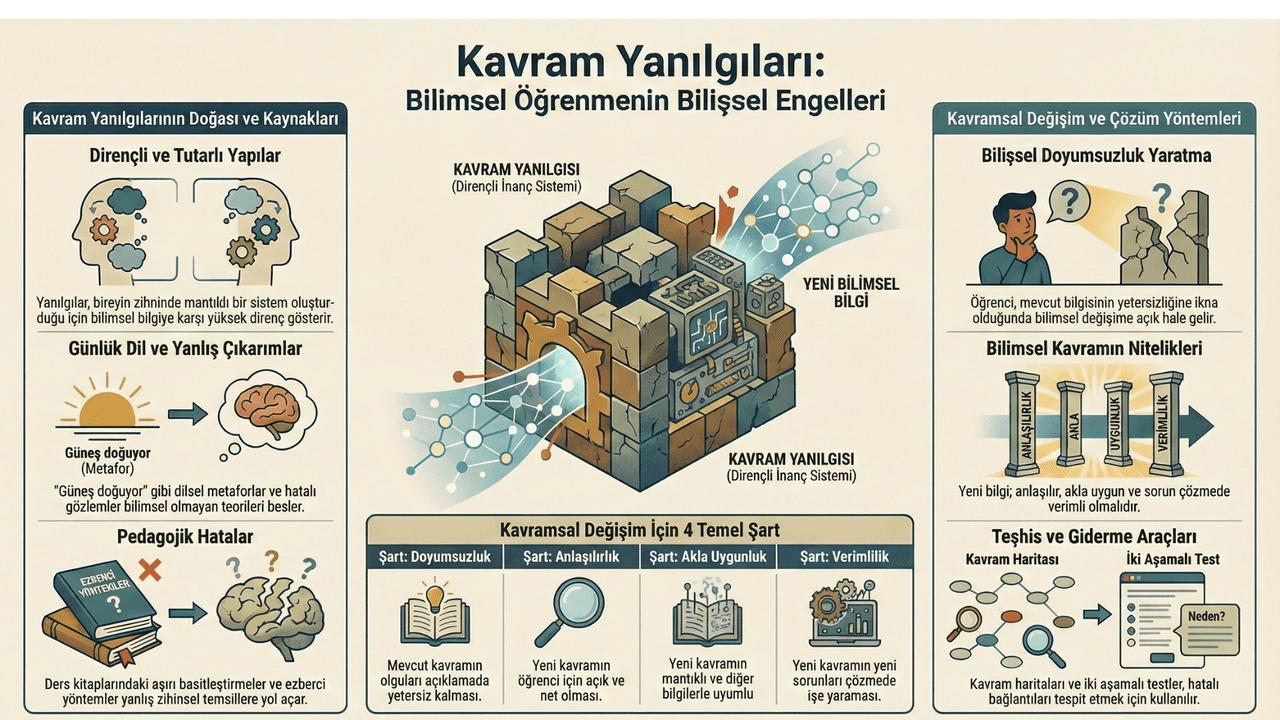
Conceptual Misconceptions in Scientific Learning(Generated by Artificial Intelligence)
Table: Examples of Scientific Conceptual Misconceptions and Their Correct Versions
The misconceptions listed in the table, such as those in physics, biology, and mathematics, stem from individuals’ tendency to perceive the world “sensory-based.” For example, observing that an object stops moving when we stop pushing it reinforces the misconception that “force is required for motion,” rather than accepting Newton’s Law of Inertia. Similarly, seeing plants grow roots into the soil may lead to the mistaken belief that plants “eat” the soil, whereas in reality, plants derive most of their mass from carbon atoms absorbed from the air.
Understanding and addressing conceptual misconceptions is one of the central focuses in education. Students’ prior concepts play a decisive role in interpreting new scientific knowledge, and misunderstandings significantly affect the learning process. Conceptual change models support learning by creating cognitive conflict between students’ existing misconceptions and scientific concepts. This approach encourages mental restructuring by making misconceptions explicit and comparing them with scientific concepts.【2】
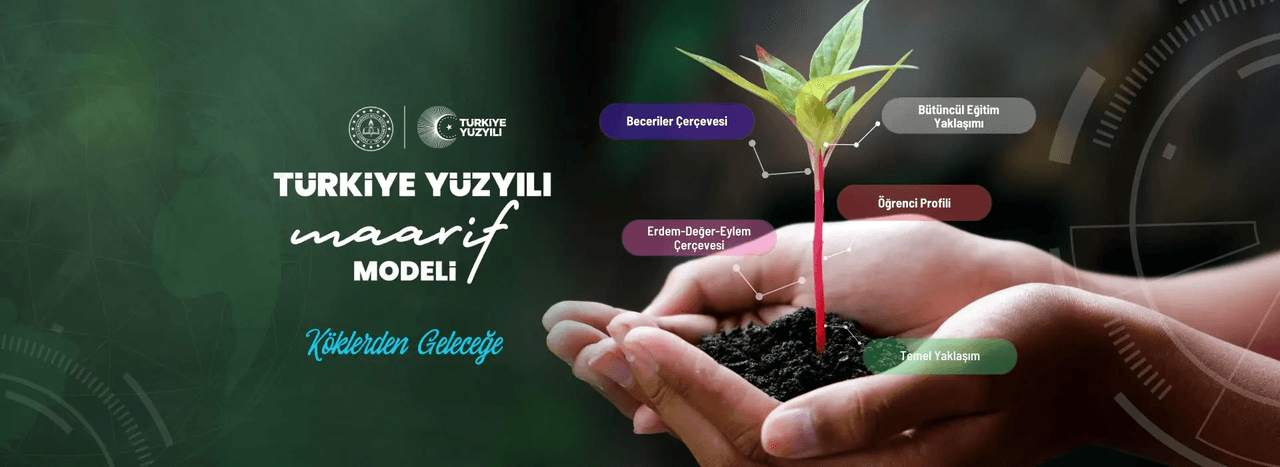
Student-Centered and Constructivist Approaches in the Türkiye Century Education Model(Republic of Türkiye Ministry of National Education)
Maarif Model instructional processes are built upon student-centered and constructivist approaches. Student-centered instruction allows learners to express their prior knowledge and conceptual misconceptions, which are then guided by teachers using conceptual change strategies.
Strategies include conceptual change texts, concept maps, analogies, predict-observe-explain activities, and structured discussions. These methods aim to help students recognize their erroneous concepts, compare them with scientific ones, and construct accurate conceptual frameworks.
Teacher education programs play a vital role in identifying conceptual misconceptions and developing effective remediation strategies. Conceptual change-oriented pedagogical approaches enable teachers to identify students’ incorrect concepts and replace them with scientific ones. The adoption of student-centered and constructivist learning models in curriculum design facilitates students’ progression from prior knowledge to scientific concepts through interactive strategies such as concept mapping, analogy, and prediction-observation.
Current research indicates that conceptual change studies must be addressed not only at the student level but also in the context of teaching materials, textbooks, and teacher professional development. Educational policies place scientific literacy and critical thinking at the center of both teaching and assessment processes.
Research on conceptual misconceptions extends beyond educational sciences and cognitive psychology, forming strong connections with philosophy, sociology, and linguistics.
The influence of language and cultural heritage on the perception of scientific concepts is essential for understanding the origins and spread of linguistic misconceptions. Furthermore, advances in artificial intelligence and machine learning are opening new horizons in conceptual misconception research by enabling the analysis of students’ cognitive models and offering personalized learning pathways.
Conceptual misconceptions emerge as a natural part of the learning process and can be encountered in any learning environment. Addressing these misconceptions is not limited to one-time interventions but involves lifelong learning, questioning, and conceptual development.
In education, it is essential to provide appropriate tools and learning environments that enable students to critically evaluate their existing thought structures. In this way, scientific reality can be understood not merely as a collection of memorized facts but as a dynamic, interrogable, and comprehensible system.
[1]
ScienceDirect, “Conceptual Change and Misconceptions in Science Education,” Studies in Science Education, accessed 29 January 2026, https://www.sciencedirect.com/science/article/pii/S095947522400118X
[2]
Ministry of National Education, “Conceptual Misconceptions and Solution Methods in Science Education,” National Education Journal, accessed 29 January 2026, https://dhgm.meb.gov.tr/yayimlar/dergiler/Milli_Egitim_Dergisi/162/basibuyuk-yazici.htm

Kavram Yanılgısı
(Yapay Zeka ile Oluşturulmuştur)
No Discussion Added Yet
Start discussion for "Conceptual Misconceptions" article
Origins and Cognitive Characteristics
Key Characteristics
Sources of Emergence
Everyday Language and Terminological Differences
Errors in Teaching Materials
Teaching Methods
Students’ Personal Observations and Incorrect Inferences
Inadequacy of Prior Knowledge Structures
Conceptual Change Theory
Remediation Strategies
Examples of Conceptual Misconceptions
Future Directions and Educational Policies
Interdisciplinary Fields
A Continuous Process of Learning and Development