
 Recently Added:
This article was automatically translated from the original Turkish version.
Iran Protests (December 2025) are a series of economic-based protests and demonstrations that began on 28 December 2025 following a record depreciation of Iran’s national currency, the rial, against the US dollar, and spread across various cities of the country, primarily Tehran, between 28–31 December 2025. The protests initially started with shopkeepers and merchants closing their businesses and shutting their shutters. In the following days, they expanded to include participation from university students and groups in different urban centers.
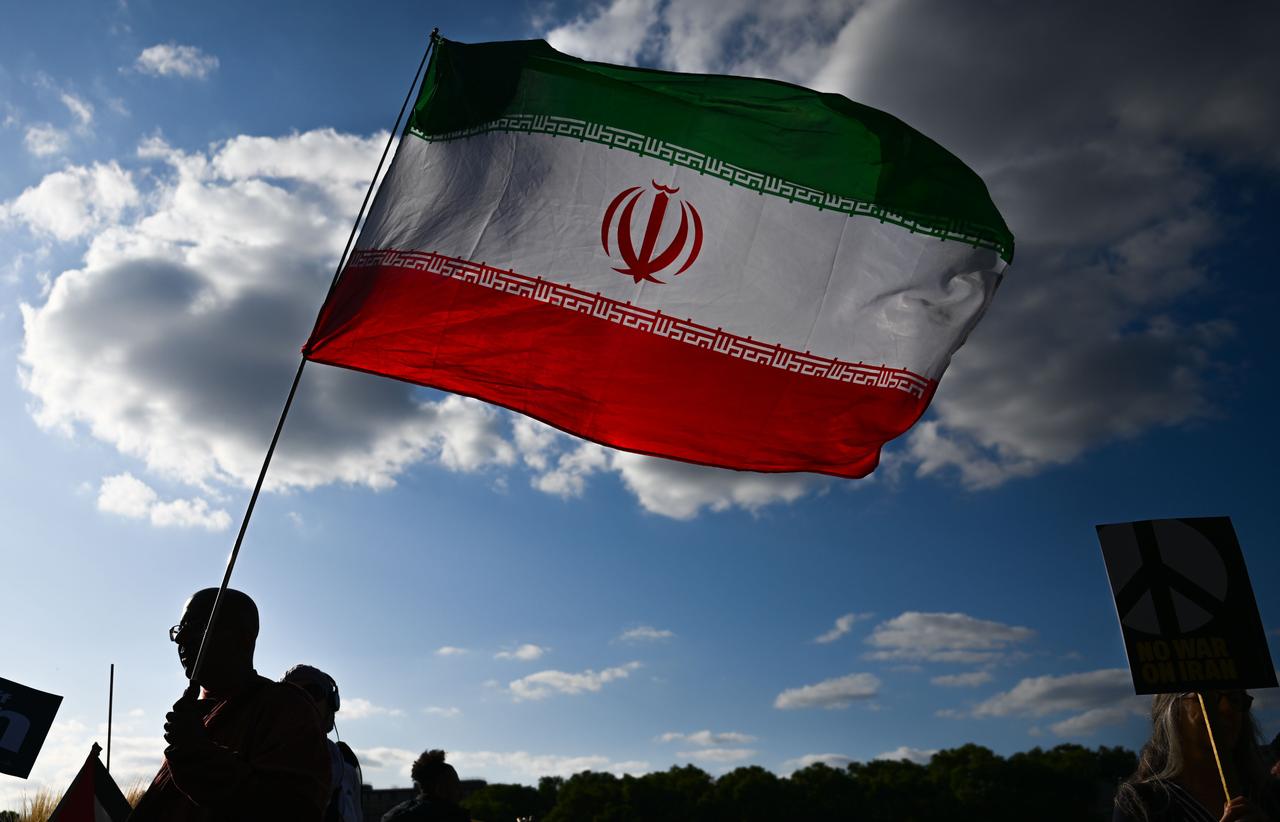
Flag of Iran – (Anadolu Ajansı)
In the final days of December 2025, the exchange rate of the Iranian rial against the US dollar reached unprecedented levels. On the day the protests began, the rial was trading at approximately 1.42 million rials per US dollar.
Official statistics for December 2025 reported an annual inflation rate of 42.2%. During the same period, food prices rose by 72% compared to the same month of the previous year, while prices for health and medical products increased by 50%. It was also reported that the inflation rate had risen by 1.8 percentage points compared to November 2025. During the initial phase of the protests, some merchants were reported to have temporarily suspended commercial activities.
In September 2025, certain United Nations sanctions previously lifted were reinstated in Iran. These sanctions apply to areas including banking operations, foreign trade, and foreign exchange transactions.
The protests began on 28 December 2025 in the capital due to a rapid increase in foreign exchange rates and worsening economic conditions. The initial demonstrations expressed public frustration over the currency’s depreciation and deteriorating living conditions.
On 29 December 2025, protests became visibly evident in commercial areas. It was reported that businesses around the Grand Bazaar and its surroundings, as well as technology and mobile phone sales centers in the Jomhouri district, had shut their shutters. Alongside merchant strikes, crowds in some areas were dispersed by security forces.
On 28–29 December 2025, it was reported that rapid response units and specialized security forces were deployed in areas where protests intensified.
On 30 December 2025, protests expanded to various neighborhoods and streets across Tehran. Demonstrations were reported in multiple areas, including Shush, Javadiyeh, Mellat Street, and the vicinity of the Grand Bazaar. On the same day, merchants kept their shops closed and public gatherings continued on the streets. It was reported that security forces had implemented intensive precautions along Tehran’s main arteries and commercial centers.
On the third day of the protests, it was confirmed that demonstrations were no longer confined to the capital. As of 30 December 2025, protests and gatherings were verified in cities including Isfahan, Shiraz, Mashhad, Kermanshah, Yazd, Zanjan, Hamedan, Karaj, Malard, and Kashan. In some cities, marches were held on main avenues, while in other areas, security forces intervened to disperse crowds. On 31 December 2025, it was reported that protests continued in many cities.
On 30 December 2025, protests extended to university campuses in the capital. Students from Tehran University, Sharif University of Technology, Khaje Nasir al-Din Tusi University, Shahid Beheshti University, Amirkabir University, Iran University of Science and Technology, Allameh Tabataba’i University, and University of Science and Culture organized marches and protests. Gatherings occurred within and around university campuses, and brief tensions were reported between students and security personnel at some institutions.
On the same day, it was reported that protests had also spread to universities outside the capital. Sources confirmed that students from Isfahan University of Technology and Yazd University participated in the demonstrations. Students at these universities were reported to have held marches on campus and chanted various slogans.
On 29–30 December 2025, in response to the ongoing protests, official statements were issued by Iran’s executive, legislative, and judicial branches.
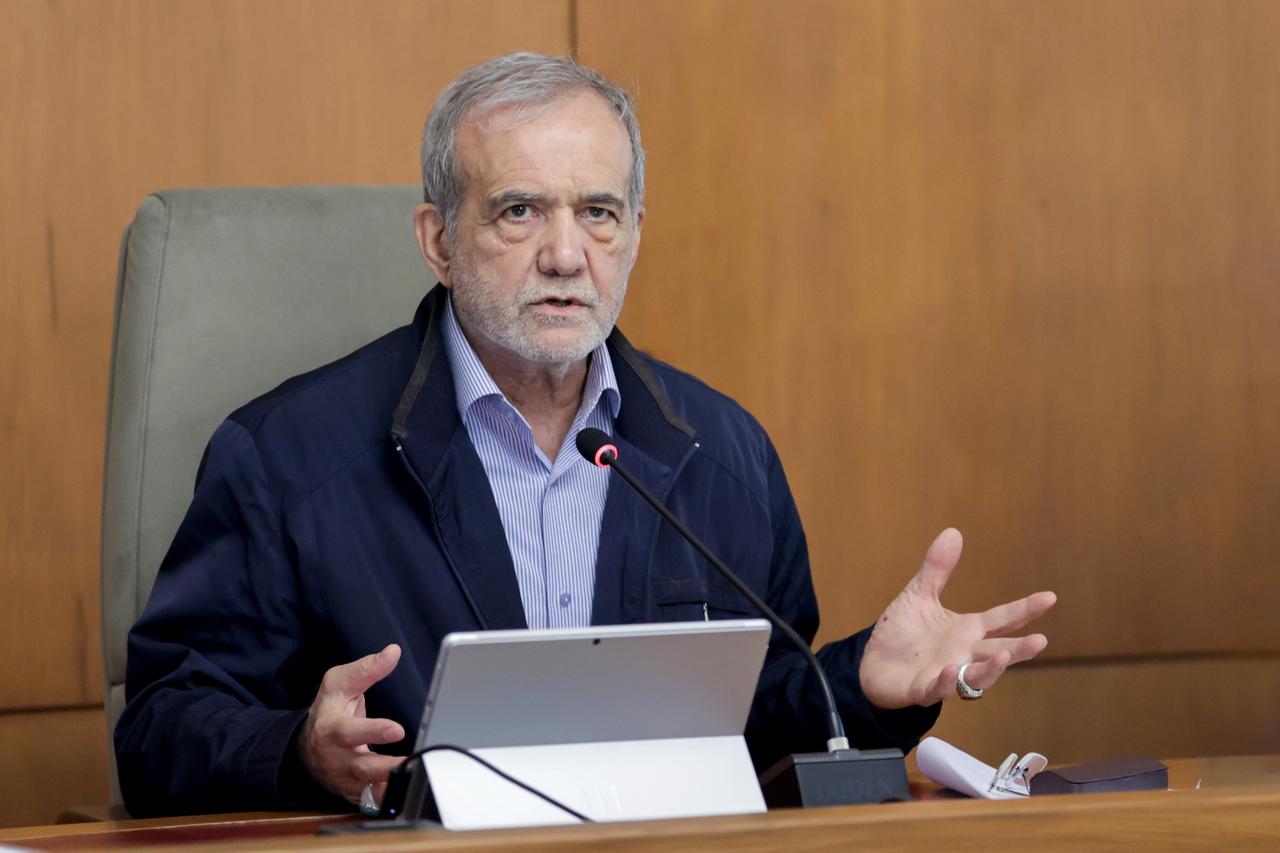
Massoud Pezeshkian – (Anadolu Ajansı)
Massoud Pezeshkian, in his statements regarding the protests, emphasized the public’s living conditions. Pezeshkian stated, “The people’s livelihood is my daily concern,” and announced that he had tasked the Minister of Interior with listening to protesters’ legitimate demands through dialogue with their representatives: “The government will act with full force to resolve problems and respond responsibly.” He also indicated that the government had placed reforms in the monetary and banking system and measures to protect the public’s purchasing power on its agenda.
Iran Government Spokesperson Fatemeh Mousavi, during a press conference on 30 December 2025, addressed the protests by saying, “We see, hear, and officially acknowledge the protests, their hardships, and crises.” Mousavi added, “Even if voices are loud, the government will listen patiently, because we believe our people have shown sufficient patience.”
Speaker of the Iranian Parliament Mohammad Bagher Ghalibaf, in a speech in the parliament, referred to the protests and asserted that malicious actors were attempting to transform public demands into violence and chaos. Ghalibaf stressed that public grievances regarding living conditions must be addressed with a sense of responsibility.
Spokesperson for the Judiciary, Asgar Jangir, in his statement on the protests, emphasized the need to avoid actions that could provide a pretext for exploitation by enemies, and called for demands to be expressed through legal channels and accompanied by concrete solutions. Jangir noted that unauthorized street protests lack legal standing.
During the period of protests, on 30 December 2025, official announcements declared a public holiday in 21 provinces of Iran due to severe cold weather conditions. According to information cited by Fars News Agency, provincial authorities announced that on Wednesday, 31 December 2025, schools, universities, banks, and certain government institutions would be closed.
The provinces declared on holiday were: Tehran, Hamedan, Qom, Alborz, Markazi, Yazd, Lorestan, North Khorasan, Razavi Khorasan, Kermanshah, Kurdistan, Ardabil, Zanjan, Ilam, Kerman, Kohgiluyeh and Boyer-Ahmad, Fars, Chaharmahal and Bakhtiari, East Azerbaijan, Mazandaran, and Gilan. It was also reported in the same sources that Iran has a total of 31 provinces.
According to the announcements, educational institutions, higher education establishments, banks, and various public offices suspended operations for one day under the official holiday. During the same period, it was reported that protests continued in the capital Tehran and some provincial centers, with security forces maintaining intensive precautions and continuing measures aimed at preserving public order.
Al Jazeera. "Iran’s President Calls on Govt to Hear Legitimate Demands of Protesters." Al Jazeera, December 30, 2025. Accessed December 31, 2025.
Al Jazeera. "Protests in Iran Spread amid Deep Discontent over Economic Duress." Al Jazeera, December 31, 2025. Accessed December 31, 2025.
Anadolu Ajansı. "Iran’s President Pledges Economic Reforms, Calls for Dialogue with Protesters." Anadolu Ajansı, December 30, 2025. Accessed December 31, 2025.
Anadolu Ajansı. "Iran’s President Vows ‘Severe’ Response to Any ‘Aggression’ after Trump’s Threat." Anadolu Ajansı, December 31, 2025. Accessed December 31, 2025.
Anadolu Ajansı. "İran’da Gösteriler Sürerken, 21 Eyalette Soğuk Hava Gerekçesiyle Resmî Tatil İlan Edildi." Anadolu Ajansı, December 30, 2025. Accessed December 31, 2025.
BBC News. "Iran Protests Spread as Currency Hits Record Low." BBC News, 2025. Accessed December 31, 2025.
CNN. "Iran Protests Spread as Currency Hits Record Low." CNN, December 29, 2025. Accessed December 31, 2025.
Iran International. "Third day of Iran protests marked by multiple arrests, attack on students." Iran International, December 30, 2025. Accessed December 31, 2025.
National Council of Resistance of Iran (NCRI). "Iran’s Bazaar Uprising Enters Third Day, Joined by Widespread University Protests and Clashes in Tehran." NCRI, 2025. Accessed December 31, 2025.
Iran Protests are a wave of demonstrations that began on December 28, 2025 in Tehran in response to a currency crisis and rising cost of living, quickly spreading across the country. The protests were triggered by the Iranian rial’s decline to 1,390,000 rials against the US dollar, high inflation, rising unemployment, and the economic hardship caused by international sanctions.
Protests began on 28 December 2025 with shopkeepers closing their stores in the Tehran Grand (Covered) Bazaar and soon spread to all 31 provinces and hundreds of cities in the following days. The demonstrations included not only economic demands but also expressions of discontent over social conditions, communication restrictions, and state policies.
According to the latest report published by the US-based Human Rights Activists News Agency (HRANA) on 21 January 2026, 4,519 people lost their lives and 26,314 were arrested nationwide during the events. Ibrahim Azizi, Chairman of the National Security and Foreign Policy Commission of the Iranian Parliament, stated on 19 January 2026 that more than 3,700 police officers were injured during the protests.
During the protests, public buildings, bank branches, buses, mosques, and hospitals in many cities—including Tehran, Mashhad, Isfahan, Tabriz, Kermanshah, and Shiraz—suffered damage. The Iranian government declared a three-day national mourning period on 11 January 2026 due to losses among security forces. During the same period, internet access was blocked and social media and communication networks were restricted. As of 19 January 2026, the protests had largely ended and internet restrictions were lifted.
Iranian flag - (Anadolu Ajansı)
The protests in Iran began on 28 December 2025 in the Bazaar, Jomhuri, and Saadi districts of Tehran and rapidly spread nationwide. The initial actions, started by shopkeepers closing their stores, were joined in the following days by university students, workers, teachers, retirees, and individuals from various professional groups.
The demonstrations emerged against the backdrop of a deepening economic crisis throughout 2025, high inflation, and the rapid depreciation of the Iranian rial. By the final week of December 2025, the rial had fallen to 1.42 million against the US dollar, compared to approximately 820,000 during the same period a year earlier. According to official data, inflation in December 2025 rose to 42.2%, food prices increased by 72% compared to the previous year, and healthcare and medical product prices rose by 50%. Iranian officials attributed the cause of the protests to “economic pressures, inflation, and currency fluctuations.”
President Masoud Pezeshkian, in a speech before the Parliament on 28 December 2025, highlighted budgetary imbalances and posed this question to lawmakers: “They tell me I impose too many taxes and that I must raise salaries. So tell me, where can I find this money?” In another statement on 30 December 2025, Pezeshkian said he had “ordered the Minister of Interior to engage in dialogue with representatives of the protesters and listen to their legitimate demands.” The government, in a statement on On the third day of the protests, acknowledged “We see, hear, and officially recognize the protests, crises, and difficulties.” Despite these statements, the protests did not subside, and security measures were intensified in many cities, especially in Tehran.
The protests quickly spread beyond Tehran to cities such as Isfahan, Shiraz, Mashhad, Kermanshah, Yazd, Hamadan, Karaj, and Zanjan, where demonstrations were held. In the following days, fatalities occurred, and in some areas, armed clashes broke out between security forces and protesters.
Factors deepening the economic crisis included "US and Western sanctions, nuclear sanctions reimposed by the United Nations in September 2025, energy crisis, severe water shortages, and infrastructure deficiencies." It was reported that dams supplying water to major cities, including the capital Tehran, were “nearly empty.” Iranian state media attributed the economic problems to “sanctions and currency depreciation” and emphasized that the protests were limited to economic demands.
President Pezeshkian announced plans for sweeping reforms in the monetary and banking system to address the economic crisis. In a social media statement, he said: “We have major steps on our agenda to reform the monetary and banking system and protect the public’s purchasing power.”
The protests in Iran began on 28 December 2025 in the capital Tehran. The initial actions were launched by mobile phone vendors and shopkeepers in commercial areas around Republic Avenue and the Tehran Grand Bazaar. The trigger was the rapid depreciation of the Iranian rial and instability in foreign exchange rates. Shopkeepers stated they could no longer conduct business due to rising prices.
These actions, which began in Tehran’s commercial districts, spread toward the city center within the day. Security forces used tear gas to disperse crowds. Numerous individuals were arrested during the events. Slogans chanted during the protests included “Work, bread, justice” and “Do not fear, we are together.” After the protests began, security forces were deployed in central Tehran to disperse crowds. That evening, videos shared on social media showed large numbers of protesters gathered at Ferdowsi Square and surrounding areas. Tehran police intervened, and clashes occurred in some districts. Iranian Government Spokesperson Fatemeh Mohajerani stated during this period: “We are monitoring, listening to, and officially recognizing the protests, crises, and difficulties.”
On 29 December 2025, demonstrations began spreading beyond Tehran. On the same day, similar actions took place in cities such as Isfahan, Yazd, Kermanshah, and Hamadan. The protests continued with road closures and mass store shutdowns in some areas.
On the second day of protests, state television and local news agencies provided limited coverage. However, videos shared on social media showed large crowds in central Tehran chanting slogans and confronting security forces. Fars News Agency reported the developments as: “Some protesters began throwing stones at provincial governorates, mosques, the Martyrs Foundation, municipal buildings, and banks.” In response, security forces increased patrols around Tehran and the bazaar area. Iranian police announced that some individuals involved in the incidents had been identified as “ringleaders” and arrested.
As of 30 December 2025, protests had spread beyond Tehran. Demonstrations were reported in provinces including Isfahan, Yazd, Kermanshah, Shiraz, Hamadan, Lorestan, Ilam, and Fars. The events grew as different segments of society joined following the commercial strikes in Tehran.
Iran’s official news agency IRNA reported that the protests began as “peaceful demonstrations,” but in some areas, “incidents violating public order” occurred. Judicial Authority of Iran Spokesperson Asgar Jahanpour called on the public to “exercise moderation” and stated: “Street protests conducted without legal permits have no legal standing. The legitimacy of a protest is only possible if conducted within the rules and permits prescribed by law. I urge citizens to exercise moderation and common sense.”
The first fatalities occurred on December 31, 2025. The provincial authorities confirmed the deaths of a young entrepreneur and a security officer in the city of Hamadan. Deputy Political and Security Official of the province, Hamzeh Amraei, stated regarding the incident: “This death is ‘suspicious’ and was carried out by ‘hostile elements’ to portray Iranian authorities negatively in the media.”
During the same period, it was reported that a 17-year-old youth was shot and killed in the city of Qom. Senior security official Morteza Heydari used the term “hostile elements” in reference to the incident: “A 17-year-old child was shot and killed... hostile elements are behind this incident.”
In Malekshahi district of Ilam province, a member of the Islamic Revolutionary Guard
Iran’s economic protests, which began on December 28 2025 at the Tehran Covered Bazaar, have entered their ninth day as of January 5 2026. According to a report published by the Iran Human Rights Activists News Agency (HRANA), the protests have spread to 27 of the country’s 31 provinces and have occurred at a total of 257 different locations. The primary cause of the protests has been reported as the sharp depreciation of the Iranian rial against the US dollar and the resulting rise in the cost of living. The Iranian currency has depreciated to 1.39 million rials per US dollar.
According to HRANA’s January 5 update, a total of 29 people have been killed in the protests, including 27 protesters and 2 members of security forces. The number of injured has been reported as 64, and 1203 people have been arrested. The report indicates that most injuries were caused by plastic and pellet bullets. The Fars News Agency reported that 250 police officers and 45 Basij militiamen among the security forces were wounded.
Iranian authorities have not released any official figures regarding deaths or injuries. The protests have been reported to have spread beyond Tehran, particularly intensifying in the western regions of the country. In Tehran, protests have partially decreased in recent days, but demonstrations continue in other major cities. Most of the actions in the capital have taken place in the northeastern and northwestern districts of the city.
The HRANA report states that students, workers, and civilians aged between 16 and 45 have participated in the protests. It also reports that protests have been organized at 17 universities and that university communities have engaged in solidarity actions.
Head of the Iranian Judiciary Gholam-Hossein Mohseni Ejei, in a statement on January 5 2026, declared that “no leniency will be shown” toward the protesters. Ejei stated that “those causing chaos and inciting unrest will be firmly punished within the framework of the law.”
Ejei affirmed that the government is open to listening to protesters who voice economic and social demands, but emphasized that legal proceedings against “those causing chaos and inciting unrest” will be expedited. He also alleged that the United States and Israel have “openly and clearly supported the unrest.”
In directives to judicial authorities, Ejei instructed that cases involving individuals armed with weapons or accused of other crimes during the protests must be “promptly and thoroughly examined and completed by prosecutors.” In this regard, provincial chief prosecutors have been ordered to establish special court divisions for these cases.
The IRGC Lorestan Command, in a written statement on January 5, declared that the “period of leniency has ended” toward those participating in the protests. The statement read: “The period of leniency has ended in light of damage to public property and private vehicles of citizens, the clear use of military weapons, and attempts to carry out projects aimed at causing death.”
In the statement, protesters were labeled as “agents of enemy states,” and it was asserted that “the instigators, organizers, and leaders of these anti-security movements will receive the punishment they deserve under the law and as swiftly as possible. All principal and operational elements of these conspiracies will be identified and apprehended down to the last individual.”
Head of the Iranian Police Organization Ahmad Reza Radan stated that the protests initially emerged from economic demands but later transformed into “street chaos.” Radan announced that in the past two days, individuals identified as “chaos leaders”—particularly those directing crowds via social media—had been arrested.
According to Radan, the majority of those arrested were young people who were released after warnings. However, he clarified that “those leading the protests remain in custody,” indicating that organizers are still being held.
Speaker of the Iranian Parliament Mohammad Bagher Ghalibaf, in a speech during an open session of the parliament on January 5 2026, stated that the people’s demands arising from economic hardship must be taken into account. However, Ghalibaf asserted that “foreign intelligence-linked elements attempting to hijack the protests must be firmly punished.”
Ministry of Foreign Affairs Spokesperson Ismail Baghai, during a weekly press briefing on January 5 2026, addressed the influence of Israel and the United States on the protests. Baghai stated that “Israel takes every opportunity to create division within Iran.” The spokesperson also characterized foreign officials’ statements regarding the protests as “statements inciting violence, terrorism, and murder.”
Chief of Staff of the Iranian Armed Forces General Abdolrahim Mousavi, in a statement on January 5 2026, asserted that the ongoing protests in the country are “part of a soft war aimed at destabilizing the nation.” Mousavi stated that these actions are part of a “soft war” strategy conducted by the United States and Israel.
Senior Iranian security official Ali Larizadeh, in a statement on January 5 2026, responded to U.S. comments regarding the events in Iran. Larizadeh warned that U.S. interference in Iran “would destabilize the Middle East and harm American interests.”
United Nations (UN) Secretary-General Antonio Guterres, on January 5 2026, expressed “deep sorrow over the loss of life and injuries” resulting from the protests in Iran. UN Spokesperson Stéphane Dujarric, in a press briefing in New York on behalf of the Secretary-General, stated that the UN “deeply regrets the loss of life and injuries resulting from clashes between security forces and demonstrators.”
Guterres urged Iranian authorities to “respect freedom of expression, the right to assembly, and the right to peaceful protest.” He added that “every individual must be allowed to protest peacefully and voice their grievances.”
The statement emphasized the “importance of all actors in Iran and the region avoiding actions that could escalate tensions or lead to instability.”
Al Jazeera. “Five Things You Need to Know About Protests in Iran.” Accessed January 6, 2026. https://www.aljazeera.com/news/2026/1/2/five-things-you-need-to-know-about-protests-in-iran-2
Al Jazeera. “Internet Disruption, Several Arrests Made as Iran Protests Continue.” Al Jazeera. Accessed January 6, 2026. https://www.aljazeera.com/news/2026/1/3/internet-disruption-several-arrests-made-as-iran-protests-continue
Al Jazeera. “Sporadic Protests in Tehran as Clashes Reported in Iran’s West.” Al Jazeera. Accessed January 6, 2026. https://www.aljazeera.com/news/2026/1/4/sporadic-protests-in-tehran-as-clashes-reported-in-irans-west
Anadolu Ajansı. “Protests Spread in Iran as Death Toll Reaches 20 with Nearly 1,000 Arrested: Report.” Accessed January 6, 2026. https://www.aa.com.tr/en/middle-east/protests-spread-in-iran-as-death-toll-reaches-20-with-nearly-1-000-arrested-report/3789765
Anadolu Ajansı. “İran Devrim Muhafızları: Protestoculara Bundan Sonra Müsamaha Gösterilmeyecek.” Accessed January 6, 2026. https://www.aa.com.tr/tr/dunya/iran-devrim-muhafizlari-protestoculara-bundan-sonra-musamaha-gosterilmeyecek/3790135
Anadolu Ajansı. “İran İnsan Hakları Aktivistleri Haber Ajansı: Gösterilerde Hayatını Kaybedenlerin Sayısı 29’a Yükseldi.” Accessed January 6, 2026. https://www.aa.com.tr/tr/dunya/iran-insan-haklari-aktivistleri-haber-ajansi-gosterilerde-hayatini-kaybedenlerin-sayisi-29a-yukseldi/3790748
Associated Press. “Iran Protests, Nuclear Tensions and the US: What to Know.” Accessed January 6, 2026.
United Nations News. “Iran: UN Urges Protection of Peaceful Assembly Amid Protests.” UN News. Accessed January 6, 2026. https://news.un.org/en/story/2026/01/1166705
United Nations News. “UN Chief Expresses Concern over Iran Protests, Urges Protection of Peaceful Assembly.” UN News. Accessed January 6, 2026.
On 6–7 January 2026, protests across Iran against economic grievances continued in numerous cities.
On 6 January 2026, in the city of Malikshahi in Ilam Province, violent clashes erupted between security forces and protesters. The unrest began following the funeral of two individuals who died on 4 January at the Imam Hussein Cemetery. After the funeral, a group of approximately 100 people began protesting with slogans and set fire to three bank buildings. During the clashes, two police officers were injured and one person was killed. On the same day in the same region, a police officer was fatally shot in an armed attack. The officer was wounded by direct gunfire during the Malikshahi protests and later died in the hospital to which he was transported.
Following the Saturday funeral in Malikshahi, armed protesters were reported to have continued demonstrations in the streets, chanting anti-government slogans. In the same incidents, three police officers were injured. New disturbances occurred around the hospital where the wounded were taken. In a hospital in the center of Ilam city, clashes between security forces and protesters disrupted healthcare services. According to local media, the unrest spread from the hospital building to surrounding streets.
President Masoud Pezeshkian ordered a “comprehensive investigation” into the events in Ilam. In response, a delegation from the Ministry of Interior was dispatched to the region. Additionally, Health Minister Mohammad Reza Zafarghandi launched a separate administrative inquiry into the incidents at the hospital.
Ilam city has been reported as one of the areas with the most intense protests in recent days. During the protests in the city, public buildings and infrastructure facilities were targeted, and damage was reported at several police stations.
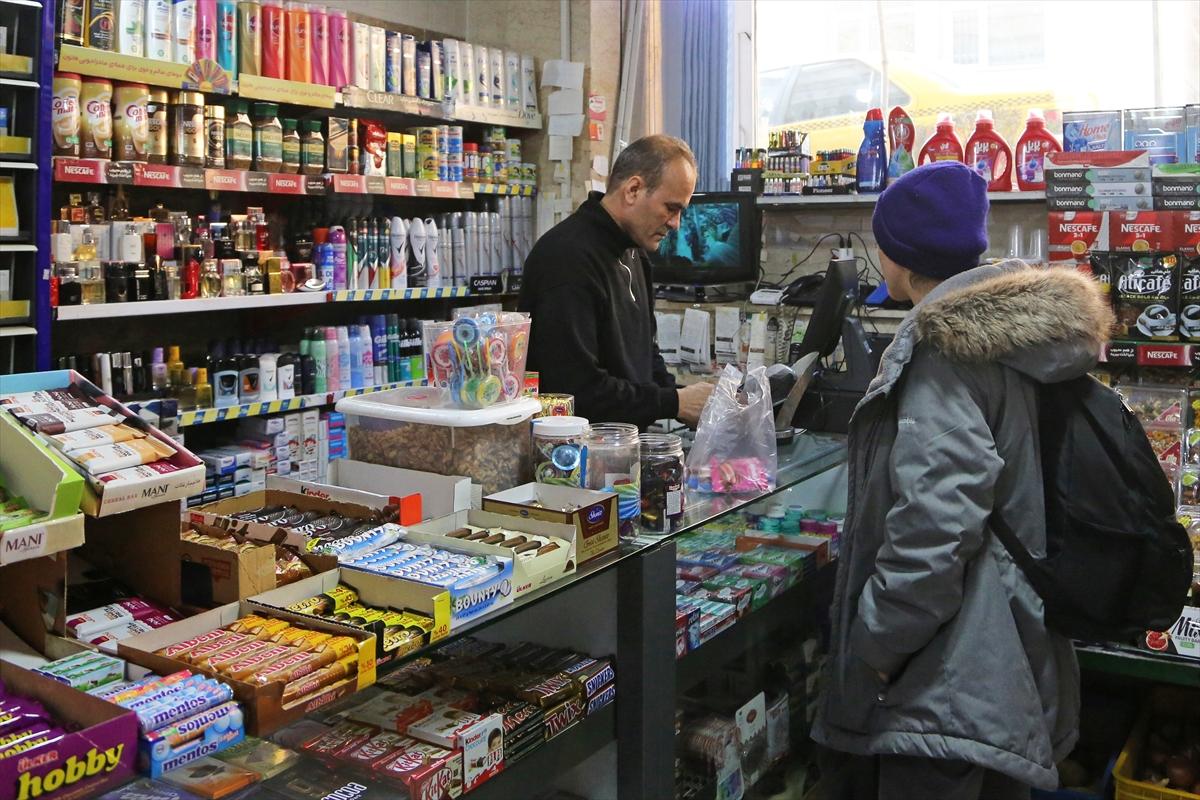
Daily life in Tehran, 7 January 2026 – (Anadolu Agency)
As of 6 January 2026, the number of deaths, injuries and arrests related to protests in Iran has increased. The Iran Human Rights Activists News Agency (HRANA), in its report, stated that 36 people have died in the protests, of whom 34 were demonstrators and 2 were security personnel. The report noted that protests occurred in 27 of 31 provinces, at a total of 285 locations, and that 2,076 people were arrested.
The majority of injuries were recorded as resulting from rubber and plastic bullets. According to HRANA data, tens of people were injured in the clashes. Iranian authorities have not issued an official statement regarding the dead or wounded. The semi-official Tasnim News Agency provided detailed figures on injuries to security forces as of 6 January. According to Tasnim, 568 police officers and 66 members of the Basij volunteer militia were injured during the protests. Tasnim reported that the injuries included two caused by live ammunition, 152 by shotgun pellets, and 11 by stabbings.
Head of Iran’s Judiciary, Gholamhossein Mohseni-Ejei, emphasized the importance of building cases against “provocateurs” involved in the protests. Ejei stated, “This will enable judicial proceedings to proceed more swiftly. The rapid prosecution of provocateurs involved in the incidents is a priority.”
Ejei also urged prosecutors and judges to strictly adhere to the law and to consider deterrent punishments. These remarks were interpreted as a signal that the judicial process for those arrested in the protests would be accelerated.
On 4 January 2026, President Masoud Pezeshkian announced that under the new budget, subsidized import exchange rates would be abolished, but that the resources generated from this measure would be used to support the population’s basic food needs.
The Iranian government decided to provide citizens with a digital credit of 10 million rials (approximately 7 US dollars) per month to alleviate economic pressure. Government spokesperson Fatemeh Mohajerani stated on state television: “Individuals will receive a monthly amount of one million toman per person into their accounts for four months”.
The program has been reported to cover the entire population and can only be used to purchase specific goods. The announcement also clarified that the purpose of the aid is to “reduce economic pressure on the public”.
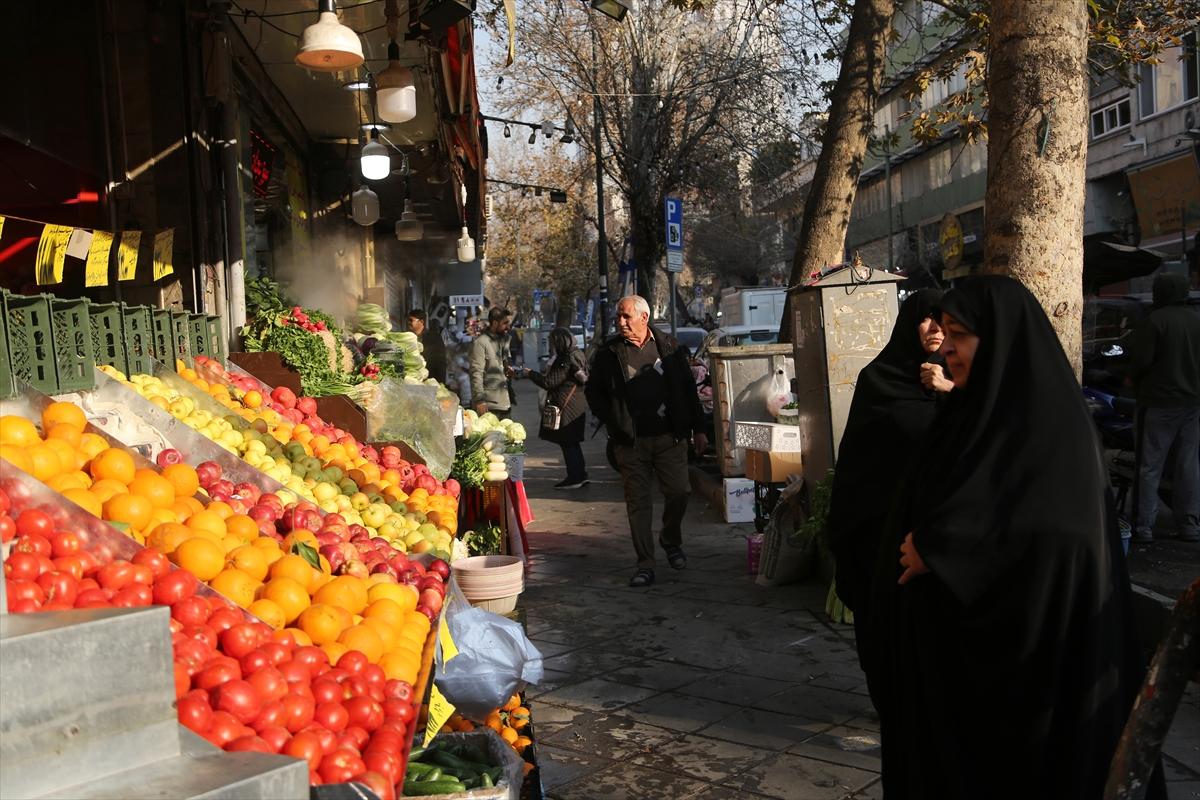
Daily life in Tehran, 7 January 2026 – (Anadolu Agency)
On 6 January 2026, Head of Iran’s Judiciary Gholamhossein Mohseni-Ejei announced during a meeting with security officials that a “rapid trial” process would be initiated for those arrested during the protests. Ejei requested that security units pay close attention to preparing files on “provocateurs”, emphasizing the importance of complete and accurate documentation to expedite judicial proceedings.
Ejei stated, “This will enable judicial proceedings to proceed more swiftly. The rapid prosecution of provocateurs involved in the incidents is a priority.”
In the same statement, Ejei underscored that prosecutors and judges must strictly comply with the law, adding, “Prosecutors and judges have been instructed to adhere to the law and consider deterrent punishments.” Ejei also issued orders that no delays or irregularities be permitted during investigations and trials. Following Ejei’s announcement, it was reported that Iran’s security forces would coordinate closely with the judiciary and begin implementing rapid trial procedures for detainees.
On the same date, Head of Judiciary Gholamhüseyin Mohseni-Ejei also declared, “This time we will show no mercy to the insurgents.”
On 7 January 2026, U.S. Senator Lindsey Graham made remarks on Fox News regarding the protests in Iran and the response by security forces. Graham addressed the Iranian leadership, saying, “Ayatollahs, you need to understand this—if you continue killing your people who are demanding a better life, Donald J. Trump will kill you.”
In the same remarks, Graham referred to the current situation in Iran, stating, “Change is coming to Iran” and “to free yourselves from this Nazi regime.” He also addressed the Iranian people directly, saying, “The Iranian people, help is on the way.”
Al Jazeera. “Protests Grow as Iran’s Government Makes Meager Offer Amid Tanking Economy.” Al Jazeera. Accessed January 7, 2026. https://www.aljazeera.com/news/2026/1/6/protests-grow-as-irans-government-makes-meager-offer-amid-tanking-economy
Anadolu Ajansı. “Police Officer Killed in Western Iran Amid Anti-Government Protests.” Accessed January 7, 2026. https://www.aa.com.tr/en/middle-east/police-officer-killed-in-western-iran-amid-anti-government-protests/3791617
Anadolu Ajansı. “US Senator Says Trump Would Kill Iran’s Supreme Leader If Protest Crackdown Continues.” Accessed January 7, 2026. https://www.aa.com.tr/en/americas/us-senator-says-trump-would-kill-iran-s-supreme-leader-if-protest-crackdown-continues/3792057
Anadolu Ajansı. “İran’daki Gösterilerde Çıkan Olaylarda Şu Ana Kadar 568 Polis ile 66 Besic Mensubu Yaralandı.” Accessed January 7, 2026. https://www.aa.com.tr/tr/dunya/irandaki-gosterilerde-cikan-olaylarda-su-ana-kadar-568-polis-ile-66-besic-mensubu-yaralandi/3791531
Asharq Al-Awsat. “Iranians Receive Monthly Payment Amid Economic Woes, Protests.” Accessed January 7, 2026. https://english.aawsat.com/world/5226275-iranians-receive-monthly-payment-amid-economic-woes-protests
In Iran, economic-based protests that began at the end of December 2025 have reached their 12th day as of January 8, 2026. The Iran Human Rights Activists News Agency (HRANA) has reported that protests are ongoing in all 31 provinces of the country. According to HRANA data, demonstrations have occurred at 348 different locations, resulting in the deaths of a total of 42 people, including 34 protesters and 8 security personnel. The agency also reported that 2,277 individuals were arrested during the 12-day period and that many others were injured.
Iran protests, January 8, 2026 - (New York Post)
The protests, which began over economic grievances, have spread to various cities across the country. Actions that started at Tehran’s Grand Bazaar quickly spread to cities such as Abadan, Tabriz, Shiraz, Kermanshah, Rasht, Borujerd, Kahriz, and Sistan-Baluchistan. The governor’s office in Gorgan was set on fire, and footage emerged showing protesters in Tehran setting police vehicles ablaze near the Settar Han Bridge. Two mosques in Tehran’s Gholhak and Sa’dat Abad neighborhoods were also set on fire. According to data from the Tesnim News Agency, a total of 568 police officers and 66 Basij members were injured during the demonstrations.
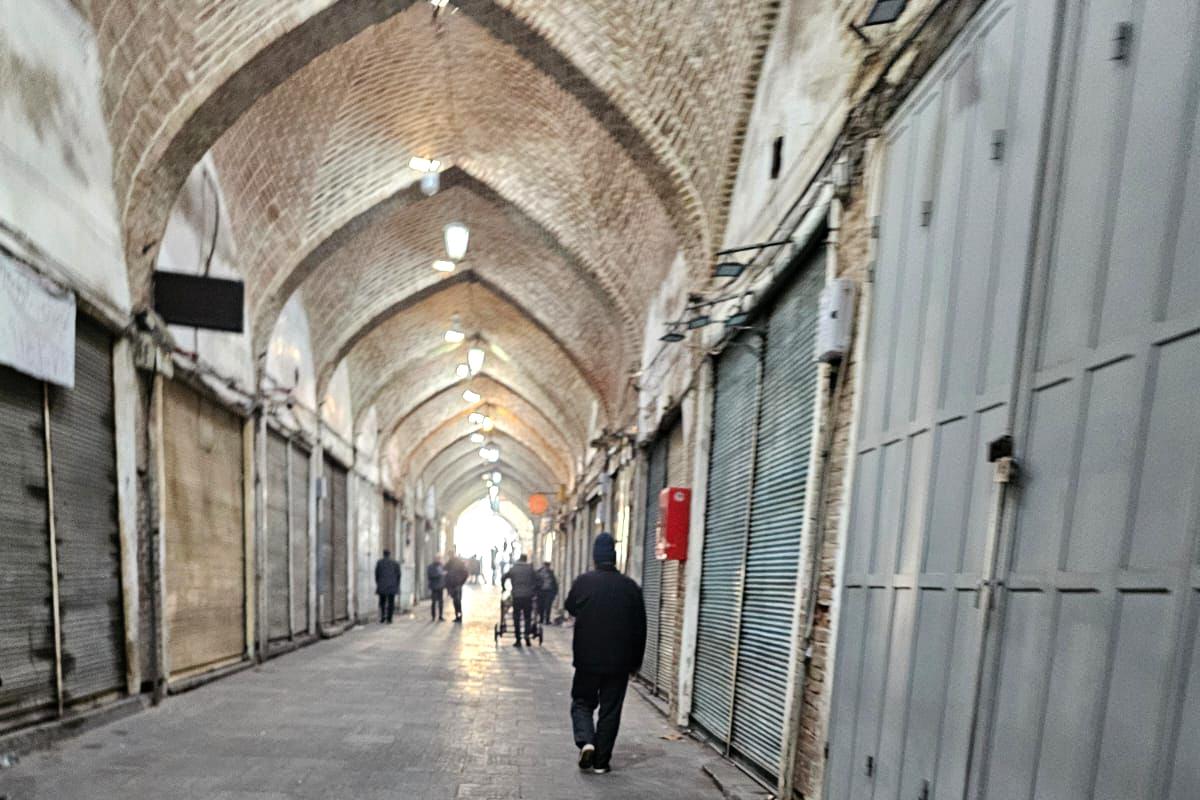
Tabriz Grand Bazaar on the 11th day of protests in Iran, January 7, 2026 - (Anadolu Agency)
On January 8, 2026, the Iranian Ministry of Foreign Affairs issued a written statement accusing the United States of “interfering in Iran’s internal affairs.” The statement declared that “the United States harbors hostility toward the Iranian people.”
The same statement referenced the Iranian Constitution, asserting that “peaceful protests are officially recognized and efforts are being made to address legitimate demands within the legal framework.”
The Iranian Ministry of Foreign Affairs accused the United States of inciting violence and terrorism through “economic and psychological warfare” by spreading misinformation. The Iranian government further emphasized that the country’s economic problems are a “consequence of U.S. sanctions.”
London-based internet monitoring organization NetBlocks reported on January 8, 2026, that internet access had been cut across the entire country of Iran. The organization stated that “live measurements show Iran is currently in the midst of a nationwide internet blackout.” Shortly after NetBlocks’ announcement, it was reported that telephone services had also been suspended nationwide.
It was confirmed that the internet disruptions were effective at the national level and in all provinces. In an assessment published on the morning of January 9, NetBlocks reported that Iran had been offline for 12 consecutive hours. The Iranian Students News Agency (ISNA), based on social media posts and user feedback, announced that serious disruptions and slowdowns in internet access had occurred nationwide.
According to network analytics data shared by Cloudflare, there have been “notable fluctuations” in Iran’s internet traffic. The data showed that internet usage volume had “fallen below normal levels” during certain time periods and recorded “sudden, short-term declines.”
The ISNA report noted that users experienced inconsistent connectivity and degraded service quality at different times of the day, and that the disruptions were not confined to any single region. According to NetBlocks and media sources, on the evening of the 12th day, widespread protests erupted in all provinces, and internet and telephone services were simultaneously cut off.
U.S. President Donald Trump made statements on January 8, 2026, regarding the ongoing protests in Iran. Trump stated that if the Iranian authorities killed protesters, Washington would “strike Iran very hard.” Appearing on the radio program The Hugh Hewitt Show, Trump assessed the situation in Iran, noting that “very large crowds have gathered and chaos has erupted.” While acknowledging that deaths had occurred during the protests, Trump did not offer a clear assessment of responsibility.
Trump used the following words on the program: “They are in a very bad situation. I also told them: If they start killing people—which they tend to do during uprisings, as they frequently instigate revolts—if they do this, we will strike them very hard.”
On the same day, U.S. President Donald Trump shared a video on the social media platform Truth Social regarding the protests in Iran. The video was produced by the Israeli-based Channel 13 Television. Trump used the following caption when sharing the video: “More than a million people took to the streets: Iran’s second largest city has fallen under the control of protesters, and regime forces have abandoned the city.”
The video included the statement: “The number of participants in the protests in Mashhad, Iran’s second largest city, exceeded one million.”
On January 8, 2026, U.S. Vice President JD Vance made statements regarding the protests in Iran during a press briefing at the White House. Vance stated that they had been closely monitoring the ongoing demonstrations in Iran. He said: “We support everyone who participates in peaceful protests and exercises their right to organize freely and make their voices heard.”
During the press briefing, Vance noted that the Iranian government has “many problems” and advised Tehran to sit down with the United States to discuss its nuclear program. He added that any steps the United States might take against Iran are “at the discretion of President Donald Trump.” Vance also stated: “We stand with everyone defending their rights around the world, including the Iranian people.”
On the night of January 8, 2026, the ongoing protests across Iran turned into violent actions. According to reports, the events that continued into the morning of January 9 occurred following appeals by Riza Pahlavi, whose father fled the country before the 1979 Revolution, and by separatist groups.
Violent incidents occurred during demonstrations in several cities, including Tehran. Videos shared on social media showed disorganized groups, some armed and masked, attacking and destroying private vehicles, motorcycles, metro stations, banks, fire trucks, and buses.
According to local sources, several municipal buses in the capital Tehran were set on fire by these groups. Iran’s state television reported that as a result of these incidents, casualties occurred in several cities and many people were injured. Details regarding the incidents and the identities of the groups responsible for the attacks remain unknown, although it was reported that security forces have increased their measures in affected areas.
During the events in Tehran on the night of January 8, numerous public and private buildings were targeted by some protest groups. Tehran Mayor Ali Reza Zakani stated in a declaration that “protesters destroyed buses, fire trucks, 42 vehicles, 24 homes, 25 mosques, 2 hospitals, and 26 banks, among other public facilities.”
In his statement, Zakani also claimed that “foreign enemies are using Tehran’s children and youth to damage public property.”
In the events that erupted in Iran’s capital Tehran, it was reported that numerous buses and ambulances, along with 24 homes, 25 mosques, 2 hospitals, and 26 banks, were set on fire. These incidents demonstrated that widespread damage had been inflicted on public and private property.
Iranian state television reported that during the nationwide events on the night of January 8, casualties and numerous injuries occurred. Videos shared on national media and social media platforms showed armed and masked groups attacking metro stations, public buildings, banks, and vehicles.
During protests on the night of January 8 in the city of Esfarayen, located in North Khorasan province, a prosecutor lost his life. The North Khorasan Prosecutor’s Office stated that “provocateurs from various regions set fire to a container containing Prosecutor Ali Akbar Hozeyinzadeh and security personnel.”
During the incident, protesters prevented fire rescue teams from intervening, resulting in the prosecutor and the security personnel with him being burned to death.
The North Khorasan Prosecutor’s Office stated that the investigation is ongoing and that efforts are underway to apprehend those involved in the attack. Judge Gholam Hossein Mohseni Ejei, head of the Judiciary, issued a message of condolence following the prosecutor’s death.
Al Jazeera. “Iran Warns Protesters, Foreign Foes as Unrest Persists.” Al Jazeera. Accessed January 8, 2026. https://www.aljazeera.com/news/2026/1/7/iran-warns-protesters-foreign-foes-as-unrest-persists
Anadolu Ajansı. "Police Officer Killed in Protests Near Tehran, Iranian Media." Accessed January 8, 2026. https://www.aa.com.tr/en/middle-east/police-officer-killed-in-protests-near-tehran-iranian-media/3793277
Anadolu Ajansı. "Trump, İran’daki Gösterilerde İnsanların Öldürülmesi Halinde Ülkeyi ‘Çok Sert Vurmakla’ Tehdit Etti." Accessed January 9, 2026. https://www.aa.com.tr/tr/dunya/trump-irandaki-gosterilerde-insanlarin-oldurulmesi-halinde-ulkeyi-cok-sert-vurmakla-tehdit-etti/3794132
Anadolu Ajansı. "İran İnsan Hakları Aktivistleri Haber Ajansı: Gösterilerde Hayatını Kaybedenlerin Sayısı 42’ye Yükseldi." Accessed January 9, 2026. https://www.aa.com.tr/tr/dunya/iran-insan-haklari-aktivistleri-haber-ajansi-gosterilerde-hayatini-kaybedenlerin-sayisi-42ye-yukseldi/3794281
Anadolu Ajansı. “Buildings in Iran’s Capital Set on Fire as Demonstrations Spread Nationwide.” Accessed January 9, 2026. https://www.aa.com.tr/en/middle-east/buildings-in-iran-s-capital-set-on-fire-as-demonstrations-spread-nationwide/3794387
Anadolu Ajansı. “Day 12 of Iran Protests Sees Large-Scale Demonstrations Plus Internet, Phone Service Cutoffs.” Accessed January 9, 2026. https://www.aa.com.tr/en/middle-east/day-12-of-iran-protests-sees-large-scale-demonstrations-plus-internet-phone-service-cutoffs/3794214
Anadolu Ajansı. “Death Toll Rises to 38 amid Protests in Iran: Report.” Accessed January 8, 2026. https://www.aa.com.tr/en/middle-east/death-toll-rises-to-38-amid-protests-in-iran-report/3792965
Anadolu Ajansı. “Iran Condemns US Interference in Its Internal Affairs amid Protests.” Accessed January 8, 2026. https://www.aa.com.tr/en/world/iran-condemns-us-interference-in-its-internal-affairs-amid-protests/3792955
Anadolu Ajansı. “İran Reportedly Facing Internet, Phone Service Cutoff.” Accessed January 9, 2026. https://www.aa.com.tr/en/middle-east/-iran-reportedly-facing-internet-phone-service-cutoff/3794120
Anadolu Ajansı. “İran’da Gösterilerin Şiddetlenmesiyle İnternet Kesilirken Dünkü Olaylarda Can Kayıplarının Yaşandığı Bildirildi.” Accessed January 10, 2026. https://www.aa.com.tr/tr/dunya/iran-da-gosterilerin-siddetlenmesiyle-internet-kesilirken-dunku-olaylarda-can-kayiplarinin-yasandigi-bildirildi/3794671
Anadolu Ajansı. “İran’daki Gösteriler 12. Gününde Çeşitli Kentlerde Devam Ediyor.” Accessed January 9, 2026. https://www.aa.com.tr/tr/dunya/iranda-gosteriler-12-gununde-cesitli-kentlerde-devam-ediyor/3794114
New York Post. “Mass Protests Continue in Iran as Internet Access and Phone Lines Are Cut Off.” YouTube video. Accessed January 9, 2026. https://www.youtube.com/watch?v=ez72Zepxsic
Iranian leader Khamenei, during a meeting with residents of Qom city on the anniversary of the uprising that began in Qom in January 1977 against the overthrown Shah regime, offered assessments regarding the unrest that started in the country due to economic problems and intensified on the night of January 8.
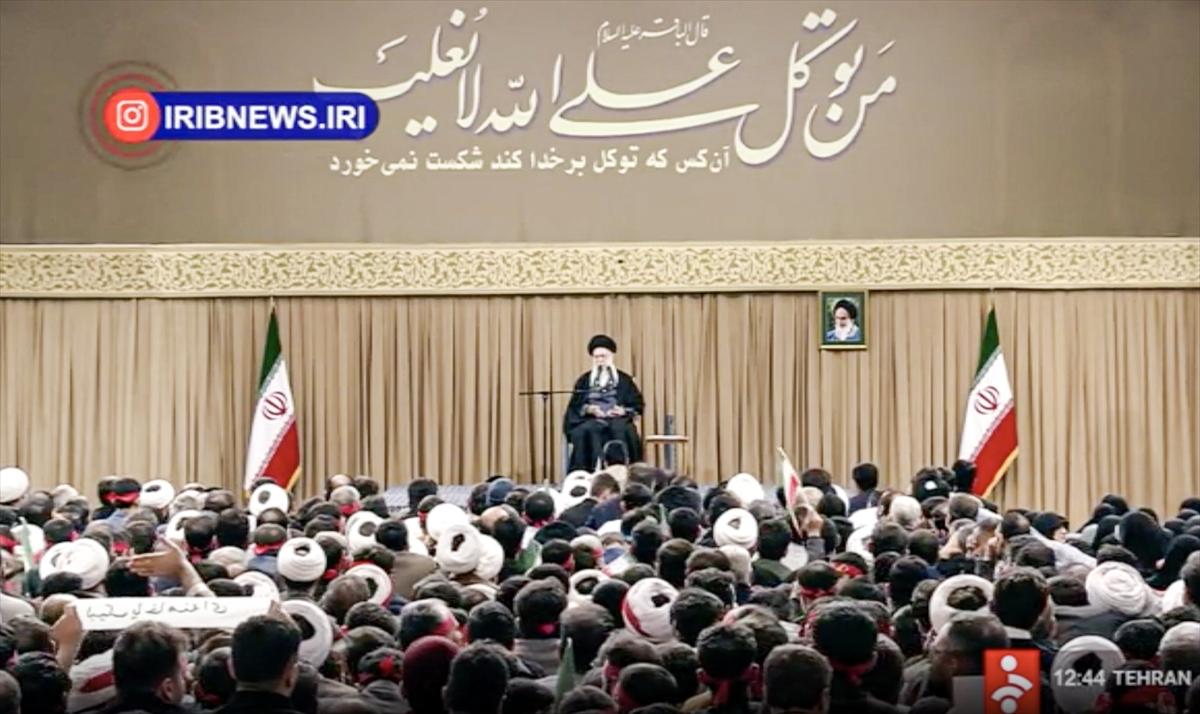
Iranian leader Ali Khamenei addresses the public, January 9, 2026 – (Anadolu Agency)
Khamenei, referring to U.S. President Trump’s threats against the Iranian government amid the demonstrations, stated: “Last night in Tehran, a group of vandals destroyed public property in an attempt to please the U.S. president. If he can manage it, let him govern his own country.”
Reminding the public that over 1,000 people lost their lives in the June 2025 attacks by Israel and the United States on Iran, Khamenei said: “This man said, ‘I gave the order; I commanded during the war.’ Thus, he admitted that his hands are stained with the blood of Iranians. Then he claims, ‘I am a supporter of Iran.’ A handful of inexperienced and thoughtless people believe him and act according to his wishes.” Khamenei affirmed that Iran will not show leniency toward agents supported by foreign powers, adding: “My people do not tolerate mercenaries working for foreigners. Whoever you are, if you serve as a mercenary for a foreign power, that country will regard you as rejected.”
That individual, who arrogantly judges the entire world, must also know that history’s tyrants and arrogant powers—Pharaoh, Nimrod, Reza Khan, Mohammad Reza, and others—fell precisely at the peak of their pride. This one will also fall.
Khamenei declared: "Everyone must know that the Islamic Republic came to power through the blood of hundreds of thousands of honorable people and will not retreat in the face of saboteurs."
According to Iranian state television, the Secretariat of the Supreme National Security Council issued a statement regarding the protests in Iran. The statement emphasized that the Iranian Security Forces “will thwart the plans of the Zionist regime and its godfather, the United States,” and declared: "Security forces and judicial authorities will show no leniency whatsoever toward saboteurs."
The statement stressed that those complaining about economic conditions must not engage in behavior that causes economic harm. It also emphasized that the Iranian people will not accept an atmosphere of insecurity in their country. The statement pointed out that Israel has maintained a hostile stance toward the Iranian people since the 12-day conflict. It added: “Although recent events originated from market instability, they have been transformed into a scenario orchestrated by the Zionist enemy to plunge the country into insecurity.”
Trump’s recent remarks demonstrate that Israel and the United States are coordinating efforts to plunge the Iranian people into chaos. Thanks to their unity, the Iranian people defeated their enemy in the 12-day war. Today, we will defeat them in the same manner.
The statement also addressed the burning of Iranian flags and statues of Qasem Soleimani in some Iranian cities, stating: “No person will allow their flag to be set on fire. No Iranian will permit the statue of Qasem Soleimani to be burned.”
The U.S.-based Iran Human Rights Activists News Agency (HRANA) published updated figures on January 9, 2026, regarding the 13-day-long protests across Iran. According to the report, a total of 65 people have been killed in protests that have spread to 31 provinces nationwide. Of these individuals, seven are under 18 years old, 50 are protesters, and 15 are members of security forces.
Iran protests, January 9, 2026 – (Associated Press)
The report states that 2,311 people have been arrested nationwide. It further notes that dozens have been injured in ongoing incidents, with these injuries “largely resulting from the impact of irrational and plastic bullets.” As of January 9, Iranian authorities have made no official statement regarding those killed or injured in the demonstrations.
Anadolu Ajansı. "İran İnsan Hakları Aktivistleri Haber Ajansı: Gösterilerde Ölenlerin Sayısı 65’e Yükseldi." Accessed January 10, 2026. https://www.aa.com.tr/tr/dunya/iran-insan-haklari-aktivistleri-haber-ajansi-gosterilerde-olenlerin-sayisi-65e-yukseldi/3795424
Anadolu Ajansı. “İran Lideri Hamaney, Bazı Grupların Trump’ı Memnun Etmek İçin Kamu Mallarını Tahrip Ettiğini Söyledi.” Accessed January 10, 2026. https://www.aa.com.tr/tr/dunya/iran-lideri-hamaney-bazi-gruplarin-trumpi-memnun-etmek-icin-kamu-mallarini-tahrip-ettigini-soyledi/3794737
Associated Press. “Iran TV Shows Video of Street Fires in Tehran During Protests.” YouTube video. Accessed January 10, 2026. https://www.youtube.com/watch?v=TCNa9WKbBWU
Protests that began on December 28, 2025, at the Tehran Grand Bazaar in Iran, triggered by the local currency’s sharp depreciation against foreign exchange and economic difficulties, have now entered their 14th day as of January 10, 2026. It has been reported that the unrest intensified over the preceding two weeks leading up to January 10, with particular concentration in the capital, Tehran.
Iranian state television and local agencies have issued statements emphasizing the need to maintain public order amid security concerns arising from the demonstrations.
The Human Rights Activists News Agency (HRANA), based in Virginia, United States, reported in a statement issued on January 11, 2026, that the death toll in the protests in Iran had risen to 116.
The report stated that 116 people have lost their lives during the protests entering their 14th day, including 37 security personnel and 4 healthcare workers. It was also noted that a prosecutor was killed during the events. HRANA announced that more than 2,600 people have been injured and 2,638 individuals have been arrested.
On January 10, 2026, the Iranian Armed Forces issued a statement through state television regarding the protests and escalating violence. The statement emphasized the “necessity of the Iranian people acting in unity and solidarity” and affirmed that the military, in coordination with other armed forces, would “strongly protect national interests, strategic infrastructure, and public property.”
The military statement included a section linking the violent incidents in the country to external influences. It stated: “Today, the enemy is attempting to disrupt public order through different tactics and create an atmosphere of insecurity. The enemy, whose hands are stained with the blood of children after 12 days of conflict, is trying to incite new unrest under the pretext of protecting the Iranian people.”
The statement underscored that the armed forces would continue to operate in coordination with security agencies and reaffirmed their “determination to safeguard national interests.” Following the statement, it was reported that security measures had been heightened across Iran, with intensified precautions taken to protect public buildings and critical infrastructure.
U.S. President Donald Trump made statements on January 10, 2026, via the social media platform Truth Social, addressing developments in Iran. In his post drawing attention to the ongoing protests in Iran, he stated that the United States was “ready to provide assistance” to the Iranian people. Trump remarked, “Iran is perhaps looking toward freedom more than ever before.”
Anadolu Ajansı. "Trump, Venezuela ve İran’daki Gelişmelerle İlgili Yorum Paylaştı." Accessed January 12, 2026. https://www.aa.com.tr/tr/dunya/trump-venezuela-ve-irandaki-gelismelerle-ilgili-yorum-paylasti/3796030
Anadolu Ajansı. "İran İnsan Hakları Aktivistleri Haber Ajansı: Gösterilerde Ölenlerin Sayısı 116’ya Yükseldi." Accessed January 12, 2026. https://www.aa.com.tr/tr/dunya/iran-insan-haklari-aktivistleri-haber-ajansi-gosterilerde-olenlerin-sayisi-116ya-yukseldi/3796111
Anadolu Ajansı. “İran Ordusundan Gösterilere İlişkin ‘Ulusal Çıkarları Koruyacağız’ Mesajı.” Accessed January 12, 2026. https://www.aa.com.tr/tr/dunya/iran-ordusundan-gosterilere-iliskin-ulusal-cikarlari-koruyacagiz-mesaji/3795585
In Iran, protests that began on December 28, 2025 due to a currency crisis and economic hardships have entered their third week as of January 11, 2026. Demonstrations continue in many cities across the country. NetBlocks reported that internet and telephone services have been disrupted for over 72 hours nationwide.
A police officer was killed in clashes that erupted in the suburbs of Tehran. Casualties have occurred among both security forces and protesters during these confrontations.
The U.S.-based Iran Human Rights Activists News Agency (HRANA), in its report dated January 11, 2026, stated that at least 544 people have been killed nationwide, including both security personnel and protesters, and that more than 1,000 people have been injured. HRANA also disclosed that 10,681 individuals were detained during demonstrations carried out at 585 different locations across all 31 provinces, including 186 cities.
Iran protests, January 9, 2026 - (Guardian News)
On January 11, 2026, Iranian President Masoud Pezeshkian made remarks on state television regarding the ongoing protests. Pezeshkian stated, “We hear the voices of the protesters and are making every effort to address their concerns.”
In his remarks, Pezeshkian accused the United States and Israel of inciting chaos within the country and added: “The United States and Israel are warning: ‘Create chaos, kill, and then we will come.’ These people are doing exactly that. I appeal to families to keep their children away from those causing unrest.”
The president also emphasized economic reforms, stating that “We have taken some structural steps to improve the economy and these will bear fruit in the near future.” Pezeshkian further declared, “Our duty is to solve the people’s problems and alleviate their concerns, while not allowing those inciting chaos to destabilize the country.”
According to Iranian state television, Pezeshkian characterized the nationwide unrest as “an attempt by the country’s enemies to heighten instability.” He added, “The enemy has infiltrated trained terrorists into the country. Those causing chaos and rebellion are not the protesting people.”
On January 11, 2026, Iranian Parliament Speaker Mohammad Bagher Ghalibaf made remarks during a parliamentary session regarding the ongoing protests and the possibility of a U.S. military intervention. According to Iranian state television, Ghalibaf stated, “If the United States launches a military attack, both Israel and U.S. military and naval centers will be legitimate targets for us.”
In his speech, Ghalibaf noted that the United States and Israel have supported demonstrators inside Iran, saying: “The enemies planned to mobilize domestic terrorists during their 12-day war but failed. Now they have succeeded in mobilizing these terrorists. We are fighting against terrorists.” Anti-U.S. slogans were shouted by members of the parliament during Ghalibaf’s speech.
As of January 11, 2026, the number of casualties and arrests related to protests across Iran has been reported differently by various sources. The U.S.-based Iran Human Rights Activists News Agency (HRANA), in its latest report, stated that at least 538 people have been killed nationwide, of whom 490 were protesters and 48 were security personnel. HRANA also reported that more than 10,600 people have been detained.
A report from the Anadolu Agency, citing data from the Tasnim News Agency, indicated that at least 109 security personnel have been killed. The report stated: “In disturbances spreading across many regions of the country, at least 109 Iranian security personnel were killed.” No official figures have been released by authorities regarding the total death toll in the protests. Associated Press (AP) stated it could not independently verify these figures.
The Iranian government has declared a three-day national mourning period for security force members killed during the protests.
United Nations (UN) Secretary-General Antonio Guterres issued a written statement on January 11, 2026, regarding the ongoing protests in Iran. The statement noted that Guterres was “shocked” by the violence occurring across Iran. The UN statement read: “The Secretary-General (Guterres) has been shocked by reports of violence and excessive use of force by Iranian authorities against protesters in many parts of the Islamic Republic of Iran.”
The statement further emphasized that “the Iranian people must be allowed to express their grievances peacefully and without fear” and stressed that “the rights to freedom of expression, freedom of assembly and freedom of peaceful association under international law must be fully respected and protected.”
The Secretary-General directly called on Iranian authorities to “exercise maximum restraint and avoid unnecessary or disproportionate use of force.” The statement reads: “The Secretary-General calls on Iranian authorities to exercise maximum restraint and avoid unnecessary or disproportionate use of force.”
Guterres also addressed the disruptions to access to information and called for “steps to restore access to information, including re-establishing communication lines.”
At the international level, the Australian Department of Foreign Affairs and Trade urged its citizens to leave Iran “as soon as possible,” citing the risk that nationwide demonstrations could escalate “without any warning.”
On January 11, 2026, Reza Pahlavi, son of Mohammad Reza Pahlavi, the Shah of Iran deposed in 1979, voiced support for the protests in Iran through statements made from abroad. In messages sent from his place of exile, Pahlavi reiterated his support for the protesters and declared: “We will bring down the Islamic Republic and its worn-out, fragile apparatus of repression completely.”
Pahlavi stated that he is “ready to lead a transitional process,” adding: “There is only one path to peace: a secular, democratic Iran. Today, I am here to offer myself to my fellow citizens as a servant on this path toward peace and democratic transition.”
In recent years, Reza Pahlavi has made repeated calls for reform and issued similar statements during previous social upheavals in Iran, including the 2022 Mahsa Amini protests. According to Reuters, Pahlavi has been noted for “frequently calling for change, especially during periods of unrest.”
U.S. President Donald Trump responded to journalists’ questions aboard Air Force One. Trump made remarks regarding the protests in Iran and the Tehran government. Trump stated that Iran has “begun to cross its red line” and added that he would “not comment on when, where or how the United States will act against the Tehran regime.”
Regarding developments in Iran, Trump said he receives “hourly reports” and told Iranian officials: “They are not leaders. They rule through violence. We take this very seriously. The military is reviewing it and we have very strong options on the table.”
Trump said Iran had contacted the United States the previous day and “offered to negotiate a nuclear deal.” On this matter, he stated: “We can meet with them. A meeting is being arranged. But because of what is happening (the protests), we may need to act before the meeting.”
Regarding the internet shutdown, Trump announced plans to speak with Elon Musk and stated that they could “reactivate internet access in the country through Starlink.”
Al Jazeera. “Iran Protests Live: Tehran Says It Will Hit Back at US, Israel if Attacked.” Al Jazeera. Accessed January 12, 2026. https://www.aljazeera.com/news/liveblog/2026/1/11/iran-protests-live-tehran-says-it-will-hit-back-at-us-israel-if-attacked
Anadolu Ajansı. "Iran Condemns US Interference in Its Internal Affairs amid Protests." Accessed January 12, 2026. https://www.aa.com.tr/en/world/iran-condemns-us-interference-in-its-internal-affairs-amid-protests/3792955
Anadolu Ajansı. "Police Officer Killed in Protests Near Tehran, Iranian Media." Accessed January 12, 2026. https://www.aa.com.tr/en/middle-east/police-officer-killed-in-protests-near-tehran-iranian-media/3793277
Anadolu Ajansı. “Anti-Government Protests in Iran Continue into Their Third Week.” Accessed January 12, 2026. https://www.aa.com.tr/en/middle-east/anti-government-protests-in-iran-continue-into-their-third-week/3796554
Anadolu Ajansı. “Death Toll Rises to 38 amid Protests in Iran: Report.” Accessed January 12, 2026. https://www.aa.com.tr/en/middle-east/death-toll-rises-to-38-amid-protests-in-iran-report/3792965
Anadolu Ajansı. “Guterres, İranlı Yetkilileri Göstericilere Gereksiz ve Orantısız Güç Kullanımından Kaçınmaya Çağırdı.” Accessed January 12, 2026. https://www.aa.com.tr/tr/dunya/guterres-iranli-yetkilileri-gostericilere-gereksiz-ve-orantisiz-guc-kullanimindan-kacinmaya-cagirdi/3796616
Anadolu Ajansı. “Trump, Iran, Venezuela, Gronland ve Ukrayna Hakkında Konuştu.” Accessed January 12, 2026. https://www.aa.com.tr/tr/dunya/trump-iran-venezuela-gronland-ve-ukrayna-hakkinda-konustu/3796658
Anadolu Ajansı. “İran ABD Saldırırsa Hem İsrail Hem de ABD Üsleri Meşru Hedefimiz Olacaktır.” Accessed January 12, 2026. https://www.aa.com.tr/tr/dunya/iran-abd-saldirirsa-hem-israil-hem-de-abd-usleri-mesru-hedefimiz-olacaktir/3796199
Anadolu Ajansı. “İran Cumhurbaşkanı: Protestocuların Sesini Duyuyor, Sorunlarını Çözmek İçin Tüm Çabamızı Gösteriyoruz.” Accessed January 12, 2026. https://www.aa.com.tr/tr/dunya/iran-cumhurbaskani-protestocularin-sesini-duyuyor-sorunlarini-cozmek-icin-tum-cabamizi-gosteriyoruz/3796444
BBC News. “Live Coverage: Iran Protests.” BBC News. Accessed January 12, 2026. https://www.bbc.com/news/live/c7510l1135wt?page=4
CNN. "Live News: Iran Protests." CNN. Accessed January 12, 2026. https://edition.cnn.com/world/live-news/iran-protests-01-11-26
Guardian News. “Protests Continue in Iran Despite Regime Crackdown.” YouTube video. Accessed January 12, 2026. https://www.youtube.com/watch?v=CASPWbK7N5E
Reuters. "Trump Says He and US Military Weighing Strong Options on Iran." Accessed January 12, 2026. https://www.reuters.com/world/middle-east/trump-says-he-us-military-weighing-strong-options-iran-2026-01-12/
Reuters. “Trump Says Weighing Tough Response to Iran Crackdown, Tehran Says Ready for War but Also Dialogue.” Accessed January 12, 2026. https://www.reuters.com/business/media-telecom/trump-says-weighing-tough-response-iran-crackdown-says-tehran-called-negotiate-2026-01-12/
On January 12, 2026, both pro-government and anti-government demonstrations occurred simultaneously across Iran. In Enghelab Square in Tehran, large crowds gathered near Tehran University carrying Iranian flags and marching through the streets. The crowds condemned the recent violent incidents and called for solutions to economic hardships.
While expressing their economic demands, protesters also stated they were opposed to foreign interference. Simultaneously with pro-government rallies, anti-regime demonstrations continued in various regions of the country. Pro-government marches were also held in cities such as Kerman, Zahedan, and Birjand, in addition to Tehran.
On January 12, the Iranian Ministry of Intelligence announced that 273 weapons had been seized from inside an international cargo truck and three individuals had been taken into custody. The same statement reported that a five-member terrorist cell linked to a banned Kurdish party had been apprehended in the city of Hurramabad, and that 15 individuals connected to Iranian-exile Persian-language media channels had also been detained.
U.S. President Donald Trump, during a flight from Florida to Washington, told journalists that the Iranian government had contacted the United States seeking talks. Trump said, “They called yesterday… Iran called yesterday to negotiate. I think they are tired of being mistreated by the United States. Iran wants to negotiate.”
Trump also stated in the same remarks that preparations for talks were underway but that the military option remained on the table due to developments on the ground. He added, “We may have to act because of what has happened before the meeting. But a meeting is being arranged. Iran called. They want to negotiate.”
Trump further said the United States was closely monitoring events in Iran and evaluating “very strong options,” stating, “The military is reviewing this and we are evaluating very strong options. We will reach a decision.”
In response to Trump’s remarks, Iranian Parliament Speaker Mohammad Bagher Ghalibaf, speaking at a rally in Tehran, addressed the United States with the following: “All your presence in the region will be eliminated. We will discipline the oppressive rulers.” Ghalibaf told the U.S. president, “An unforgettable lesson will be delivered.” Iranian President Masoud Pezeshkian and Foreign Minister Abbas Araghchi also attended the rally in Tehran.
On January 12, 2026, Iranian Foreign Minister Abbas Araghchi held a press conference to address the ongoing demonstrations in the country. Araghchi stated, “What is happening now is not a protest; it is a terrorist war against the country.”
Araghchi said Iranian authorities had obtained audio recordings in which civilians were ordered to open fire on security forces. He declared, “Iranian officials possess audio recordings in which terrorist elements were ordered to fire on civilians and security personnel.” The Foreign Minister asserted that armed groups had targeted public buildings, police stations, and shops, and that footage existed showing weapons used against security forces. Araghchi claimed the protests, which began on December 28, were “initially peaceful and legitimate, initiated by merchants” but quickly turned violent.
Araghchi maintained that Iran’s security forces had intervened in the events “calmly” and that the government had immediately initiated talks with relevant parties to hear their demands. In the same statement, he argued that security forces were not responsible for deaths, saying, “Most of those killed during the protests were shot in the back.”
Araghchi explained that terrorist elements had targeted both protesters and security forces and declared that the situation was “fully under control.” During the same press conference, Araghchi characterized U.S. President Donald Trump’s statements as “interference in Iran’s internal affairs.” He said, “Trump’s remarks on the protests are interference in our internal affairs.”
Following Trump’s threat of intervention, Araghchi stated that the events had turned bloody, saying, “After Trump’s threat of intervention, the protests turned into bloody acts to legitimize foreign interference.”
In response to Trump’s claim that the United States was evaluating “very strong measures” against Iran, Araghchi declared, “Tehran is ready for both war and dialogue.” Araghchi also revealed that the Iranian government held documents proving the involvement of the United States and Israel in the events. He further stated that internet services would be restored “in coordination with security authorities.”
On January 12, 2026, the Iranian Ministry of Foreign Affairs summoned the ambassadors of the United Kingdom, Germany, France, and Italy to Tehran, citing foreign support for the protests. According to Iranian state media, ministry officials showed the four ambassadors violent footage from the country’s recent events and asserted that these actions had gone beyond peaceful demonstrations to become organized sabotage activities.
The ambassadors were asked to transmit these images directly to their respective foreign ministries and were urged to retract official statements supporting the protesters. Iranian officials stated that any political or media-backed support from these countries constituted “an unacceptable interference in Iran’s internal affairs and a threat to national security.”
Shortly before this diplomatic summons, it was reported that during a demonstration outside the Iranian Embassy in London, a protester removed the Iranian flag and replaced it with the lion-and-sun emblem associated with the pre-revolutionary monarchy.
The U.S.-based Human Rights Activists News Agency (HRANA), in its report published on January 13, 2026, released data on the 16th day of the protests in Iran. The report stated that demonstrations had spread to all 31 provinces of the country. According to HRANA, since the protests began, a total of 664 people have been killed, including 133 security personnel, one prosecutor, and nine individuals under the age of 18. The same report indicated that 10,721 people have been arrested.
As of January 13, 2026, internet connectivity across Iran has been disrupted for over 100 hours. London-based internet monitoring group NetBlocks reported that online connectivity levels across the country were at approximately 1 percent of normal levels.
According to a post by NetBlocks on the U.S.-based social media platform X, national connectivity levels “have remained flat on a straight line.” The disruption began around January 9, when protests intensified across Iran.
On January 13, 2026, the United States issued a call to its citizens urging them to “leave the country immediately” due to the security situation in Iran. This warning was issued through the U.S. Virtual Embassy in Tehran.
The advisory requested U.S. citizens to “make an exit plan from Iran without relying on assistance from the Washington administration.” The statement read: “Leave Iran immediately. If you cannot leave, move to a safe location inside your home or another secure building.”
The advisory emphasized that standard protective measures for U.S. citizens could not be implemented due to the ongoing protests and rising security risks. On the same day, White House Press Secretary Caroline Leavitt assessed President Donald Trump’s approach to Iran, stating, “President Trump prefers diplomacy first but always keeps the military option on the table.”
On January 13, 2026, U.S. President Donald Trump announced the initiation of a new trade policy targeting countries maintaining economic relations with Iran. In a post on the U.S.-based platform Truth Social, Trump stated, “Countries doing business with Iran will pay a 25 percent customs tariff on trade with the United States. The decision is effective immediately.”
Trump also declared the decision to be “final and absolute.” In response, China expressed disapproval of the U.S. decision, though no further details were provided.
On the same day, two U.S. Department of Defense officials, who requested anonymity, told CBS News that options for military and covert operations against Iran had been presented to Trump. The officials said that “cyber and psychological operations” were being assessed and could target Iran’s command structure, communication networks, and state-controlled media outlets.
According to the same sources, the presentation to Trump emphasized that air power and long-range missile capabilities remained central, but cyber and psychological elements were being evaluated as “complementary tools.”
The Tesnim News Agency published a statement from the Office of Educational Affairs at Tehran University. The statement announced that undergraduate student dormitories would be closed for 10 days and students were instructed to vacate them immediately. The decision was described as a measure to reduce student participation in the ongoing protests.
On January 13, Abbas Mescidi Arani, head of Iran’s Forensic Medicine Organization, stated that most of the deceased protesters had been killed by armed terrorists using sharp weapons to target vital organs or by being shot at close range with hunting rifles. According to Iranian state television, Arani detailed the causes of death among the protesters.
Arani said a significant number of those killed had suffered fatal injuries from “sharp weapons targeting vital organs, being shot at point-blank range with hunting rifles, or being targeted from rooftops.” He alleged that armed elements with military training had infiltrated the protest crowds and deliberately targeted demonstrators in vital areas.
During the period of January 12–13, 2026, as protests in Iran continued, numerous countries and international actors issued statements.
Russian Security Council Secretary Sergey Shoigu, during a phone call with Iranian National Security Council Secretary Ali Larijani, strongly condemned “new attempts by external powers to interfere in Iran’s internal affairs.”
During the call, Shoigu conveyed condolences to Larijani over the “significant loss of life” in Iran and affirmed Russia’s readiness to continue cooperation with Iran based on the 2025 Comprehensive Strategic Partnership Agreement.
Russian Foreign Ministry Spokesperson Maria Zakharova, in a press briefing in Moscow on January 13, 2026, assessed the protests in Iran. She stated that external powers were attempting to exploit social tensions to destabilize Iran, saying, “Hostile external powers are trying to use rising social tensions to destabilize and overthrow the state. We strongly condemn external destructive interference in Iran’s internal political processes.”
Zakharova claimed that “color revolution methods” were being applied in Iran’s protests and that these efforts targeted the country’s internal stability. She criticized U.S. actions toward Iran, adding, “Washington’s threats to launch new attacks on Iranian territory are absolutely unacceptable. Those planning to use externally incited incidents as a pretext for renewed attacks must be aware that such actions will have dire consequences for the situation in the Middle East and global security. We reject attempts to blackmail Iran by increasing tariffs on its trading partners.”
On January 13, 2026, during a visit to India, German Chancellor Friedrich Merz said in a press statement regarding the situation in Iran, “If a regime can only maintain power through violence, it has effectively ended. I believe we are witnessing the final days and weeks of this regime.”
Merz argued that the Iranian regime had lost its legitimacy and confirmed that Germany was in close contact with the United States, the United Kingdom, and France. He added, “Foreign ministers are in close contact to ensure a peaceful transition to a government with democratic legitimacy.”
German Foreign Minister Johann Wadephul, following a meeting with U.S. Secretary of State Marco Rubio in Washington, declared that stricter sanctions against Iran were necessary. Wadephul said, “We will use all existing measures to impose sanctions on this regime.” He also stated that Germany was working toward adding Iran to the European Union’s terrorist sanctions list.
According to French media reports on January 13, 2026, non-essential personnel at the French Embassy in Tehran began leaving Iran on January 12 due to security risks. Sources did not specify the number of personnel who departed but confirmed the departures occurred amid ongoing protests.
French Foreign Minister Jean-Noël Barrot summoned the Iranian Ambassador, Mohammad Amin-Nejad, and labeled the actions of Iran’s security forces as “state violence.” In a speech to parliament, Barrot said, “The perpetrators who have directed weapons against peaceful protesters cannot go unpunished.”
European Commission President Ursula von der Leyen issued a statement on her social media account on January 13, 2026, regarding the protests in Iran and the rising death toll. Von der Leyen said, “The increasing loss of life in Iran is horrifying. We condemn excessive use of force and the continuous restriction of freedoms.” She expressed support for the European Parliament’s decision to ban all Iranian diplomatic personnel and representatives from entering its buildings and confirmed that the European Union was preparing additional sanctions. She emphasized that “excessive use of force in Iran is unacceptable.”
European Commission Spokesperson for External Relations, Anouar El Anouni, announced at a press briefing the same day that the committee responsible for political affairs and security would meet to discuss further steps.
European Parliament President Roberta Metsola announced that access to the Parliament’s buildings had been banned for all Iranian diplomatic personnel in solidarity with the protesters. In response, Iranian Foreign Minister Abbas Araghchi posted on his X account, “Iran is not seeking hostility with the EU but will respond to any restrictions. People are not fools; they see what is happening with their own eyes.” Araghchi also accused the European Parliament of double standards, pointing to its silence on Israel’s actions in Gaza, stating, “European officials avoid taking action against Israel.”
European Commission President Ursula von der Leyen described the rising death toll as “horrifying,” adding, “I condemn unequivocally the excessive use of force and the persistent suppression of freedoms.” Together with EU High Representative for Foreign Policy Kaja Kallas, she confirmed that new sanctions targeting individuals responsible for the crackdown in Iran would be rapidly prepared.
On January 13, 2026, several European countries issued joint statements condemning the suppression of protests in Iran. British Foreign Secretary Yvette Cooper, speaking in the House of Commons, announced that Iran’s ambassador had been summoned and demanded that the Tehran regime “account for the horrifying reports.”
UN High Commissioner for Human Rights Volker Türk issued a statement on January 13, 2026, through the UN Office in Geneva. The statement was read out by UN Spokesperson Jeremy Laurence during a weekly press briefing.
Volker Türk called on Iranian authorities to immediately halt all violence and repression against peaceful protesters. He noted that hundreds had been killed and thousands arrested, adding, “Labeling protesters as ‘terrorists’ to justify violence against them is unacceptable.”
Türk urged Iranian authorities to restore internet and telecommunications services. He also stated, “All deaths and violence against protesters must be investigated according to international human rights standards, and those responsible must be held accountable.”
UN Spokesperson Stephane Dujarric, in a press briefing on January 13, 2026, commented on U.S. President Donald Trump’s message to Iranian protesters that “help is on the way.” Dujarric said, “We are increasingly concerned about the growing military rhetoric surrounding the situation in Iran.”
The UN spokesperson added, “All member states must turn to diplomacy rather than military threats.” Dujarric confirmed that the UN had no plans to evacuate its personnel in Iran, noting that 46 international staff and 448 local employees remained on duty.
Italian Foreign Minister Antonio Tajani summoned Iranian Ambassador Mohammad Reza Sabouri and declared, “The extremely high human cost paid by protesters in blood is absolutely unacceptable.” Tajani added, “Iranian women and men are fighting in the streets, paying an extremely high price in blood, pain, imprisonment, and likely torture.”
Spanish Foreign Minister Jose Manuel Albares, in an interview with Catalunya Radio, stated, “We wish to express our strong rejection and condemnation of the events unfolding in Iran for days.” The Portuguese Ministry of Foreign Affairs also summoned the Iranian ambassador to condemn the violent suppression of the protests.
Dutch Foreign Minister David van Weel expressed deep shock over the events in Iran, saying, “We are deeply shocked by the bloody suppression of peaceful demonstrations in Iran.” Irish Prime Minister Micheál Martin, speaking alongside EU partners, confirmed that sanctions had been imposed on Iran, stating, “We have called for an end to repression. There is a need for a different government, more freedom, and the rights to assemble and express oneself.” Finnish Foreign Minister Elina Valtonen wrote on X, “The Iranian regime has quietly killed the internet to suppress dissent.”
Statements by U.S. President Donald Trump
On January 13, 2026, U.S. President Donald Trump posted a statement on his social media account regarding the protests in Iran. Trump wrote: “Iranian patriots, continue your protests, seize your institutions. Record the names of killers and exploiters. They will pay a heavy price. I have canceled all meetings with Iranian officials until the senseless killing of protesters stops. Help is on the way.” At the end of the message, Trump added the hashtag “MIGA” (Make Iran Great Again).
On the same day, in a speech on economic policy in Detroit, Trump reiterated his message regarding the protests in Iran.
Trump said: “I am speaking to all Iranian patriots: Keep protesting, and if possible, take control of your institutions. Record the names of the killers and exploiters who abuse you.”
He added, “I have canceled all meetings with Iranian officials until the senseless killing of protesters stops. The only thing I have told the demonstrators is that help is on the way.” Trump also reminded the audience that new customs tariffs had been imposed on countries trading with Iran, confirming that the policy had taken effect as of January 13.
In an interview with CBS News on January 13, 2026, Trump responded to reports that Iran planned to execute protesters: “I have no information about executions. If they hang them, you will see some things… If they do this, we will respond with a very strong reaction.” When asked about his “ultimate goal” regarding Iran, Trump replied, “The ultimate goal is to win. I like to win.”
Trump continued, addressing uncertainty over the death toll: “No one has given us exact numbers on how many they have killed.” He reiterated that a “strong response” would follow any executions of protesters.
Since the United States has no diplomatic mission in Iran, the Virtual U.S. Embassy for Iran issued a security advisory. The advisory stated: “U.S. citizens must leave Iran immediately. If safe, consider crossing overland into Turkey or Armenia.”
The advisory also warned about dual nationality: “The Iranian government does not recognize dual nationality and will treat dual nationals solely as Iranian citizens.”
The security notice further warned that U.S. citizens should be aware that “displaying an American passport or indicating U.S. connections may serve as grounds for arrest.”
Anadolu Ajansı. "Iran Summons European Ambassadors over Support for Protests." Accessed January 13, 2026. https://www.aa.com.tr/en/europe/iran-summons-european-ambassadors-over-support-for-protests/3797360
Anadolu Ajansı. "Iran İnsan Hakları Aktivistleri Haber Ajansı: Gösterilerde Ölenlerin Sayısı 664’e Yükseldi." Accessed January 14, 2026. https://www.aa.com.tr/tr/dunya/iran-insan-haklari-aktivistleri-haber-ajansi-gosterilerde-olenlerin-sayisi-664e-yukseldi/3797948
Anadolu Ajansı. "Non-Essential French Embassy Staff Depart Iran: Reports." Accessed January 13, 2026. https://www.aa.com.tr/en/europe/non-essential-french-embassy-staff-depart-iran-reports/3797538
Anadolu Ajansı. "Trump Says Iran Wants to Negotiate, Reached Out for Possible Nuclear Talks." Accessed January 13, 2026. https://www.aa.com.tr/en/americas/trump-says-iran-wants-to-negotiate-reached-out-for-possible-nuclear-talks/3796654
Anadolu Ajansı. "Trump İran’daki Protestoculara ‘Devam Edin, Yardım Yolda’ Mesajı Verdi." Accessed January 14, 2026. https://www.aa.com.tr/tr/dunya/trump-irandaki-protestoculara-devam-edin-yardim-yolda-mesaji-verdi/3798280
Anadolu Ajansı. “ABD’den Vatandaşlarına ‘Derhal İran’ı Terk Edin’ Çağrısı.” Accessed January 13, 2026. https://www.aa.com.tr/tr/dunya/abdden-vatandaslarina-derhal-irani-terk-edin-cagrisi/3797587
Anadolu Ajansı. “Germany’s Merz Says Iran Regime’s Fall in Final Days and Weeks.” Accessed January 13, 2026. https://www.aa.com.tr/en/europe/germanys-merz-says-iran-regimes-fall-in-final-days-and-weeks/3797830
Anadolu Ajansı. “Iran Holds Pro-Government Protests as Anti-Government Demonstrations Continue Unabated.” Accessed January 13, 2026. https://www.aa.com.tr/en/middle-east/iran-holds-pro-government-protests-as-anti-government-demonstrations-continue-unabated/3797285
Anadolu Ajansı. “Iran Remains Offline for over 100 Hours, Says Internet Watchdog.” Accessed January 13, 2026. https://www.aa.com.tr/en/middle-east/iran-remains-offline-for-over-100-hours-says-internet-watchdog/3797588
Anadolu Ajansı. “Iran’s Foreign Minister Calls Ongoing Protests ‘Terrorist War.’” Accessed January 13, 2026. https://www.aa.com.tr/en/middle-east/iran-s-foreign-minister-calls-ongoing-protests-terrorist-war-/3796772
Anadolu Ajansı. “Russia Condemns Foreign Attempts to Interfere in Iran’s Internal Affairs.” Accessed January 13, 2026. https://www.aa.com.tr/en/asia-pacific/russia-condemns-foreign-attempts-to-interfere-in-irans-internal-affairs/3797459
Anadolu Ajansı. “Rusya: İran’ın İç Siyasi Süreçlerine Dışarıdan Müdahaleyi Şiddetle Kınıyoruz.” Accessed January 14, 2026. https://www.aa.com.tr/tr/dunya/rusya-iranin-ic-siyasi-sureclerine-disaridan-mudahaleyi-siddetle-kiniyoruz/3798326
Anadolu Ajansı. “Trump Warns of ‘Very Strong Action’ if Iran Hangs Protesters.” Accessed January 14, 2026. https://www.aa.com.tr/en/americas/trump-warns-of-very-strong-action-if-iran-hangs-protesters-/3798600
Anadolu Ajansı. “Trump, İran ile İş Yapan Ülkelere Yüzde 25 Gümrük Vergisi Getirdi.” Accessed January 13, 2026. https://www.aa.com.tr/tr/dunya/trump-iran-ile-is-yapan-ulkelere-yuzde-25-gumruk-vergisi-getirdi-/3797562
Anadolu Ajansı. “Trump’ın İran’a Yönelik Siber ve Psikolojik Saldırı Seçeneklerini Değerlendirdiği İddia Edildi.” Accessed January 13, 2026. https://www.aa.com.tr/tr/dunya/trumpin-irana-yonelik-siber-ve-psikolojik-saldiri-seceneklerini-degerlendirdigi-iddia-edildi/3797594
BBC News. “Iran warns it will retaliate if US attacks, as hundreds killed in protests.” Accessed January 13, 2026. https://www.bbc.com/news/articles/cm2jek15m8no
CNN. "Why are there mass protests in Iran, and could the US get involved?" Accessed January 13, 2026. https://edition.cnn.com/2026/01/12/middleeast/iran-mass-protests-explained-intl
CNN. “January 12, 2025 - Iran protests updates.” CNN. Accessed January 13, 2026. https://edition.cnn.com/world/live-news/iran-protests-01-12-26
Reuters. “Deaths from Iran protests reach more than 500, rights group says.” Accessed January 13, 2026. https://www.reuters.com/business/media-telecom/confronting-protests-iran-vows-strike-back-if-us-attacks-2026-01-11/
According to a report published by the Human Rights Activists News Agency (HRANA) on January 14, 2026, protests continued across the country on the 17th day of the unrest. The report states that the total death toll has reached 2,550, of which 2,403 are protesters and 147 are members of security forces. Additionally, 1,134 people have been injured and 18,434 have been arrested.
According to the HRANA report, demonstrations have spread to all 31 provinces and numerous cities. Gholam-Hossein Mohseni Ejei, Head of Iran’s Judiciary, stated that “some perpetrators” will be publicly tried. Iran’s Attorney General, Mohammad Mowahhidi, announced that those arrested in connection with the protests would be classified as “terrorists” and that orders had been issued to identify and seize their assets.
Mowahhidi also called on individuals who suffered material damage during the unrest to submit documentation and evidence to authorities, in order to enable “deterrent actions” against “terrorists and their supporters.” Iran’s state television announced that a ceremony was held at Tehran University to honor the 100 security personnel who lost their lives during the protests. During the ceremony, anti-Israel and anti-United States slogans were chanted and banners were displayed.
Commander of the IRGC Aerospace Force, Major General Seyyid Majeed Mosavi, stated that his country is at its “highest level of defense readiness.” He made this statement during an interview with the semi-official Fars News Agency. Mosavi confirmed that Iran’s missile stockpiles have been expanded and that its production capacities in various sectors have surpassed those prior to the 12-day conflict in June 2025. He added, “The IRGC Aerospace Force is at its highest level of defense readiness and prepared to respond to any attack.”
Mosavi emphasized that all damage sustained during the June 2025 12-day conflict has been fully repaired and that the force remains at “the highest level of preparedness.” During these hostilities, Iran launched hundreds of ballistic missiles at Israel in response to Tel Aviv’s attack, while the United States bombed three Iranian nuclear facilities.
Mosavi’s remarks followed statements by U.S. President Donald Trump, who expressed support for protesters in Iran and signaled the “possibility of military action.” In this context, the IRGC warned that it would respond to any attack by the United States or Israel with a “regional-level response.” Iran’s Permanent Representative to the United Nations, Amir Said Iravani, accused the Trump administration in a letter to UN Secretary-General António Guterres of “encouraging violence” and threatening military intervention against Iran. Iran’s National Security Council Secretary, Ali Larizadeh Ganji, described U.S. President Trump as “one of the main killers of the Iranian people.”
Iranian Foreign Minister Abbas Araghchi, in a post on the U.S.-based social media platform X, stated that “Israel is trying to drag the United States into wars on its behalf” and that “it does not hide this.” In his remarks on Israel’s influence over the U.S., Araghchi said, “Israel boasts of arming protesters, and this is the reason for hundreds of deaths.”
In the same post, Araghchi directly addressed U.S. President Donald Trump, urging him, “If you want to stop the deaths in Iran, you must turn to Israel.” This statement followed diplomatic accusations that Israel is attempting to draw the United States into a military confrontation with Iran.
The claim referenced by Araghchi appeared in a post by Tamir Morag, a diplomatic correspondent for the Israeli Channel 14 television, who wrote, “Foreign elements are arming protesters in Iran with firearms, leading to hundreds of deaths. Everyone can guess who is meant.”
Araghchi’s post directly quoted Morag’s statement, which he characterized as “evidence that Israel is not concealing its actions.”
On January 14, 2026, during a signing ceremony for presidential orders at the White House, U.S. President Donald Trump addressed developments in Iran. Trump stated, “We were informed that executions in Iran have been halted. There is currently no plan or schedule for executions. If such a thing were to occur, we would all be saddened. However, according to the information reaching me, executions have stopped.”
In the same remarks, Trump noted that Iranian authorities would investigate the killings of protesters. He confirmed that the information about the suspension of executions came from “authoritative sources” and added, “We received this information from authoritative sources and hope it is accurate.” When asked about the possibility of military intervention, Trump replied, “We will watch and see how the situation develops.”
Additionally, on January 13, 2026, during a speech in Michigan and on his social media account, Trump directly expressed support for protesters in Iran. In a post on the X platform, he wrote, “All patriotic Iranians, continue your protests. Take over the institutions. Those identified as killers and torturers will pay a heavy price.” Trump also reiterated his message to protesters: “Help is on the way.”
Israel has raised its preparedness level in response to the possibility of a U.S. military strike against Iran. Israeli officials have indicated that a U.S. attack is no longer a matter of probability but of timing. Doron Kadosh, a military correspondent for Army Radio in Israel, reported that Israeli assessments suggest that if the United States attacks Iran, Iranian leader Ali Khamenei will order strikes against both American targets in the Middle East and Israel.
Israeli military analyst Avi Ashkenazi stated that Israel maintains close coordination with the U.S. Central Command (CENTCOM). Ashkenazi said, “The Israeli military, particularly its air force, intelligence, and Northern Command, are on high alert, continuously monitoring Iran.”
According to Israeli media reports, the air force and military intelligence units have increased their alert levels in anticipation of a potential Iranian missile barrage. Sources close to Israel’s Ministry of Defense have indicated that Iran may respond directly or through allied forces following any U.S. operation. Israeli analyst Ronen Bergman told Yedioth Ahronoth newspaper, “There is no clear indication that Iran is on the verge of an attack, nor is there certainty that the United States is preparing to launch a large-scale operation.”
The municipalities of Dimona and Beersheba in southern Israel and Gan Yavne in central Israel have decided to open public shelters. Dimona Mayor Benny Biton told Israel Hayom newspaper, “Being prepared is better than being surprised.” Beersheba and Gan Yavne municipalities have similarly opened public shelters. According to Israeli Channel 13 television, this decision was made without an official order from the military. The move is linked to rising tensions between Iran and the United States. Israeli military spokesperson Efrat Defrin stated on X that the military is “on high alert” and “closely monitoring developments.”
On Israeli social media platforms, videos have been shared claiming that the Iron Dome air defense system has been deployed to Jerusalem. According to the Anadolu Agency, these videos have not been independently verified.
The foreign ministers of the G7 countries and the European Union’s High Representative for Foreign Affairs and Security Policy, Kaja Kallas, issued a joint statement regarding the ongoing protests in Iran. The statement expressed “deep concern” over developments in Iran, adding, “We strongly condemn the Iranian authorities’ escalating brutal crackdown on the Iranian people, who have courageously voiced legitimate demands for a better life, dignity, and freedom since the end of December 2025.”
The G7 and EU representatives condemned “the deliberate use of violence, the killing of demonstrators, arbitrary arrests, and the intimidation tactics employed by security forces.” The statement further called on the Iranian government to protect fundamental human rights, stating, “If Iran continues to violate international human rights law and suppress its people, the G7 members are prepared to impose restrictive additional measures.”
As of January 14, 2026, European countries have urged their citizens to leave Iran immediately due to the deteriorating security situation. The German Federal Foreign Office warned in its travel advisory that there is a “risk of arbitrary detention.”
The advisory noted that Germany’s Embassy in Tehran can provide only limited consular services on the ground. The ministry also stated, “The worsening security situation and the increased likelihood of further military clashes cannot be ignored.” Italy, Poland, and Spain issued similar advisories, urging their citizens to leave Iran. Italy’s Ministry of Foreign Affairs reported that approximately 600 Italian citizens are in Iran and emphasized, “Rome strongly reiterates its call for Italian citizens in Iran to leave the country.”
The Polish Ministry of Foreign Affairs, in a post on the U.S.-based social media platform X, warned, “Do not travel to Iran.” The Spanish Ministry of Foreign Affairs stated in its travel advisory, “Travel to Iran is strongly discouraged due to the extremely unstable situation in Iran and the region. Spanish citizens currently in Iran are advised to leave the country using available means.”
The United Kingdom Government announced on the night of January 14 that it had temporarily closed its Embassy in Tehran due to the spread of protests. The government statement read, “The United Kingdom’s Embassy in Tehran has been temporarily closed.” It added, “The embassy will now operate remotely.”
According to the UK Foreign, Commonwealth and Development Office’s update on January 14, 2026, “Embassy personnel have been temporarily withdrawn from Iran for security reasons.” The same advisory warned, “If you are in difficulty in Iran, the UK government cannot assist you.”
The UK government’s advisory to its citizens noted the “possibility of detention or questioning” and stated that holding a British passport “could be considered sufficient grounds for such risks.”
On January 14, 2026, the Qatar International Media Office confirmed that some personnel had been withdrawn from Al Udeid Air Base due to rising regional tensions. The statement read, “These measures are taken in response to current regional tensions.” Qatari officials emphasized that the precautions were taken “to ensure the highest priority of safety for its citizens and residents.” The statement also noted, “Any further developments will be communicated through official channels.”
Al Jazeera. “Iran Protests Live.” Al Jazeera. Accessed January 14, 2026. https://www.aljazeera.com/news/liveblog/2026/1/14/iran-protests-live-tehran-says-trump-encouraging-political-destabilisation
Anadolu Ajansı. "European Countries Urge Their Citizens to Leave Iran." Accessed January 15, 2026. https://www.aa.com.tr/en/europe/european-countries-urge-their-citizens-to-leave-iran/3799673
Anadolu Ajansı. "European Nations Condemn Repression of Anti-Government Protests in Iran." Accessed January 14, 2026. https://www.aa.com.tr/en/europe/european-nations-condemn-repression-of-anti-government-protests-in-iran/3798638
Anadolu Ajansı. "France Summons Iranian Ambassador to Denounce State Violence." Accessed January 14, 2026. https://www.aa.com.tr/en/europe/france-summons-iranian-ambassador-to-denounce-state-violence-/3798587
Anadolu Ajansı. "Germany Urges Citizens to Leave Iran amid Protests." Accessed January 15, 2026. https://www.aa.com.tr/en/europe/germany-urges-citizens-to-leave-iran-amid-protests/3799149
Anadolu Ajansı. "Iran İnsan Hakları Aktivistleri Haber Ajansı: Gösterilerde Ölenlerin Sayısı 2 Bin 550’ye Yükseldi." Accessed January 14, 2026. https://www.aa.com.tr/tr/dunya/iran-insan-haklari-aktivistleri-haber-ajansi-gosterilerde-olenlerin-sayisi-2-bin-550ye-yukseldi/3798682
Anadolu Ajansı. "Israeli Municipalities Order Shelters Opened amid Heightened Regional Tensions." Accessed January 15, 2026. https://www.aa.com.tr/en/middle-east/israeli-municipalities-order-shelters-opened-amid-heightened-regional-tensions/3799522
Anadolu Ajansı. "Italy Has Deep Concern about Iran’s Violent Crackdown on Protesters." Accessed January 14, 2026. https://www.aa.com.tr/en/europe/italy-has-deep-concern-about-irans-violent-crackdown-on-protesters/3798582
Anadolu Ajansı. "Trump’tan İran’a Yönelik Askeri Seçenek Açıklaması: Sürecin Nasıl Gelişeceğini İzleyip Göreceğiz." Accessed January 15, 2026. https://www.aa.com.tr/tr/dunya/trumptan-irana-yonelik-askeri-secenek-aciklamasi-surecin-nasil-gelisecegini-izleyip-gorecegiz/3799684
Anadolu Ajansı. "İran Dışişleri Bakanı: İsrail, ABD’yi Kendi Adına Savaşlara Sürüklemeye Çalışıyor." Accessed January 15, 2026. https://www.aa.com.tr/tr/dunya/iran-disisleri-bakani-israilin-abdyi-kendi-adina-savaslara-suruklemeye-calistigini-soyledi/3799320
Anadolu Ajansı. “Iran’s Revolutionary Guard Says Missile Stockpiles Expanded as Tensions Mount with US.” Accessed January 15, 2026. https://www.aa.com.tr/en/middle-east/iran-s-revolutionary-guard-says-missile-stockpiles-expanded-as-tensions-mount-with-us/3799121
Anadolu Ajansı. “Israel on Alert amid Expectations of Imminent US Strike on Iran.” Accessed January 15, 2026. https://www.aa.com.tr/en/middle-east/israel-on-alert-amid-expectations-of-imminent-us-strike-on-iran/3799290
Anadolu Ajansı. “Italy Summons Iranian Ambassador Because of Violent Repression of Protesters.” Accessed January 14, 2026. https://www.aa.com.tr/en/europe/italy-summons-iranian-ambassador-because-of-violent-repression-of-protesters/3798652
Anadolu Ajansı. “Qatar Confirms Departure of Some Personnel from Al-Udeid Air Base amid Regional Tensions.” Accessed January 15, 2026. https://www.aa.com.tr/en/middle-east/qatar-confirms-departure-of-some-personnel-from-al-udeid-air-base-amid-regional-tensions/3799354
Anadolu Ajansı. “UK Temporarily Closes Embassy in Tehran amid Rising Tension: Reports.” Accessed January 15, 2026. https://www.aa.com.tr/en/europe/uk-temporarily-closes-embassy-in-tehran-amid-rising-tension-reports/3799681
Anadolu Ajansı. “UN ‘Very Concerned’ over Rising Military-like Rhetoric on Situation in Iran.” Accessed January 14, 2026. https://www.aa.com.tr/en/middle-east/un-very-concerned-over-rising-military-like-rhetoric-on-situation-in-iran/3798628
BBC News. “More than 2,000 people reported killed at Iran protests as Trump says 'help is on its way'.” BBC News. Accessed January 14, 2026. https://www.bbc.com/news/articles/cr57vmznmd9o
CNN. “January 13, 2026: Iran protests updates.” CNN. Accessed January 14, 2026. https://edition.cnn.com/world/live-news/iran-protests-trump-01-13-26
Gov.UK. "G7 Foreign Ministers’ Statement on Iran." Gov.UK. Accessed January 15, 2026. https://www.gov.uk/government/news/g7-foreign-ministers-statement-on-iran
Prizren Post. “Iran’s Revolutionary Guard Says It Is at Peak Defensive Readiness.” Prizren Post. Accessed January 15, 2026. https://prizrenpost.com/en/irans-revolutionary-guard-says-it-is-at-peak-defensive-readiness/
The U.S.-based Human Rights Activists News Agency (HRANA), in an update published on January 15, 2026, reported that the death toll from ongoing protests across Iran has risen to 2,615. The same report stated that 2,054 people were injured and 18,470 were arrested. The agency noted that the unrest has continued in many parts of the country and that the number of fatalities remains on the rise.
On January 15, 2026, the U.S. Department of the Treasury announced new sanctions amid the ongoing protests in Iran. The announcement was issued by the Office of Foreign Assets Control (OFAC), a body under the Treasury Department. OFAC stated that sanctions have been imposed on security officials designated as “architects of repression” against the protests in Iran.
The sanctions list includes Ali Laricani, Secretary General of Iran’s Supreme National Security Council. Laricani is described as “one of the first Iranian leaders to call for a violent response to the legitimate demands of the people.” OFAC also announced sanctions against “shadow banking networks” that facilitate the embezzlement and laundering of Iran’s oil and petrochemical revenues. As part of this measure, 18 individuals and entities, including Bank Melli and Shahr Bank, have been added to the sanctions list.
U.S. Treasury Secretary Scott Bessent, in his statement on the issue, said, “The United States stands firmly alongside the Iranian people calling for freedom and justice.” The same statement emphasized that sanctions against key Iranian leaders were implemented “at the direction of President Donald Trump” and that “all available tools will be used against those involved in suppressing the Iranian people.” The U.S. Department of State further announced that Fardis Prison, where Iranian women are detained, has been added to the sanctions list on grounds of “inhumane treatment.” During the U.S. sanctions announcements, Iranian officials accused the United States and Israel of turning the protests into “terrorist acts.”
On January 15, 2026, White House Press Secretary Karoline Leavitt announced that planned mass executions in Iran had been halted. At a press briefing, Leavitt stated, “The President has been informed that the 800 executions scheduled for yesterday have been suspended.” She added that President Donald Trump is closely monitoring developments in Iran and that “the President and his team are closely tracking the situation, with all options remaining on the table.”
The White House statement referenced reports by international human rights organizations that described Iran’s violent crackdown on protests as having caused thousands of deaths. It also emphasized that the United States will respond forcefully if the Iranian regime proceeds with executions of protesters. The statement further reaffirmed the U.S. commitment to supporting the Iranian protesters and noted that “new steps will be evaluated as necessary.” Iranian officials, in response, accused the United States and Israel of “supporting chaos and terrorism within the country.”
On January 15, 2026, Spanish Foreign Minister José Manuel Albares outlined his country’s position on developments in Iran. In a speech before the Plenary Session of the Spanish Parliament, he stated that “a unilateral U.S. intervention in Iran will not bring stability.” Albares said, “Unilateral external intervention cannot provide the stability Iran currently needs.” He emphasized the need to prevent developments that could lead to “a state of chaos” and declared, “The priority must be to avoid instability.”
Albares called on Iranian authorities to respect “freedom of expression, the right to peaceful protest, and the restoration of communication with the outside world.” He also issued a “call to avoid chaotic situations.” In the same statement, he affirmed Spain’s opposition to the death penalty and stated that “Spain rejects executions.” Regarding Spanish citizens in Iran, it was reported that approximately 140 Spanish nationals and diplomatic personnel currently in the country have no evacuation plans. Albares urged those remaining in Iran to maintain contact with the Spanish Embassy.
On January 15, 2026, the Türkiye Embassy in Tehran issued an advisory to Turkish citizens due to the ongoing impact of protests in Iran. The embassy statement advised, “Our citizens are encouraged to closely follow the latest developments.” It further recommended that Turkish citizens monitor official announcements from the Ministry and Türkiye’s diplomatic missions in Iran via their websites and social media accounts.
The embassy warned Turkish citizens planning to travel to Iran to “exercise caution regarding their personal safety.” Turkish citizens already in Iran were advised to “remain vigilant regarding developments and use the designated emergency contact numbers.” The 24-hour Consular Call Center emergency hotline and contact details for diplomatic missions in Tehran, Mashhad, Tabriz, and Urmia have been made publicly available.
Al Jazeera. “US Says ‘All Options on the Table’ if Iran Protest Killings Continue.” Al Jazeera. Accessed January 17, 2026. https://www.aljazeera.com/news/2026/1/15/us-says-all-options-on-the-table-if-iran-protest-killings-continue
Anadolu Ajansı. "ABD, İran’daki Göstericilere Yönelik Şiddetten Sorumlu Tuttuğu Yetkililere Yaptırım Açıkladı." Accessed January 17, 2026. https://www.aa.com.tr/tr/dunya/abd-irandaki-gostericilere-yonelik-siddetten-sorumlu-tuttugu-yetkililere-yaptirim-acikladi/3800641
Anadolu Ajansı. "Spain Says It Rejects US Intervention in Iran." Accessed January 17, 2026. https://www.aa.com.tr/en/europe/spain-says-it-rejects-us-intervention-in-iran-/3800708
Anadolu Ajansı. "US Sanctions Iranian Officials, Banking Networks amid Protests." Accessed January 17, 2026. https://www.aa.com.tr/en/americas/us-sanctions-iranian-officials-banking-networks-amid-protests-/3800591
Anadolu Ajansı. “Türkiye Warns Citizens in Iran to Remain Cautious amid Ongoing Developments.” Accessed January 17, 2026. https://www.aa.com.tr/en/middle-east/turkiye-warns-citizens-in-iran-to-remain-cautious-amid-ongoing-developments/3800756
HRANA. "Day Eighteen of the Protests: Global Focus on Casualties and Mass Arrests amid Communications Blackout." Human Rights Activists News Agency (HRANA). Accessed January 15, 2026. https://www.en-hrana.org/day-eighteen-of-the-protests-global-focus-on-casualties-and-mass-arrests-amid-communications-blackout/
On 16 January 2026, Brigadier General Ahmedreza Radan, Commander of the Iranian Police Organization, made a statement regarding the security situation following nationwide protests. In remarks broadcast by state television Press TV, he said: “Last Thursday night was the calmest night since the unrest began; no gatherings have been reported anywhere in the country.”
Radan further stated in his remarks: “With the grace of God and the conscious presence of the people, the final nail has been driven into the coffin of terrorism,” indicating that calm had been restored following security forces’ intervention.
Authorities stated that the protests, which began due to economic conditions, had escalated into “violent uprisings involving attacks on public property and security forces.” Iran security units reported that during operations in the provinces of Fars, Kerman, Hormozgan and Golestan, they had seized “weapons, explosives and military ammunition.”
The statement also accused the United States and Israel of “supporting and financing the protests.” According to data from the Human Rights Activists News Agency (HRANA), on the day Radan’s statement was released, at least 2,677 people were killed and approximately 19,100 were arrested during the protests.
On 16 January 2026, Iranian state television announced that 3,000 individuals had been taken into custody in connection with the protests. The report stated that those detained were accused of “inciting unrest or provoking demonstrations” across the country.
An unnamed security source speaking to state television indicated that some of those arrested had “links to terrorist groups,” while others were accused of “inciting the events.”
On 16 January 2026, Gholamhossein Darzi, Deputy Permanent Representative of Iran to the United Nations (UN), addressed an emergency session of the UN Security Council discussing the protests in Iran. In his speech, Darzi asserted that the United States had used humanitarian rhetoric to create conditions for political instability and military intervention in Iran.
Darzi told the UN meeting: “This session was convened at the request of the US representative, who resorts to lies to conceal his country’s direct role in turning unrest in Iran into violence.” He claimed that the protests had begun peacefully on 28 December 2025 with legitimate economic demands, but were later deliberately hijacked by “organized armed groups” who transformed them into violent incidents. The Iranian representative also stated that Israel was attempting to push the United States into war with Iran.
Darzi added: “These humanitarian claims by the United States are particularly cynical when one considers its long and well-documented record of unlawful military interventions, regime-change operations, and systematic violations of international law and the UN Charter.” He emphasized that any use of force against Iran would constitute a clear violation of international law and the UN Charter, and affirmed that Iran does not seek conflict but will respond to any act of aggression.
On 16 January 2026, US President Donald Trump made statements regarding developments in Iran via his social media account. In his post, Trump expressed approval for the Iranian government’s decision to cancel over 800 planned executions. He wrote: “I have great respect for the Iranian leadership for cancelling all executions planned for yesterday — more than 800 of them. Thank you!”
On the same day, in remarks to journalists, Trump stated he had considered a military strike against Iran but had voluntarily decided against launching a military operation. He emphasized that the decision was entirely his own: “No one convinced me. I convinced myself.”
On 16 January 2026, Qatar’s Prime Minister and Minister of Foreign Affairs Sheikh Mohammed bin Abdulrahman Al Thani held a telephone conversation with Iran’s Foreign Minister Abbas Araghchi. The statement regarding the call was issued by the Qatar Ministry of Foreign Affairs.
The ministry’s statement noted that during the call, both sides discussed bilateral relations between Qatar and Iran, as well as “regional developments and matters of mutual interest.” The Qatari Prime Minister reiterated his country’s position favoring “de-escalation and peaceful solutions.” The statement emphasized that Sheikh Mohammed had “supported efforts to reduce tensions and resolve disputes through peaceful means.”
The Qatari statement further indicated that such approaches are “of vital importance for strengthening regional security and stability.”
On 17 January 2026, the semi-official Fars News Agency reported that internet and communication restrictions in Iran would be lifted gradually. The decision was said to have been made “following the containment of security concerns and the arrest of key figures linked to terrorist organizations by security forces.”
The same report stated that Iranian officials had claimed that limiting internet access had “significantly weakened the internal networks of opposition groups abroad” and had “disrupted the activities of terrorist cells.”
Authorities outlined a three-phase plan to restore communication services:
In the first phase, short message service (SMS) has been reactivated. In the second phase, the national internet network and domestic messaging applications (Eita and Bale) will be fully restored. In the third phase, international internet access will be reinstated.
Local sources confirmed that access to domestic messaging platforms such as Eita and Bale had been restored after days of disruption. Iranian government officials stated in their announcement that they were “fully aware of their obligations regarding human rights” and that security forces had taken “all necessary measures to exercise maximum restraint.”
The independent internet monitoring group NetBlocks reported that as of the morning of 17 January, there had been a slight increase in connectivity levels across Iran, but overall connectivity remained at only “2 percent of normal levels.”
On 17 January 2026, the US-based Human Rights Activists News Agency (HRANA) published a new report on the protests that began in Iran in December 2025. The report stated that since the start of the protests, 3,090 people have been killed, 2,055 have been injured, and 22,123 have been arrested. It was also reported that Iranian security forces had taken into custody 3,000 individuals accused of being affiliated with terrorist organizations or inciting violence during the protests. Iranian authorities have not released any official figures on fatalities or injuries.
An Anadolu Ajansı. "Iran to Gradually Lift Internet, Communication Restrictions." Accessed January 17, 2026. https://www.aa.com.tr/en/middle-east/iran-to-gradually-lift-internet-communication-restrictions/3801920
Anadolu Ajansı. "ABD Merkezli İran İnsan Hakları Aktivistleri Haber Ajansı: İran’daki Olaylarda Ölenlerin Sayısı 3 Bin 90’a Yükseldi." Accessed January 17, 2026. https://www.aa.com.tr/tr/dunya/abd-merkezli-iran-insan-haklari-aktivistleri-haber-ajansi-irandaki-olaylarda-olenlerin-sayisi-3-bin-90a-yukseldi/3801905
Anadolu Ajansı. "Death Toll in Iran Protests at 2,677: Human Rights Group." Accessed January 17, 2026. https://www.aa.com.tr/en/middle-east/death-toll-in-iran-protests-at-2-677-human-rights-group/3801006
Anadolu Ajansı. "Iran Has Arrested 3,000 over Role in Ongoing Nationwide Protests: State TV." Accessed January 17, 2026. https://www.aa.com.tr/en/middle-east/iran-has-arrested-3-000-over-role-in-ongoing-nationwide-protests-state-tv/3801270
Anadolu Ajansı. "Trump İran’da Planlanan İdamların İptal Edilmesine Saygı Duyduğunu Belirtti." Accessed January 17, 2026. https://www.aa.com.tr/tr/dunya/trump-iranda-planlanan-idamlarin-iptal-edilmesine-saygi-duydugunu-belirtti/3801699
Anadolu Ajansı. “Iran’s Police Chief Says Calm Restored after Week of Unrest.” Accessed January 17, 2026. https://www.aa.com.tr/en/middle-east/irans-police-chief-says-calm-restored-after-week-of-unrest/3801518
Anadolu Ajansı. “Qatari Prime Minister Affirms Support for De-escalation in Call with Iran’s Top Diplomat.” Accessed January 17, 2026. https://www.aa.com.tr/en/middle-east/qatari-prime-minister-affirms-support-for-de-escalation-in-call-with-iran-s-top-diplomat/3800829
Anadolu Ajansı. “Trump Praises Iran for Cancelling Scheduled Executions.” Accessed January 17, 2026. https://www.aa.com.tr/en/americas/trump-praises-iran-for-cancelling-scheduled-executions/3801703
Anadolu Ajansı. “İran BM’de ABD’yi ‘İnsani Söylemler Altında İran’ı İstikrarsızlaştırmakla’ Eleştirdi.” Accessed January 17, 2026. https://www.aa.com.tr/tr/dunya/iran-bmde-abdyi-insani-soylemler-altinda-iran-i-istikrarsizlastirmakla-elestirdi/3800861
The U.S.-based Iran Human Rights Activists News Agency (HRANA), in a statement dated January 18, 2026, reported that 3,308 people lost their lives and 24,266 people were detained during the events. Iran’s leader Ayatollah Ali Khamenei, in a statement made on January 17 regarding the protests, said: “The recent unrest was orchestrated by the United States with the aim of swallowing Iran.”
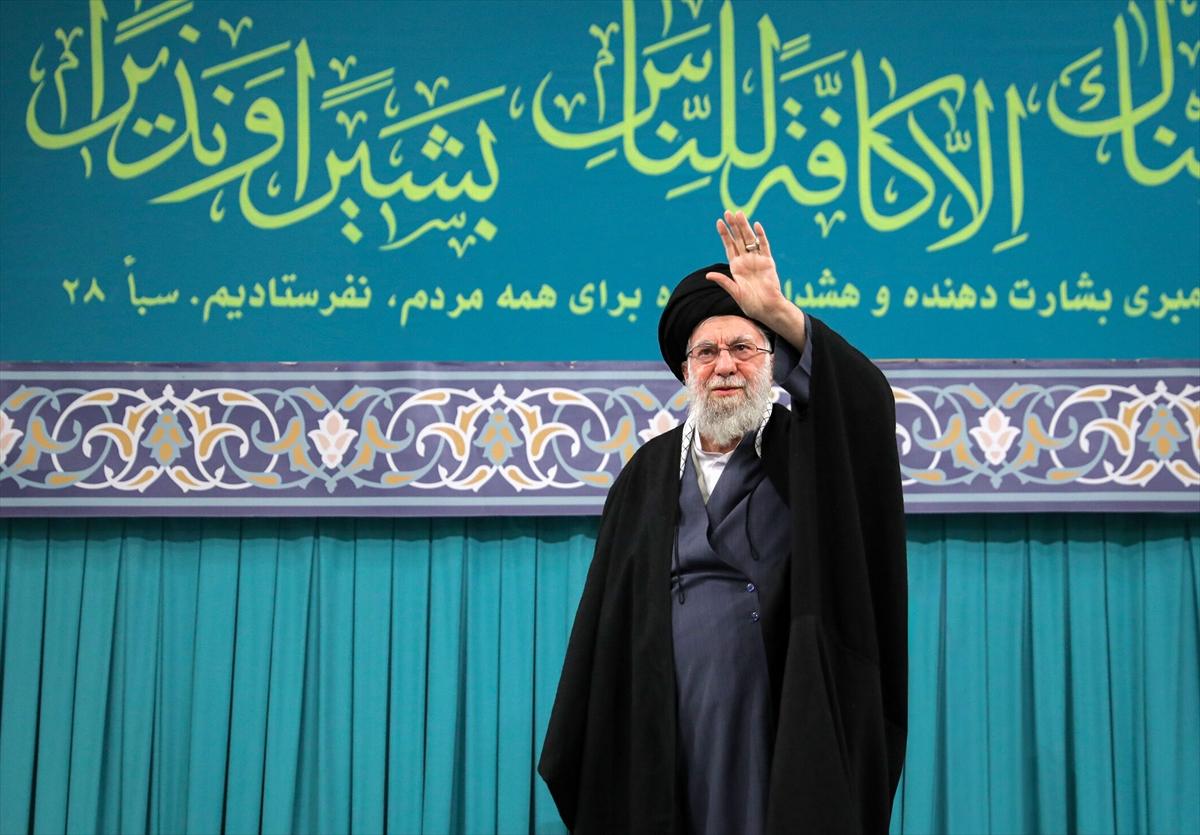
Iran’s leader Ali Khamenei, January 17, 2026 – (Anadolu Ajansı)
Ebrahim Azizi, Chairman of the National Security and Foreign Policy Commission of the Iranian Parliament, made statements on January 19, 2026, regarding the ongoing protests in the country. According to information reported by Mehr News Agency, Azizi stated that more than 3,700 police officers were injured during the protests.
During the press conference, Azizi noted that the protests had spread nationwide since last month and that security forces had intervened in many regions. No official data has been released regarding the death toll.
According to the latest figures released by HRANA on January 19, the number of deaths in the protests has exceeded 3,700 and the number of detentions has surpassed 24,300.
Iranian President Masoud Pezeshkian, during a Cabinet meeting on January 18, 2026, made statements regarding communication restrictions in the country. According to reports in the Iranian press, Pezeshkian said, following an assessment of internet access restrictions, “I recommended that internet limitations be lifted as soon as possible.”
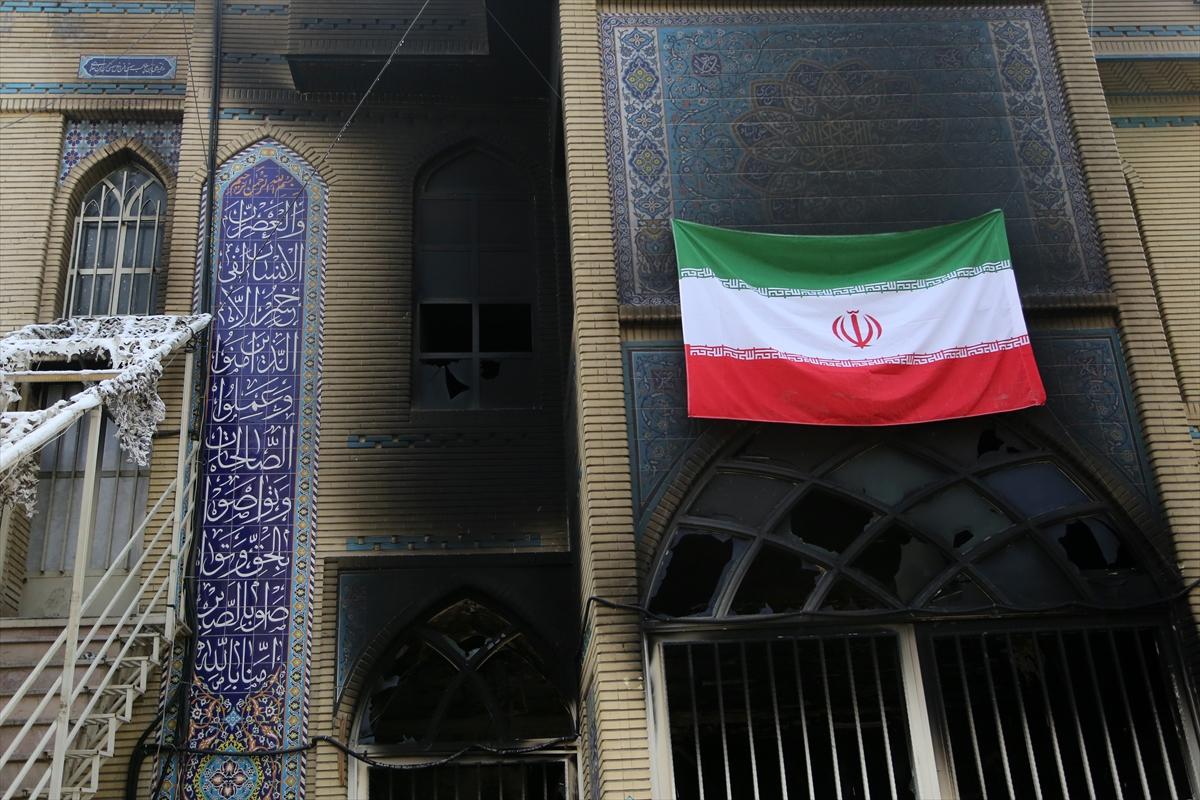
Buildings damaged during protests in Tehran, January 21, 2026 – (Anadolu Ajansı)
Pezeshkian emphasized that those detained in connection with the protests must be treated fairly and carefully during the review of their cases. He added: “Those who did not participate in terrorist acts must be treated with Islamic mercy. However, no leniency should be shown to those who led terrorist incidents.”
On January 18, 2026, Iranian President Masoud Pezeshkian, in a post on the U.S.-based social media platform X, made a statement regarding a possible attack on Iran’s leader Ayatollah Ali Khamenei. In his message, Pezeshkian said: “If the Iranian people are facing hardship or economic difficulties, one of the main reasons is the long-standing hostility and inhumane sanctions imposed by the United States and its allies. An attack on our leader would mean a full-scale war against the Iranian people.”
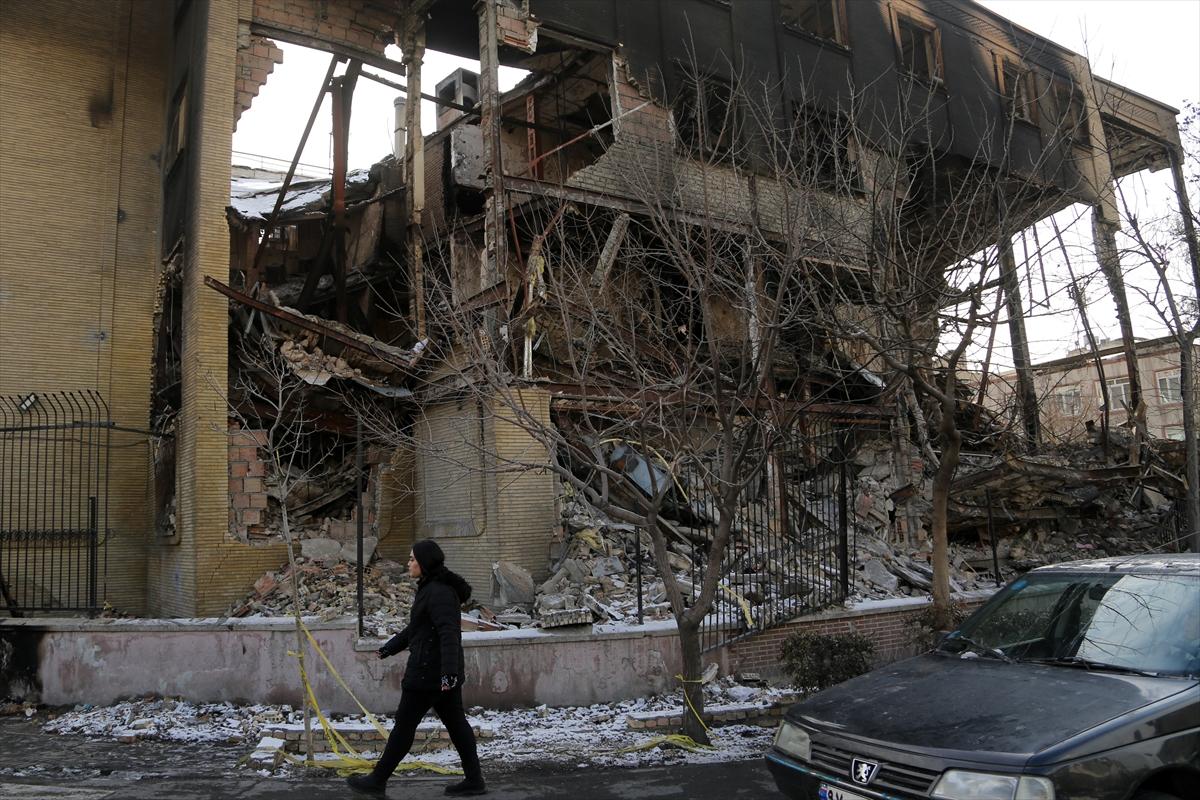
Buildings damaged during protests in Tehran, January 21, 2026 – (Anadolu Ajansı)
According to information reported by HRANA, the protests have largely subsided across various cities in the country as of January 18–19, 2026.
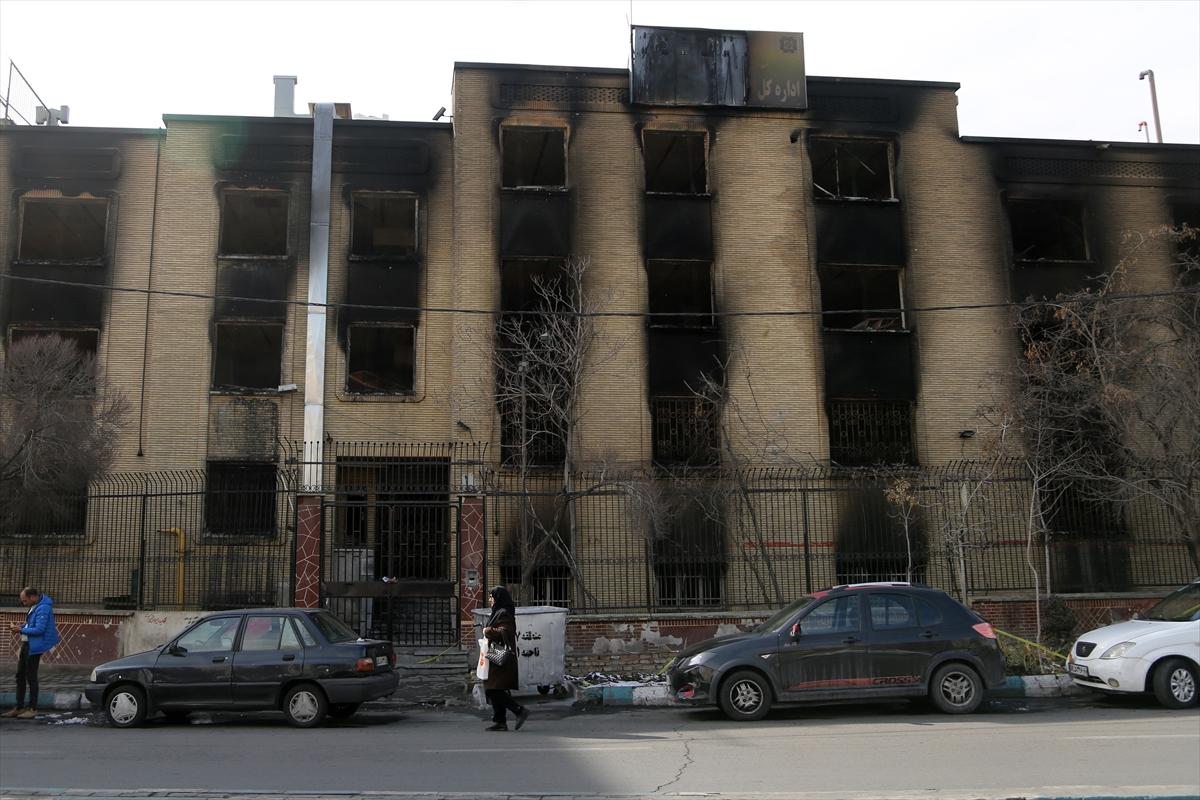
Buildings damaged in Tehran during protests in Iran, 21 January 2026 – (Anadolu Agency)
The U.S.-based Iran Human Rights Activists News Agency (HRANA) stated in its new report published on 21 January 2026 that the number of people killed in demonstrations sparked by economic issues has risen to 4,519. It was reported that 26,314 people were arrested across the country during the events. According to the same report, 197 security personnel also lost their lives during the protests.
Anadolu Ajansı. "ABD Merkezli İnsan Hakları Aktivistleri Haber Ajansı: İran’daki Olaylarda Ölenlerin Sayısı 3 Bin 308’e Yükseldi." Accessed January 19, 2026.
Anadolu Ajansı. "ABD Merkezli İnsan Hakları Aktivistleri Haber Ajansı: İran’daki Olaylarda Ölenlerin Sayısı 4 Bin 519’a Çıktı." Accessed January 21, 2026. https://www.aa.com.tr/tr/dunya/abd-merkezli-insan-haklari-aktivistleri-haber-ajansi-irandaki-olaylarda-olenlerin-sayisi-4-bin-519a-cikti/3805927
Anadolu Ajansı. "İran Cumhurbaşkanı Pezeşkiyan: Liderimize Yönelik Bir Saldırı, İran Halkıyla Topyekûn Savaş Anlamına Gelir." Accessed January 19, 2026.
Anadolu Ajansı. "İran Cumhurbaşkanı Pezeşkiyan: İnternet Kısıtlamasının Kaldırılması Yönünde Tavsiyede Bulundum." Accessed January 19, 2026.
Anadolu Ajansı. “Over 3,700 Police Officers Injured in Iran Protests, Lawmaker Says.” Accessed January 19, 2026. https://www.aa.com.tr/en/middle-east/over-3-700-police-officers-injured-in-iran-protests-lawmaker-says/3803885
The Iranian Foundation of Martyrs and Veterans, citing data from the Forensic Medicine Organization, stated in a written announcement on January 21, 2026, that a total of 3,117 people lost their lives during incidents related to protests across the country.
The statement indicated that 2,427 of the deceased were security personnel and civilian citizens killed by “armed terrorist groups”, and that these individuals are considered “martyrs.” The foundation also reported that some of those killed in the incidents were “civilians passing by as a result of terrorist acts and protesters targeted during demonstrations.”
Iranian officials further announced that more than 3,700 security personnel were injured and approximately 3,000 individuals suspected of being affiliated with terrorist organizations or accused of inciting the unrest were taken into custody.
The U.S.-based Iran Human Rights Activists News Agency (HRANA), in a report published on January 23, 2026, announced that 5,002 people lost their lives during protests across Iran. The same report stated that 26,752 people were arrested and 7,391 people sustained serious injuries.
HRANA noted that it had updated its previous death toll of 4,902 from the day before, based on newly verified cases.
On January 22, 2026, Iranian President Masoud Pezeshkian issued a written message regarding the deaths during the protests. While affirming that protests are a natural right of the people, Pezeshkian emphasized that violent incidents differ from peaceful demonstrations. He stated, “We mourn all lives lost today and stand in solidarity with every one of our citizens enduring great suffering during these days. Protest is the natural right of citizens, and the government considers it its duty to listen to the voice of the people.”
Pezeshkian described the events as “an American Zionist conspiracy” and asserted that the attacks by Israel and the United States in June 2025 had provoked “a treacherous revenge” for their defeat. He added, “The hands stained with the blood of thousands of women, men, youths, children, scientists, and commanders during the 12-day war have now reappeared in a different form.”
Pezeshkian stated that the circumstances and allegations arising from the subsequent arrests would be examined with the utmost care. In his message, he emphasized that “learning from the painful experiences and identifying and addressing weaknesses are essential for building the future,” and affirmed that his country would “build a strong future under the guidance of Iran’s Leader, Ayatollah Ali Khamenei, in a state of unity and solidarity.”
On January 21, 2026, Iranian Foreign Minister Abbas Araghchi issued a warning to the United States in an article published in The Wall Street Journal. Araghchi stated, “If we are attacked again, our powerful armed forces will not hesitate to respond with everything at our disposal.”
He further declared, “A comprehensive conflict will undoubtedly be severe and last far longer than the imaginary timelines the United States and its allies are trying to impose on Israel.” Araghchi added, “This conflict will certainly draw in a wider region and have effects on ordinary people around the world.”
According to an Al Jazeera report dated January 23, Iranian officials denied that any death sentences had been issued during the protests and rejected such claims.
On January 22, 2026, U.S. President Donald Trump told reporters aboard Air Force One that the United States had dispatched a naval fleet moving toward Iran. Trump said, “I do not wish for anything to happen, but we are closely monitoring them.”
Trump stated that a military intervention remained on the table if protesters in Iran were killed, but that he had temporarily softened his stance after learning that “hundreds of planned executions had been canceled.”
Regarding those allegations, Trump said, “I told them: ‘If you hang those people, you will suffer the harshest blow you have ever received. What we have done to your nuclear program will seem insignificant by comparison.’”
In another statement following his return from the World Economic Forum in Davos, Trump declared, “We have a massive force moving toward Iran.” In an interview with CNBC, he specified that military action would be taken if Iran resumed nuclear activities: “They cannot continue nuclear activities. If they do, the same thing will happen again.”
U.S. officials announced that the USS Abraham Lincoln aircraft carrier, along with guided-missile destroyers, had been directed toward the Middle East. A U.S. Navy official shared that “the Lincoln strike group is currently in the Indian Ocean.” It was also indicated that additional air defense systems could be deployed to U.S. bases in the Middle East as part of this buildup.
Al Jazeera. "Trump Says US Still Watching Iran as Massive Fleet Heads to Gulf Region." Al Jazeera, January 23, 2026. Accessed January 23, 2026. https://www.aljazeera.com/news/2026/1/23/trump-says-us-still-watching-iran-as-massive-fleet-heads-to-gulf-region
Al Jazeera. “At Least 3,117 People Killed During Iran Protests, State Media Reports.” Al Jazeera, January 21, 2026. Accessed January 23, 2026. https://www.aljazeera.com/news/2026/1/21/at-least-3117-people-killed-during-iran-protests-state-media-reports
Anadolu Ajansı. “ABD Merkezli İnsan Hakları Aktivistleri Haber Ajansı: İran’daki Olaylarda Ölenlerin Sayısı 5 Bini Geçti.” Accessed January 23, 2026. https://www.aa.com.tr/tr/dunya/abd-merkezli-insan-haklari-aktivistleri-haber-ajansi-irandaki-olaylarda-olenlerin-sayisi-5-bini-gecti/3808455
Anadolu Ajansı. “Death Toll Surpasses 5,000 in Iran Protests: Report.” Accessed January 23, 2026. https://www.aa.com.tr/en/middle-east/death-toll-surpasses-5-000-in-iran-protests-report/3808513
Anadolu Ajansı. “İran Cumhurbaşkanı Pezeşkiyan, Son Olaylarda Yaşadıkları Acı Tecrübelerden Ders Çıkarılmasının Önemini Vurguladı.” Accessed January 23, 2026. https://www.aa.com.tr/tr/dunya/iran-cumhurbaskani-pezeskiyan-son-olaylarda-yasadiklari-aci-tecrubelerden-ders-cikarilmasinin-onemini-vurguladi/3808285
Anadolu Ajansı. “İran, Ülkedeki Olaylarda 3 Bin 117 Kişinin Hayatını Kaybettiğini Duyurdu.” Accessed January 23, 2026. https://www.aa.com.tr/tr/dunya/iran-ulkedeki-olaylarda-3-bin-117-kisinin-hayatini-kaybettigini-duyurdu-/3807031
Associated Press. “Toll in Iran’s protest crackdown reaches at least 5,002 dead as Trump says US ‘armada’ approaching.” Accessed January 23, 2026. https://apnews.com/article/iran-protests-crackdown-death-toll-acb1968a973f19be217ea28b4a7adb0b
Reuters. "Trump says US 'armada' heading toward Iran." Reuters, January 22, 2026. Accessed January 23, 2026. https://www.reuters.com/world/middle-east/us-military-assets-heading-middle-east-even-trump-backs-off-toughest-iran-2026-01-22/
The Iran Human Rights Activists News Agency (HRANA), based in the United States, reported in a statement issued on January 25, 2026, that 5,459 people lost their lives and 40,887 were arrested during demonstrations sparked by economic issues in Iran.
On January 26, 2026, HRANA updated its figures and announced that the number of deaths had risen to 5,848 and the number of arrests had increased to 41,283. In its updated report published on January 27, 2026, HRANA stated that during the demonstrations triggered by economic problems in Iran, 6,126 people had died. According to HRANA’s data, among the deceased were 214 security personnel, and a total of 41,880 individuals had been arrested.
HRANA stated that while the unrest had subsided, it continued to verify additional cases, which is why it updated the death and arrest figures.
Hussein Kermanpur, Director of the Center for Public Relations at Iran’s Ministry of Health, stated on January 26, 2026, that approximately 3,000 people who had been injured during the protests and had not previously sought medical care had come to hospitals over the past six days. In remarks to the Tesnim News Agency, Kermanpur said, “Following the Ministry of Health’s assurance that all injured would be treated impartially, approximately 3,000 people who had attempted to treat themselves at home came to hospitals within six days.”
The official emphasized that home-based treatments may be insufficient, stating, “Because injuries cannot be adequately treated at home. Even some of our colleagues cannot treat such wounds alone with the facilities available at home.” He also clarified that health institutions have no role in identifying individuals involved in the events, adding, “Our sole responsibility is to provide healthcare services to anyone injured, regardless of the cause.”
The Head of Iran’s Judiciary, Gholam Hossein Mohseni Ejei, made statements during a meeting regarding the judicial proceedings of those arrested during protests. Ejei affirmed that trials would be conducted promptly and in accordance with the law, saying, “The public expects those who engaged in violent acts to be swiftly tried and those found guilty to be punished. This is also on our agenda.”
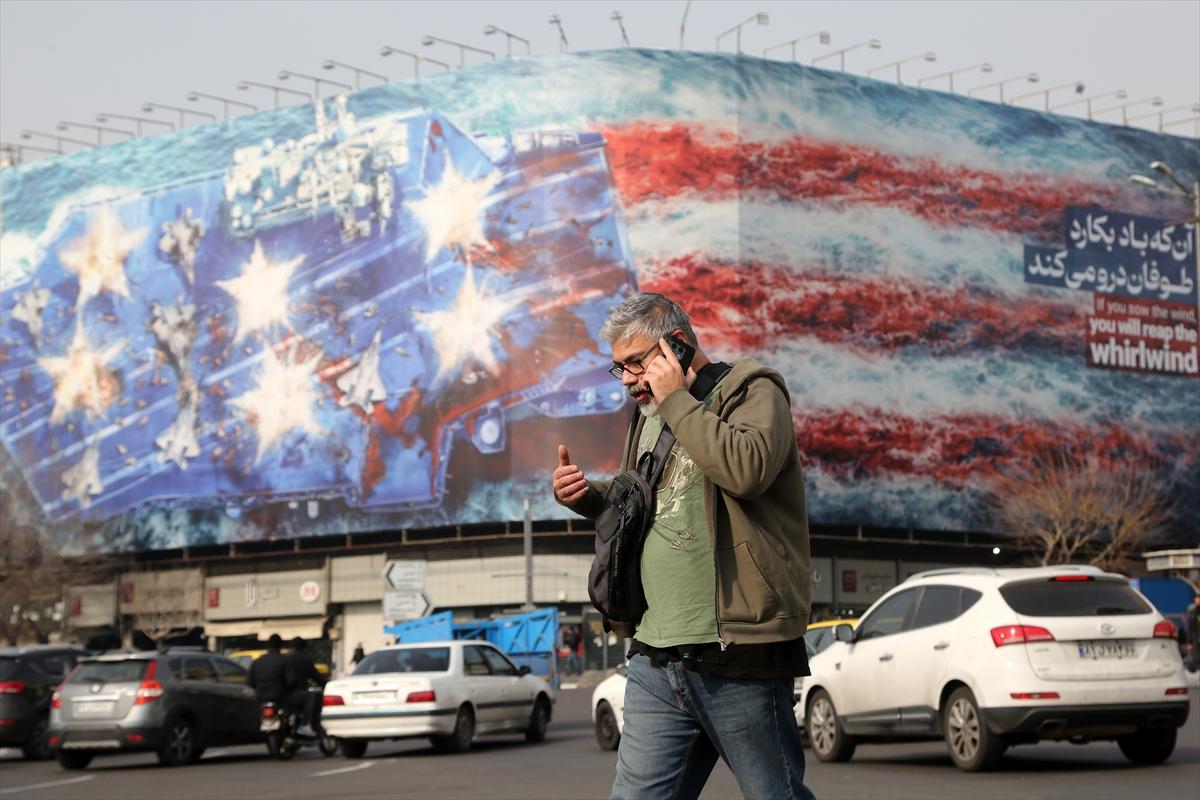
Anti-US poster hung at Revolution Square in Iran, January 25, 2026 – (Anadolu Agency)
Ejei stated that to ensure justice is fully realized, those who used weapons or engaged in arson during the protests must be punished without leniency, emphasizing the importance of adhering to legal principles during trials and sentencing.
Ejei also commented on how material damage caused during the protests would be addressed. He noted, “In addition to punishing those who participated in, incited, or ordered violent acts, their assets will also be seized.” He added, “Judicial authorities must rigorously follow legal procedures in this matter.”
Ejei further claimed that the United States and Israel directly supported, rather than merely indirectly encouraged, those engaging in violent acts during the protests and had trained them in various fields.
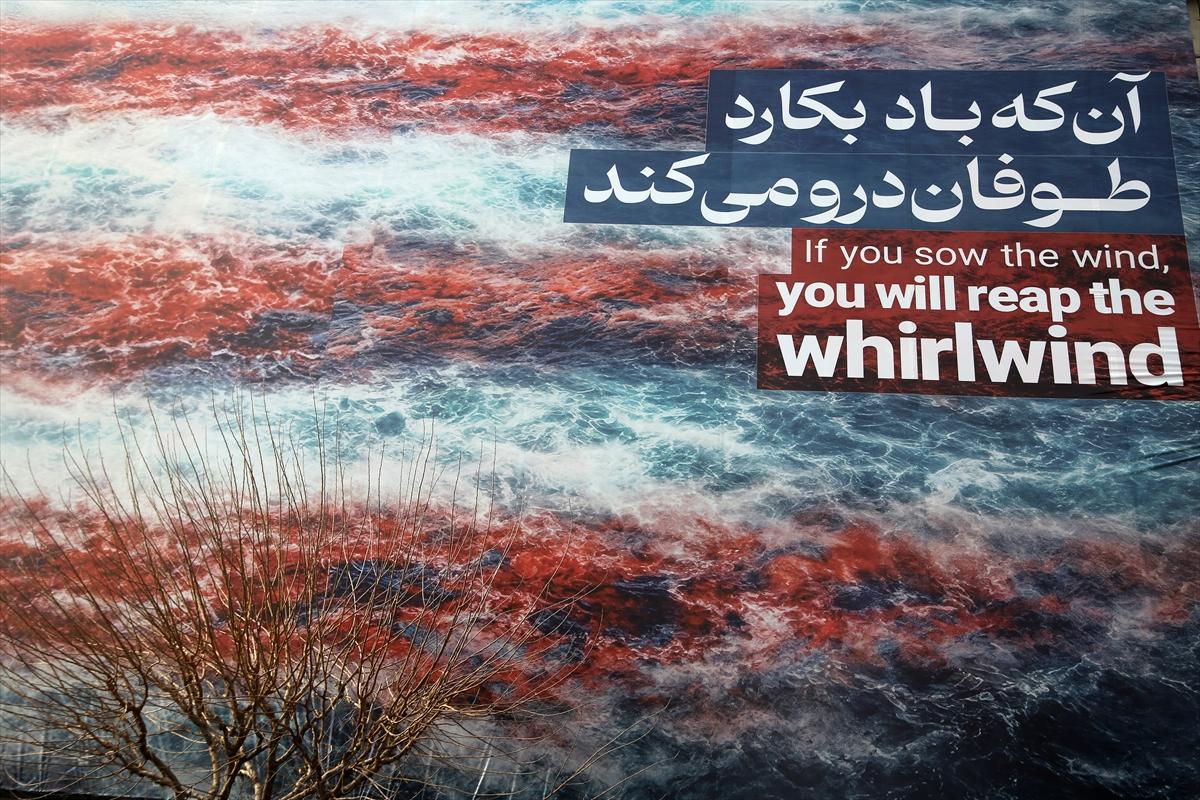
Anti-US poster hung at Revolution Square in Iran, January 25, 2026 – (Anadolu Agency)
According to the Entekhab news website, Ali Hekimcevadi, President of the Organization of Iranian Computer Engineers and Information Technology Sector, made statements regarding the economic impact of the internet shutdown imposed by the authorities after Protests that began on December 28, 2025. Hekimcevadi said, “The internet shutdown imposes daily economic losses of 2 to 3 billion tumans on the country.”
Hekimcevadi identified digital businesses and information technology service providers as the sectors most affected by the internet shutdown, noting that these enterprises, whose revenues depend heavily on uninterrupted global internet access, have experienced severe declines in operations, with some having come to a complete standstill.
Hekimcevadi emphasized that the aforementioned economic damage only includes "direct" losses, noting that "indirect" damages such as loss of confidence, decline in international rankings, capital flight, and brain drain were not included in these calculations.
According to the Fararu news site, "A written statement by the Iran Chamber of Commerce reported that merchants and businesspeople continue to face serious problems accessing the internet." The statement added, "Only a few systems have been installed at the Iran Chamber of Commerce, but these are neither sufficient nor accessible for such a large number of merchants. Communication with partners and customers abroad has become extremely difficult, and a portion of trade has effectively come to a halt."
Daily life in Tehran, 24 January 2026 – (Anadolu Agency)
On 26 January 2026, Iran’s Minister of Communications and Information Technology, Seyyid Settar Hashemi, stated that the internet shutdown imposed on 8 January, following the start of protests, has caused the country’s economy daily losses of approximately 34.5 million US dollars. Hashemi said, "The estimated daily damage to the core of the digital economy is around 3.5 million US dollars. This loss primarily affects operators and sectors related to network infrastructure. The projected daily impact on the macroeconomy is approximately 34.5 million US dollars."
The Iranian minister highlighted that approximately 10 million people in Iran are employed directly and indirectly in the digital economy, noting that the internet shutdown has directly harmed employment and public livelihoods, which could lead to "social" and "security" consequences.
Israel’s Northern Command Commander, Major General Rafi Milo, in a statement broadcast on Channel 12 television on 26 January 2026, referred to Israel’s military preparations within the framework of the possibility of a U.S. Do not attack Iran strike.
Major General Milo said, "We observe the American military buildup both in the Persian Gulf and across the broader Middle East." He added, "We do not know where this situation will lead," noting that if Washington chooses to attack Tehran, "this could affect Israel and that Iran’s response might be directed at us."
The Israeli commander also stated that the potential involvement of Hezbollah in a broader conflict is being closely monitored. "We are extremely cautious, well-prepared, and conducting both strong defensive and offensive preparations," he said.
Major General Milo claimed that Türkiye and Qatar represent a "major problem" in terms of regional balances. Regarding Syria, he described the situation on the ground as "complex and difficult," and indicated that the Israeli military will continue its attacks in southern Syria, where it maintains an occupation.
Israeli Defense Forces Spokesperson Effie Defrin, in a separate statement, announced that throughout the week, the Israeli military had intensified its readiness levels across all fronts in response to the potential Iranian attack by the United States.
Iran’s Ministry of Foreign Affairs Spokesperson, Ismail Bekayi, responded on 26 January 2026 during his weekly press briefing to allegations that the United States is preparing for a possible military strike against Iran.
Bekayi stated, "Iran relies on its own capabilities and experience, including its past engagements in June. We are in a stronger position. Iran will respond to any attack with a broader and more consequential retaliation.""
Bekayi emphasized that military threats and troop deployments constitute a clear violation of international law. The spokesperson added, "The deployment of warships to the region will not create the slightest weakness in Iran’s will and determination to defend its sovereignty."
Bekayi has stated that Iran is facing a “hybrid war” characterized by the continuation of attacks in June. In his statement, he said: “We have been confronted in recent months with claims or threats originating from the United States and the Zionist regime. Regional countries are aware that the target of any security issue in the region is not solely Iran. Therefore, there is a shared concern among regional countries.”
Bekayi has also denied reports that Iran’s Foreign Minister Abbas Araghchi exchanged messages with U.S. President Donald Trump’s Middle East Special Representative Steve Witkoff.
On 26 January 2026, during a meeting with governors in the capital Tehran, Iranian President Masoud Pezeshkian made assessments regarding the country’s economic situation. Pezeshkian said: “Today my concern is the people’s problems of livelihood, housing, health and education. The misconduct displayed by some groups must not prevent officials from acting fairly toward the public.” Emphasizing the importance of direct contact with the people and closely monitoring their concerns, Pezeshkian added: “To ensure public security, we must stand together with the people. All institutions must consider themselves obligated to listen to the voice of the people.” Pezeshkian also argued that no power can take control of Iran as long as it serves the people.
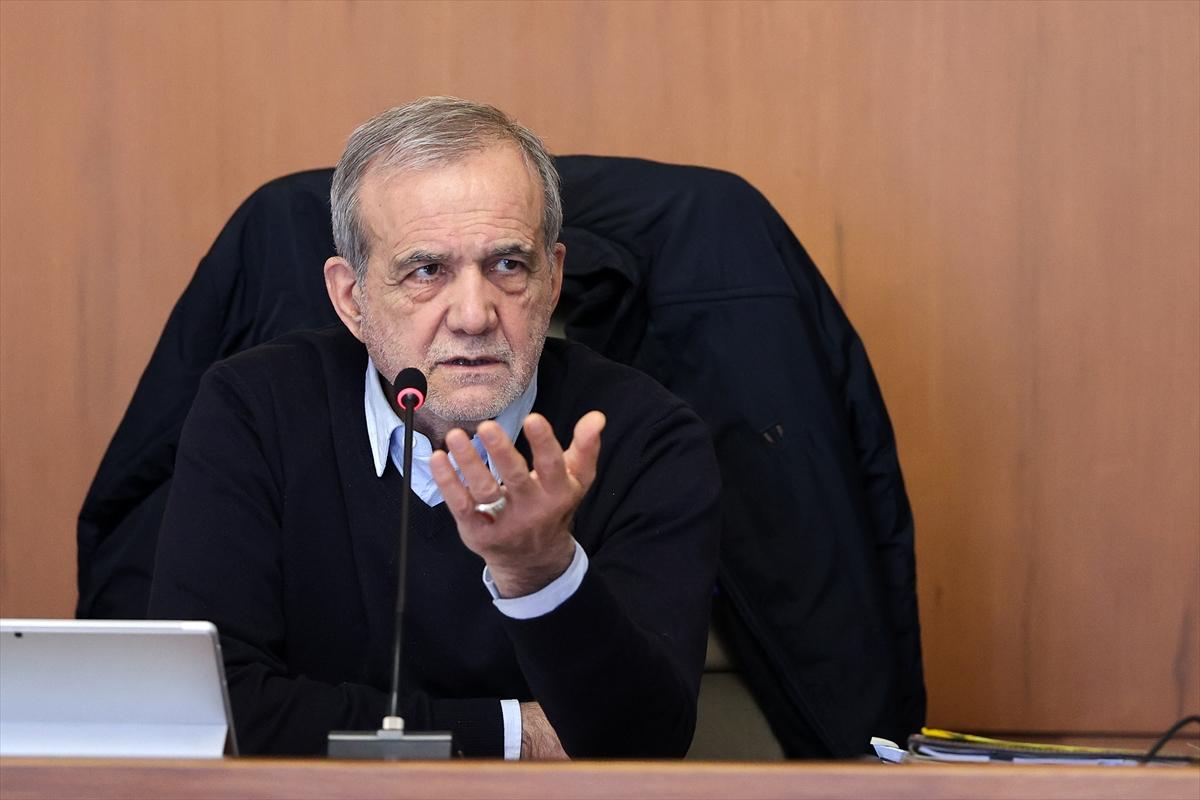
Iranian President Pezeshkian, 25 January 2026 – (Anadolu Agency)
During the same meeting, Iranian Interior Minister Iskander Momeni also made statements. Momeni noted that the voice of the Iranian people has always been heard and that protests have therefore been approached with reason, saying: “While demonstrations proceeded naturally, they were transformed into violent acts by enemies.” Emphasizing that the government held various meetings at the outset of the protests and made important decisions to address economic problems, Momeni added: “The role of foreign intelligence services became evident as the demonstrations continued.” Like President Pezeshkian, Momeni stressed the importance of maintaining continuous contact with the public, stating: “Governors must take advantage of opportunities to establish direct contact with the people.”
In a written statement issued by the UAE Ministry of Foreign Affairs on 26 January, it was stated: “The UAE confirms that it will not permit its airspace, territory or territorial waters to be used in any military attack against Iran.” The statement also emphasized that the UAE will provide no logistical support for any attack against Iran and called for adherence to international law and respect for state sovereignty in resolving crises. The statement further affirmed that the UAE favors resolving disputes through diplomatic means.
According to reports in the U.S. press, U.S. officials speaking to the New York Times stated that President Donald Trump’s administration has increased military preparations for a possible strike against Iran. The officials reported that the USS Abraham Lincoln aircraft carrier, accompanied by three warships armed with Tomahawk missiles, entered the U.S. Central Command’s area of responsibility in the Western Indian Ocean as of 26 January. Officials indicated that, should the White House issue an order for an attack, the carrier could be “ready for combat within one or two days.”
The officials claimed that the U.S. has deployed a dozen additional F-15E fighter jets to the region to increase its strike aircraft capacity and has sent additional Patriot and THAAD air defense systems to protect U.S. forces from potential retaliatory strikes by Iran’s short- and medium-range missiles. One official noted that the Washington administration has held consultations not only with Israeli officials and meetings in Baghdad but also with Saudi and Qatari officials.
According to Iranian media reports, Mohajerani addressed journalists in Tehran on 27 January. Speaking about the perception of war against Iran being cultivated in the foreign press and how this has stirred public anxiety, she stated: “In the context of a war threat, we hear the drums of war in the foreign media. Of course, we are not encountering such threats for the first time. We have long been aware that we are in a multi-stage war. Our priority is resolving problems through diplomacy. But other options remain on the agenda. We are fully prepared for war.”
Regarding those who lost their lives during the protests in Iran, Mohajerani said: “As the President has also said, we mourn every life lost. More than three thousand deaths are not a small number. What is at stake is a human life. We have not forgotten that our security forces were brutally killed. We are not strangers to these difficult days.” Mohajerani expressed confidence that Iran will overcome these difficult times through communication with the people, adding: “We believe we must emerge from this process by engaging in dialogue with the people and recognizing their legitimate grievances.”
Mohajerani emphasized that the government has adopted a different approach to the protests and has held talks with leaders of peaceful demonstrations, noting that some university administrators who adopted harsh attitudes toward students have been removed from their posts. She also noted that investigations into the protests and violent acts are ongoing and that reports on the matter will be published in the coming days.
U.S. President Donald Trump, in a statement posted on his social media account on January 28, 2026, used the phrase "A massive armada is advancing toward Iran." He specified that the USS Abraham Lincoln, a large aircraft carrier, leads this fleet and emphasized that it is larger than the one sent to Venezuela. In his statement, he added, "(The fleet) is ready, willing, and capable of swiftly and forcefully carrying out its mission if necessary, just as it was in Venezuela."
The U.S. President called on Iran to quickly come to the table for an "fair, equal, and good agreement for everyone" and stressed that such an agreement must exclude nuclear weapons. He stated, "Time is running out. This is truly important. As I told Iran before, make an agreement." He warned that otherwise, "The next strike will be worse. Do not allow it."
Trump also recalled the "Midnight Pull" operation conducted on June 22, 2025. This operation was carried out by the United States against Iran’s nuclear facilities in the cities of Natanz, Fordo, and Isfahan, following Israel’s attacks that began on June 13, 2025.
Foreign Minister Hakan Fidan, in an interview with the Qatar-based Al Jazeera channel on January 28, 2026, commented on potential military actions against Iran. Fidan stated, "Attacking Iran is wrong. Restarting the war is wrong. When you start negotiations, Iran is ready to re-negotiate on the nuclear file."
Fidan added, "My consistent advice to the Americans has always been to close files with Iran one by one, start with the nuclear issue, close it, then move on to others. If you present everything as one package, it becomes very difficult for our Iranian friends to digest and process, and sometimes it can even appear humiliating. It is also extremely difficult to convey this not only to them but also to their leadership. If we can make these matters more tolerable, I believe it will be helpful."
The European Union (EU) has called on all state and non-state actors to respect international law and act with restraint regarding any potential military scenario against Iran. EU Commission Spokesperson for External Relations Anouar El Anouni responded to journalists’ questions during a daily press briefing in Brussels on January 28, 2026.
In response to a question about a possible U.S. military strike against Iran, El Anouni said, "I will not comment on hypothetical scenarios." He noted that military escalation carries a serious risk of undermining regional stability and emphasized the need to give diplomacy a chance. El Anouni affirmed the EU’s strong commitment to peace, security, and stability in the Middle East, stating, "In this context, we call on all state and non-state actors to respect international law, act with restraint, and avoid any action that could escalate tensions in the Middle East."
Anadolu Ajansı. “ABD Başkanı Trump: Devasa Bir Armada İran’a İlerliyor.” Accessed January 28, 2026. https://www.aa.com.tr/tr/dunya/abd-baskani-trump-devasa-bir-armada-irana-ilerliyor/3813255
Anadolu Ajansı. “AB’den İran’a Yönelik Olası Askerî Adıma Karşı İtidal Çağrısı.” Accessed January 28, 2026. https://www.aa.com.tr/tr/dunya/abden-irana-yonelik-olasi-askeri-adima-karsi-itidal-cagrisi-/3813184
Anadolu Ajansı. “Dışişleri Bakanı Fidan: İran’a Saldırmak Savaşı Yeniden Başlatmak Yanlıştır.” Accessed January 28, 2026. https://www.aa.com.tr/tr/gundem/disisleri-bakani-fidan-irana-saldirmak-savasi-yeniden-baslatmak-yanlistir/3813052
CNBC. "Trump warns Iran an ‘armada’ is heading its way and to agree a nuclear deal, or else." January 28, 2026. Accessed January 28, 2026. https://www.cnbc.com/2026/01/28/trump-iran-armada-nuclear-program-deal.html
The United States has significantly increased its military presence in the Middle East amid rising tensions with Iran. The Pentagon has deployed aircraft carrier strike groups advanced fighter aircraft fleets and missile defense systems to the region.
USS Abraham Lincoln (CVN 72) has entered the area of responsibility of U.S. Central Command (CENTCOM). The carrier carries Carrier Air Wing (CVW) 9 which includes F-35C Lightning II fighter jets belonging to the VMFA-314 squadron numerous F/A-18E/F Super Hornets and EA-18G Growler aircraft designed for electronic attack. The carrier is escorted by destroyers USS Frank E. Petersen Jr. (DDG-121) USS Michael Murphy (DDG-112) and USS Spruance (DDG-111) under Destroyer Squadron 21.
These vessels are reported to be equipped with the Aegis Combat System and the MK 41 Vertical Launch System and capable of firing a variety of munitions including BGM-109 Tomahawk cruise missiles. It has also been stated that nuclear-powered attack submarines are part of the U.S. naval presence in the region and that these assets provide the force with a “stealth cruise missile capability”.
The U.S. Air Force has also provided land-based air support to the region. F-15E Strike Eagles have been deployed from RAF Lakenheath in the United Kingdom to Muwaffaq Salti Air Base in Jordan. These platforms are described as designed for deep strike missions with the capacity to carry precision-guided munitions and bunker-busting bombs. Additionally it has been noted that KC-135 Stratotanker refueling aircraft provide aerial refueling while RC-135W Rivet Joint intelligence aircraft collect targeting data by monitoring Iran’s radar and communication networks.
At Al Udeid Air Base in Qatar a new unit called MEAD-CDOC the “Middle East Air Defense and Combined Operations Center” has been established with participation from U.S. Central Command and allied partners. The purpose of this unit is to strengthen the integrated missile defense network. During the same period Patriot and THAAD systems have been deployed to Israel the United Arab Emirates and Jordan. Additional Patriot batteries have also been deployed to reinforce defensive lines at bases in Qatar Kuwait and Jordan. It has been reported that the United States has deployed an additional 5 700 troops to the region bringing the total force to approximately 50 000.
In response to the U.S. military buildup in the region Iran has taken steps to enhance its defensive capabilities. Commander of the Islamic Revolutionary Guard Corps Major General Amir Hatami announced that 1 000 newly developed unmanned aerial vehicles (UAVs) have been integrated into the armed forces inventory. These systems are described as designed for attack reconnaissance and electronic warfare missions with the ability to strike both fixed and mobile targets across maritime aerial and land domains.
Hatami stated that these systems were developed “in line with new security threats and the operational lessons of the past 12 days of conflict”. He added that the UAVs were produced through collaboration between military experts and the Ministry of Defense and that “maintaining and enhancing strategic superiority remains the continuous priority of the Iranian armed forces”.
Hatami further defined the fundamental defensive approach of the Iranian Armed Forces stating “Preparedness to respond decisively to rapid military operations and any type of attack continues to guide Iran’s defense planning”.
The Tehran administration has declared that any potential military attack from the United States will be met with a “rapid and comprehensive response”. Iranian officials have also reiterated that they are open to negotiations only under “fair balanced and non-coercive conditions”. These statements followed U.S. President Donald Trump’s remark that “a massive armada is moving toward Iran”.
Iran’s Deputy Foreign Minister Kazem Gharibabadi stated that Tehran’s priority in its dealings with the United States is not negotiation but full preparedness to defend the country. In an interview with the semi-official Tesnim News Agency Gharibabadi said “If the Americans seek negotiations with an unpredictable outcome Iran will accept it but the United States cannot force us into negotiations through military deployments”.
Referring to the possibility of a limited U.S. attack Gharibabadi stated “We will target every base or point from which an attack is launched against us. Military intervention is not an easy option for the United States because they know Iran’s response will not be merely proportional”. He further noted that Iran’s potential response is designed “to ensure that the United States will never again even consider launching limited attacks”.
The Iranian official also commented on the possibility of negotiations stating “Given the enemy’s war posture negotiations are not our priority. Iran’s priority is to be 200 percent prepared to defend the country”. Gharibabadi confirmed that there is currently no formal negotiation process underway with the United States and that only indirect message exchanges are taking place.
On the same day Iran’s Permanent Mission to the United Nations responded to U.S. President Donald Trump’s military threats with a post on the social media platform X. The statement read “Iran is ready for dialogue based on mutual respect and shared interests but if forced it will defend itself and respond in a manner unprecedented in scale and intensity”.
Additionally Iran’s advisor Ali Shamkhani posted on his social media account saying “A limited attack is a misconception. Any military action taken from any source or at any level will be considered the start of war and will be met with an immediate comprehensive and unmatched response targeting everyone who supports Tel Aviv and its aggressors”. Notably Shamkhani shared this message in multiple languages including Hebrew.
Iranian Foreign Minister Abbas Araghchi responded to U.S. President Donald Trump’s call for an agreement. Araghchi emphasized that Iran has always welcomed a nuclear agreement based on mutual benefit fairness and equality stating “Such an agreement must be based on equality must not include pressure threats or coercion must guarantee Iran’s right to peaceful nuclear technology and must ensure that Iran does not acquire nuclear weapons”.
Araghchi noted that Iran’s security doctrine does not include weapons of mass destruction and that Iran has never sought to acquire such weapons.
Iranian Parliament Speaker Mohammad Bagher Ghalibaf responded to U.S. attempts to initiate negotiations with Tehran through military threats. Ghalibaf stated “Diplomacy must be conducted on the basis of mutual respect and trust. Negotiations under the shadow of threats and military power do not resolve problems but instead increase instability”.
Ghalibaf affirmed that the Tehran administration does not fundamentally reject dialogue and diplomacy but insists that such processes must be based on sincerity mutual respect and assurance. He added “Negotiations are not possible unless the economic gains of the Iranian people are guaranteed. We do not view imposition as negotiation. If dialogue is genuine and conducted within the framework of international norms rules and regulations we welcome it. However we must consider past experiences and current conditions. What we have seen so far from the U.S. President indicates his pursuit of imposition and his effort to force his views upon us. (Donald Trump) If this view is not accepted he turns toward imposing war”.
Al Jazeera. “Live: Iran Warns of Quick Retaliation as Trump Revives US Threats.” Al Jazeera Live Blog. Accessed January 29, 2026. https://www.aljazeera.com/news/liveblog/2026/1/29/live-iran-warns-of-quick-retaliation-as-trump-revives-us-threats
Anadolu Ajansı. "ABD Merkezli İnsan Hakları Aktivistleri Ajansı: İran’daki Olaylarda Ölenlerin Sayısı 6 Bin 373’e Yükseldi." Accessed January 29, 2026. https://www.aa.com.tr/tr/dunya/abd-merkezli-insan-haklari-aktivistleri-ajansi-irandaki-olaylarda-olenlerin-sayisi-6-bin-373e-yukseldi/3814095
Anadolu Ajansı. "ABD, İran’a Karşı Orta Doğu’daki Askerî Varlığını Artırıyor." Accessed January 29, 2026. https://www.aa.com.tr/tr/dunya/abd-irana-karsi-orta-dogudaki-askeri-varligini-artiriyor/3813722
Anadolu Ajansı. "Iran Integrates 1,000 Drones into Army amid US War Threats." Accessed January 29, 2026. https://www.aa.com.tr/en/middle-east/iran-integrates-1-000-drones-into-army-amid-us-war-threats/3814285
Anadolu Ajansı. "İran: Önceliğimiz ABD ile Müzakere Değil, Ülkeyi Savunmaya Tam Hazırlık." Accessed January 29, 2026. https://www.aa.com.tr/tr/dunya/iran-onceligimiz-abd-ile-muzakere-degil-ulkeyi-savunmaya-tam-hazirlik-/3813417
Anadolu Ajansı. “AB, İran Devrim Muhafızlarını Terör Listesine Almayı Görüşecek.” Accessed January 29, 2026. https://www.aa.com.tr/tr/dunya/ab-iran-devrim-muhafizlarini-teror-listesine-almayi-gorusecek/3813930
Anadolu Ajansı. “İran Dışişleri Bakanı Erakçi, Trump’ın Anlaşma Çağrısına Yanıt Verdi.” Accessed January 29, 2026. https://www.aa.com.tr/tr/dunya/iran-disisleri-bakani-erakci-trumpin-anlasma-cagrisina-yanit-verdi/3813655
Anadolu Ajansı. “İran Meclis Başkanı Kalibaf: Tehdit ve Askerî Güç Gölgesindeki Müzakere Sorunları Çözmez.” Accessed January 29, 2026. https://www.aa.com.tr/tr/dunya/iran-meclis-baskani-kalibaf-tehdit-ve-askeri-guc-golgesindeki-muzakere-sorunlari-cozmez/3814076
According to information reported in the U.S. media on January 30, 2026, President Trump was reportedly briefed on potential strike options against Iran, jointly prepared by the White House and the Pentagon. This briefing coincided with the deployment of additional U.S. military forces to the region. It was stated that military planning was being conducted in parallel with diplomatic initiatives.
According to officials, the plans included large-scale bombing scenarios targeting facilities belonging to the Iranian government and assets under the command of the Revolutionary Guard Corps. It was also indicated that more limited, symbolic targeting options were being considered. These military options were designed to be escalated progressively if Iran failed to halt its nuclear activities.
The planning process reportedly incorporated tools beyond military operations, including cyberattacks and intensified economic sanctions. Cyber operations targeting Iran’s banking system and new economic sanction measures were among the key elements on the U.S. administration’s agenda.
On the same day, U.S.-based media outlets reported an increase in the U.S. Navy’s military presence in the Middle East. The destroyer USS Delbert D. Black was deployed to the region, raising the total number of U.S. destroyers in the area to six. Three warships and the aircraft carrier USS Abraham Lincoln were also reported to be operating in the region.
The U.S. Central Command (CENTCOM) announced on January 26 that the USS Abraham Lincoln carrier strike group had been deployed to the Middle East to support regional security and stability. This deployment formed the logistical foundation for the ongoing military preparations as of January 30.
In a statement on January 28, President Trump pointed to a large U.S. naval force advancing toward Iran, asserting that it was larger than the fleet previously sent to Venezuela. This statement demonstrated the simultaneous pursuit of military pressure and diplomatic outreach.
In public statements on January 30, President Trump issued strong remarks regarding Iran’s nuclear weapons program and domestic protests. He stated that the use of military force against Iran remained an option on the table, while emphasizing his preference for avoiding its use.
Trump said he had conveyed two key messages to the Iranian government: that Iran must not acquire nuclear weapons and that the killing of protesters must end. He also noted that efforts had been made in recent weeks to halt executions.
During the same remarks, Trump commented on the United Kingdom’s plans for cooperation with China, using critical language to challenge the foreign policy choices of different countries. These statements indicated that the Iran-centered tension was being addressed within a broader framework of U.S. foreign policy rhetoric.
On January 30, a telephone conversation took place between Recep Tayyip Erdoğan and Masoud Pezeshkian. The discussion focused on Türkiye-Iran bilateral relations and the escalating military tensions in the region. Erdoğan stated that Türkiye was prepared to assume a facilitating role between Iran and the United States.
In a statement issued by the Presidency, the importance of de-escalating tensions and resolving issues through diplomatic channels was emphasized. Erdoğan also announced that he would receive Iran’s Minister of Foreign Affairs on the same day. These contacts demonstrated Türkiye’s active diplomatic role in the crisis.
Iranian President Pezeshkian stated that successful diplomatic engagement with the United States required avoiding threatening actions. He emphasized that mutual trust was essential for diplomacy to be effective.
Pezeshkian declared that Iran adheres to a diplomatic approach based on dialogue, mutual respect, and the rejection of violence within the framework of international law. It was underscored that Iran aims to conduct its diplomatic process in accordance with the principle of “honorable diplomacy.”
On January 30, Hakan Fidan made statements during a joint press conference with Iran’s Minister of Foreign Affairs, Abbas Araghchi. Fidan expressed opposition to any military intervention against Iran and stressed that the issues must be resolved through negotiations.
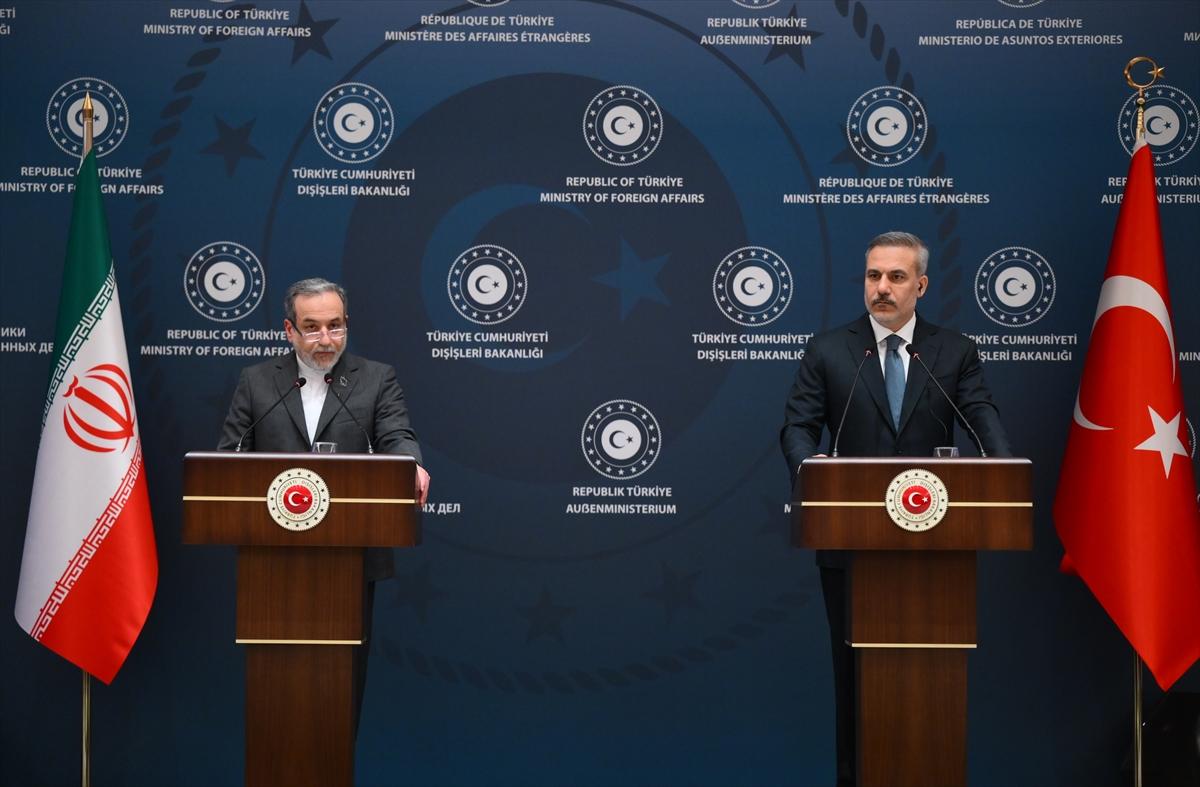
Joint Press Conference by Foreign Minister Fidan and Iranian Foreign Minister Araghchi. January 30, 2026 (Anadolu Agency)
Fidan noted that developments in Iran were being closely monitored and expressed sorrow over the loss of life during the protests. He also drew attention to attempts by the PKK to exploit the situation in the region and highlighted the shared security concerns of Türkiye and Iran.
During the press conference, it was stated that the resumption of nuclear negotiations between Iran and the United States was crucial for reducing regional tensions. Türkiye’s opposition to military options and its advocacy for diplomacy were clearly stated.
Al Jazeera. “LIVE: Iran warns retaliation to US attack will not be limited.” Al Jazeera, January 30, 2026. Accessed January 30, 2026. https://www.aljazeera.com/news/liveblog/2026/1/30/live-iran
Anadolu Ajansı. "Cumhurbaşkanı Erdoğan, İran Cumhurbaşkanı Pezeşkiyan ile telefonda görüştü." Anadolu Ajansı, January 30, 2026. Accessed January 30, 2026.
Anadolu Ajansı. "Trump’ın, İran’a yönelik olası saldırı planları hakkında bilgilendirildiği iddia edildi." Anadolu Ajansı, January 30, 2026. Accessed January 30, 2026.
Anadolu Ajansı. "İran Dışişleri Bakanı Erakçi: Türkiye ile her zaman yakın istişare halindeyiz." Anadolu Ajansı, January 30, 2026. Accessed January 30, 2026.
Anadolu Ajansı. “ABD Başkanı Trump, İran’a gözdağı verdi.” January 30, 2026. Accessed January 30, 2026.
Anadolu Ajansı. “İran Cumhurbaşkanı: Diplomasinin başarılı olması için ABD’nin tehditlerden kaçınması gerektiğini belirtti.” Anadolu Ajansı, January 30, 2026. Accessed January 30, 2026. https://www.aa.com.tr/tr/dunya/iran-cumhurbaskani-diplomasinin-basarili-olmasi-icin-abdnin-tehditlerden-kacinmasi-gerektigini-belirtti/3815302
According to information reported in the U.S. media on January 30, 2026, President Trump was reportedly briefed on Possible attack against Türkiye options jointly prepared by the White House and the Pentagon. This briefing coincided with the deployment of additional U.S. military forces to the region. It was stated that military planning was being conducted in parallel with diplomatic initiatives.
According to officials, the plans under consideration included large-scale bombing scenarios targeting facilities linked to the Iranian government and Army of the Revolution Guards-affiliated sites. It was also indicated that more limited options involving symbolic targets were being evaluated. These military options were designed to be escalated progressively if Iran failed to halt its nuclear activities.
The planning process was said to include not only military operations but also cyberattacks and the intensification of economic sanctions. Cyber operations targeting Iran’s banking system and new economic sanction measures were among the key elements on the U.S. administration’s agenda.
On the same day, U.S.-based media outlets reported an increase in the U.S. Navy’s military presence in the Middle East. The deployment of the destroyer USS Delbert D. Black to the region was confirmed, raising the total number of U.S. destroyers in the area to six. Three warships and the aircraft carrier USS Abraham Lincoln were also reported to be operating in the region.
The U.S. Central Command (CENTCOM) announced on January 26 that the USS Abraham Lincoln carrier strike group had been deployed to the Middle East to support regional security and stability. This deployment formed the operational foundation for the military preparations ongoing as of January 30.
In a statement on January 28, President Trump pointed to a significant U.S. naval force moving toward To Iran, asserting that it was larger than the fleet previously sent to Venezuela. This statement demonstrated the simultaneous pursuit of military pressure and diplomatic engagement.
In public statements on January 30, President Trump issued strong remarks regarding Iran’s nuclear weapons program and internal protests. Trump indicated that the use of military force against Iran remained an option on the table, while also stating his preference not to employ it.
Trump said he had conveyed two key messages to the Iranian government: that Iran must not acquire nuclear weapons and that killings of protesters must cease. The president also noted that efforts had been made in recent weeks to halt executions.
During the same remarks, Trump commented on the United Kingdom’s plans for cooperation with China and criticized the foreign policy choices of other countries. These statements indicated that the Iran-centered tension was being addressed within a broader framework of U.S. foreign policy rhetoric.
On January 30, a telephone conversation took place between Recep Tayyip Erdoğan and Masoud Pezeshkian. The discussion focused on Türkiye-Iran bilateral relations and rising military tensions in the region. Erdoğan stated that Türkiye was prepared to assume a facilitating role between Iran and the United States.
In a statement issued by the Presidency, the importance of reducing tensions and resolving issues through diplomatic channels was emphasized. Erdoğan also announced that he would receive Iran’s Minister of Foreign Affairs on the same day. These contacts demonstrated Türkiye’s active diplomatic role in the crisis.
Iranian President Pezeshkian stated that for diplomatic initiatives with the United States to succeed, threatening actions must be avoided. He emphasized that mutual trust was essential for diplomacy to be effective.
Pezeshkian declared that Iran adheres to a diplomatic approach based on dialogue, mutual respect, and the rejection of violence within the framework of international law. It was stressed that Iran aims to conduct its diplomatic process in accordance with the principle of “honorable diplomacy.”
On January 30, Hakan Fidan made statements during a joint press conference with Iran’s Minister of Foreign Affairs, Abbas Araghchi. Fidan opposed any military intervention against Iran and stressed that the issue must be resolved through negotiations.
Joint Press Conference by Foreign Minister Fidan and Iranian Foreign Minister Araghchi. January 30, 2026 (Anadolu Agency)
Fidan noted that The developments in Iran was being closely monitored and expressed sorrow over the loss of life during the protests. He also drew attention to attempts by the PKK to exploit developments in the region and emphasized the shared security concerns of Türkiye and Iran.
During the press conference, it was stated that the resumption of Nuclear negotiations between Iran and the United States was important for reducing regional tensions. Türkiye’s opposition to military options and its advocacy for diplomacy were clearly articulated.
Anadolu Ajansı. "ABD’den İran’a Hürmüz Boğazı’ndaki Askeri Faaliyetleri Konusunda Güvenlik Uyarısı." Accessed January 31, 2026. https://www.aa.com.tr/tr/dunya/abdden-irana-hurmuz-bogazindaki-askeri-faaliyetleri-konusunda-guvenlik-uyarisi/3816043
Anadolu Ajansı. "Trump: İran’la Anlaşma Yaparsak Bu İyi Olur, Anlaşma Yapamazsak Neler Olacağını Göreceğiz." Accessed January 31, 2026. https://www.aa.com.tr/tr/dunya/trump-iranla-anlasma-yaparsak-bu-iyi-olur-anlasma-yapamazsak-neler-olacagini-gorecegiz/3815799
Anadolu Ajansı. “ABD Merkezli İnsan Hakları Aktivistleri Ajansı: İran’daki Olaylarda Ölenlerin Sayısı 6 Bin 563’e Yükseldi.” Accessed January 31, 2026. https://www.aa.com.tr/tr/dunya/abd-merkezli-insan-haklari-aktivistleri-ajansi-irandaki-olaylarda-olenlerin-sayisi-6-bin-563e-yukseldi/3816012
Anadolu Ajansı. “Eski İran Cumhurbaşkanı Ruhani’den Büyük Reform Çağrısı.” Accessed January 31, 2026. https://www.aa.com.tr/tr/dunya/eski-iran-cumhurbaskani-ruhani-den-buyuk-reform-cagrisi/3816329
Anadolu Ajansı. “İran Cumhurbaşkanı Pezeşkiyan: Halka Karşı Davranış Biçimimizi Değiştirmemiz Gerekiyor.” Accessed January 31, 2026. https://www.aa.com.tr/tr/dunya/iran-cumhurbaskani-pezeskiyan-halka-karsi-davranis-bicimimizi-degistirmemiz-gerekiyor/3816085
Anadolu Ajansı. “İran Ordusu: Elimiz Tetikte, Düşmanın Hareketlerini İzliyoruz.” Accessed January 31, 2026. https://www.aa.com.tr/tr/dunya/iran-ordusu-elimiz-tetikte-dusmanin-hareketlerini-izliyoruz/3816227
Anadolu Ajansı. “İran’ın Güneyindeki Bender Abbas Kentindeki Bir Binada Patlama Meydana Geldi.” Accessed January 31, 2026. https://www.aa.com.tr/tr/dunya/iran-in-guneyindeki-bender-abbas-kentindeki-bir-binada-patlama-meydana-geldi/3816377
Ahmad Vahidi, Deputy Commander of the Islamic Revolutionary Guard Corps, stated on February 1 that the presence of the U.S. Navy in the region is “part of a psychological operation.” Vahidi said, “The presence of these naval groups in the region is not a new development. We view this as part of the enemy’s psychological warfare and believe it should not be taken seriously.”
Vahidi noted that Iran’s armed forces’ readiness level is far higher than during the 12-day Iran-Israel war and emphasized that “all enemy movements are under complete control and surveillance.”
Iran’s leader Ali Khamenei, in a speech on February 1 at his residence in Tehran marking the 47th anniversary of the revolution, stated that if the United States attacks Iran, the conflict will become regional. Khamenei pointed out that Washington’s occasional references to war and discussions of aircraft and warships are not new, adding, “In the past, Americans have repeatedly threatened in their statements, saying ‘all options are on the table.’ The option of war was always included.”
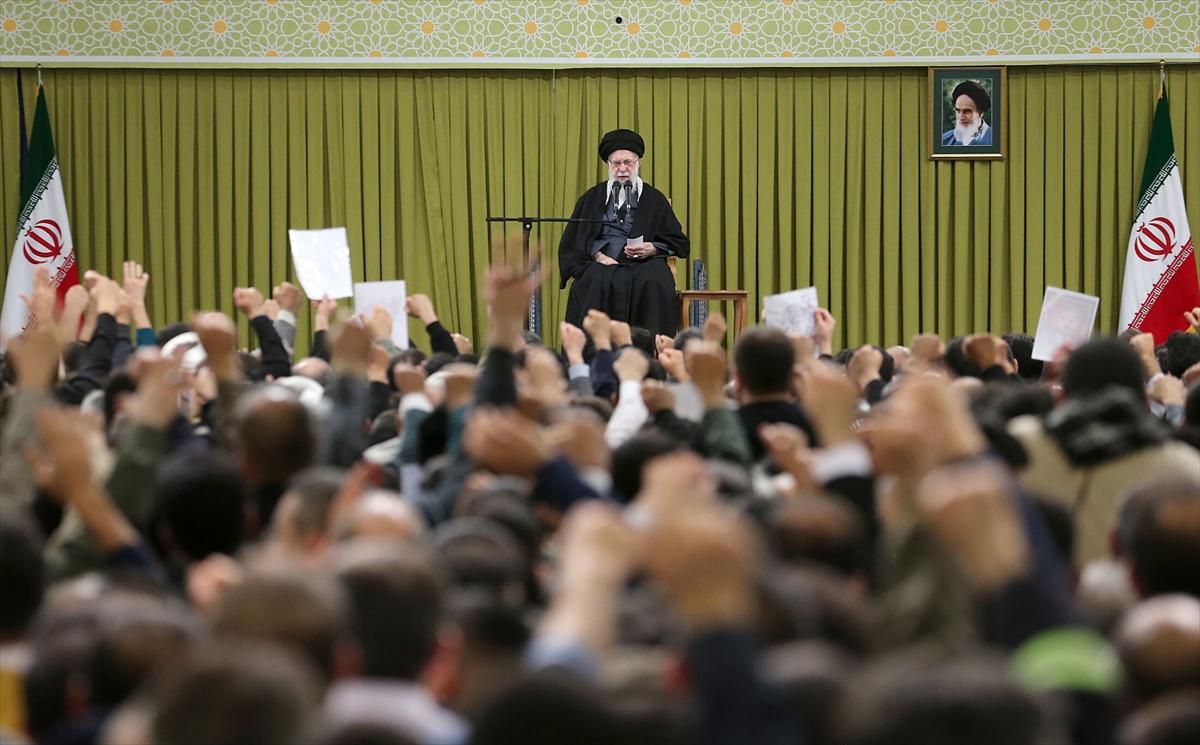
Iran’s leader Ali Khamenei, February 1, 2026 – (Anadolu Agency)
Khamenei emphasized that the Tehran government does not wish to be the initiator of war or to attack any country, stating, “The Iranian people respond with great force to anyone who attacks them or causes them harm.”
Comparing recent street protests in Iran to a coup attempt, Khamenei said, “The unrest resembled a coup. This coup was suppressed. Their aim was to destroy the key and critical centers of the country’s governance. That is why they attacked police, state institutions, Revolutionary Guard centers, banks, and mosques, burned the Quran, and targeted the centers of national authority. This was a situation similar to a coup attempt.”
According to Israel’s state television channel KAN, a senior Israeli military official made statements regarding Iran’s ballistic missile capabilities. The official said, “Israel cannot coexist with Iran’s ballistic missiles. Iran’s ballistic missiles are not a limited military challenge but an existential threat.”
The official claimed that before Israel’s recent strikes on Iran, Tehran possessed approximately 2,000 ballistic missiles and has since rapidly expanded its missile systems through renewed production.
The Israeli official asserted that Iran may now have the capacity to launch dozens of missiles simultaneously, a development that would complicate future conflict scenarios. He argued that any potential strike against Iran cannot focus solely on its nuclear program but must also target missile launch infrastructure, storage facilities, and production capacity. He further stated that Iran’s missile threat is no longer a secondary concern but has become central to Israel’s security strategy.
U.S. President Donald Trump told Fox News that Iran is currently negotiating with the United States on its nuclear program.
Trump argued that it is not wise to inform regional allies of U.S. plans regarding Iran, stating that sharing developments with regional partners “could be worse than sharing them with the media.” Trump said, “But look, the plan is this: (Iran) is talking to us. We will see if we can achieve something, otherwise we will see what happens.”
The U.S. president recalled that regional allies have claimed Iran is always open to negotiations, confirming this while referencing previous failed negotiations, saying, “This is true, they are negotiating, so we will see what happens. The last time we negotiated, we had to force them to shut down their nuclear program, and it did not work.”
According to Israeli media reports, the Israeli military assesses that the United States is determined to launch an attack on Iran but believes that deploying military assets to the Middle East will take time. Israel’s state television KAN reported that high-level coordination continues between the U.S. and Israel, and that Washington would notify Tel Aviv hours before any potential strike.
Iran’s Foreign Minister Abbas Araghchi, in a CNN interview published on his official Telegram account, stated that an agreement is only possible in the nuclear domain. Araghchi said Iran is seeking a path to restart negotiations with the United States alongside regional countries, adding, “President Trump said there should be no nuclear weapons, and we fully agree. We can only negotiate on the nuclear issue. We are ready to discuss our nuclear program to guarantee its exclusively peaceful nature. In return, we expect sanctions to be lifted. But we need trust. Minimum trust is absolutely necessary.”
Araghchi stated that Iran is prepared to discuss all details of its uranium enrichment activities if they remain for peaceful purposes.
Araghchi emphasized that Iran’s lack of trust stems from the 2015 nuclear deal signed with the United States, China, Russia, the United Kingdom, France, and Germany, from which the U.S. withdrew in 2018. He said, “The United States withdrew from the agreement without justification. Last year, when we decided to enter negotiations, we were attacked. Therefore, we have lost trust in the United States.”
Araghchi also commented on the recent escalation in Iran-U.S. military tensions, stating that Iran is prepared for war and therefore has no concerns. “In my view, war is not inevitable and can be prevented. The best way to prevent war is to be prepared for it. Being prepared does not mean we want war; it means we are determined to avoid it. My greatest concern is military operations based on false intelligence and miscalculations on this issue.”
Araghchi added that “different elements” are trying to push the United States toward war, but that U.S. President Trump is “smart enough to make the right decision.” He stressed that a war between Iran and the United States would negatively affect the entire region, saying, “During our conflict with Israel, we worked hard to prevent escalation. But if we fight the United States, given its military bases in the region, the conflict will inevitably spread to wider areas.”
Araghchi noted that if a potential agreement between Iran and the United States is reached, the regional economy would also revive, adding, “From our perspective, there is no problem with U.S. companies operating in Iran in various fields. The party creating problems here is the United States, as it does not permit its own companies to operate in Iran.”
On February 2, Iranian President Masoud Pezeshkian, according to reports in Iranian media, issued a directive to restart nuclear negotiations with the United States. According to information cited by the Tasnim News Agency, negotiations are expected to resume shortly with the participation of senior officials from both countries.
The report indicated that negotiations are anticipated to be conducted at the level of Iranian Foreign Minister Abbas Araghchi and U.S. representative Steve Witkoff. The timing and location of the talks have not yet been finalized and are currently under discussion between the two sides.
Iran’s Ministry of Foreign Affairs Spokesperson Ismael Baghaei announced at a weekly press briefing that Iran has not received any “ultimatum” or “deadline” from the United States. Baghaei said, “Tehran has always acted honestly and seriously in diplomatic processes but has never accepted any ultimatum or deadline.”
Regarding U.S. President Donald Trump’s previous statements about granting Iran a deadline, Baghaei stated, “Therefore, the claim that Iran received any deadline from the United States cannot be verified.” The spokesperson noted that tensions persist between Iran and the United States, but both sides are exchanging messages to reduce tensions. He emphasized that Iran acts “honestly and resolutely” in diplomatic processes but “never accepts pressure or imposed deadlines.”
Baghaei addressed Trump’s call for an “equitable agreement,” saying, “What constitutes an equitable agreement for the Islamic Republic of Iran and the other side is entirely clear. Our basis is international agreements and the principles of international law.”
The statement recalled that Iran’s right to peaceful nuclear energy use is recognized in relevant international agreements. Baghaei affirmed that “no new negotiation framework will be created.”
Speaker of the Iranian Parliament Mohammad Bagher Ghalibaf announced that the armed forces of European Union countries have been added to the terror list. In a speech in the Iranian Parliament, he said, “In accordance with the Reciprocity Law, in response to the designation of the Islamic Revolutionary Guard Corps as a terrorist organization, the armed forces of European countries are recognized as terrorist groups. The consequences of this step rest with the European Union.”
Kalibaf stated that the EU’s decision was made under U.S. influence. During the parliamentary session, some members of parliament appeared in the uniforms of the Revolutionary Guard and chanted slogans against the United States and the EU.
Following Kalibaf’s speech, Parliament Deputy Speaker Alireza Salimi referenced the Strategic Action Law, stating, “According to this law, the armed forces of European countries have been officially declared as terrorist organizations, as you have stated. Under this framework, military attachés from these countries stationed in our embassies must be expelled immediately, as they are terrorists.”
Salimi added, “Providing shelter to terrorists violates current laws,” and emphasized that such individuals cannot remain in the country under the status of military attachés. Parliament Speaker Kalibaf ordered the National Security and Foreign Policy Committee to monitor this matter and coordinate with the Ministry of Foreign Affairs.
High Representative of the European Union for Foreign Affairs and Security Policy Kaja Kallas, in a written post on her “X” account on January 29, confirmed that EU foreign ministers had designated the Islamic Revolutionary Guard Corps as a terrorist organization.
The Office of the President of Iran published a report on those who lost their lives during protests that began in December 2025. The report stated that the names of 2,986 out of a total of 3,117 individuals have been disclosed, while the identities of 131 individuals remain unconfirmed.
The report was prepared under President Masoud Pezeshkian’s policy of “transparency, accountability, and responsibility.” The document states, “All those who lost their lives in recent events are children of this land, and no grieving family should be left without recognition.”
The same report emphasized that the Islamic Republic of Iran does not view these deaths as mere statistics, stating, “Unlike the historical enemies of this land who treat human lives as numbers to be manipulated for political gain, the Islamic Republic of Iran holds that those who lost their lives in these tragic events are not mere numbers; each is a community and a world.”
In a statement issued on January 21 by the Foundation of Martyrs and Veterans of Iran, it was reported that 3,117 people, including security forces and civilians, lost their lives during the protests. The statement indicated that 2,427 of these individuals were security personnel and civilians killed by “armed terrorist groups” and were designated as “martyrs.”
The U.S.-based Iran Human Rights News Agency (HRANA) reported that 6,713 people lost their lives during the demonstrations and that 49,000 were arrested.
U.S. President Donald Trump, during a visit to Florida, told journalists that India would purchase oil from Venezuela instead of Iran. Trump said, “India is coming and will buy oil from Venezuela instead of Iran,” and added that “the concept of an agreement is already in place.”
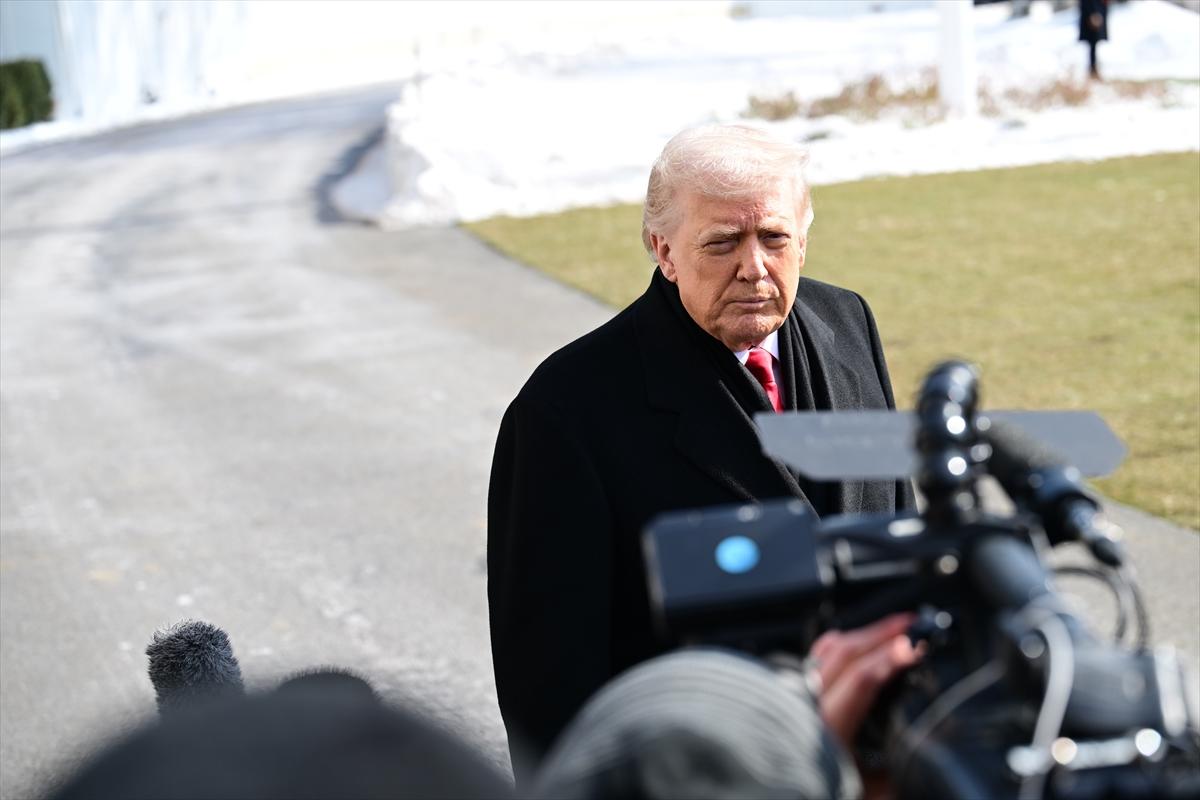
U.S. President Donald Trump, January 27, 2026 – (Anadolu Agency)
Trump noted that China also has an open door to Venezuelan oil. He mentioned that talks have begun with Cuba and responded to Mexican President Claudia Sheinbaum’s warning that sanctions on Cuba could trigger a humanitarian crisis by saying, “There is no need for a humanitarian crisis. I believe they will come to us and want to make an agreement. Then Cuba will become free again.”
Regarding Iran, when asked whether he had made a final decision, Trump emphasized the presence of strong U.S. military assets in the region. “I cannot say for certain, but we have very large and powerful ships moving in that direction. I hope they agree on something acceptable.” He reiterated that Iran must not acquire nuclear weapons.
Trump said, “A mutually satisfactory agreement without nuclear weapons is possible, and they must do it. But I do not know whether they will. But they are talking to us. They are talking seriously to us.”
Al Jazeera. "Khamenei Warns US of ‘Regional War’ If Iran Is Attacked." Al Jazeera, February 1, 2026. Accessed February 2, 2026. https://www.aljazeera.com/news/2026/2/1/khamenei-warns-us-of-regional-war-if-iran-is-attacked
Anadolu Ajansı. "Iran Denies Trump’s Ultimatum in Talks with US." Accessed February 2, 2026. https://www.aa.com.tr/en/middle-east/iran-denies-trump-s-ultimatum-in-talks-with-us/3817736
Anadolu Ajansı. "İran Cumhurbaşkanlığı Ofisi, Protestolarda Hayatını Kaybedenlerin İsim Listesini Yayımladı." Accessed February 2, 2026. https://www.aa.com.tr/tr/dunya/iran-cumhurbaskanligi-ofisi-protestolarda-hayatini-kaybedenlerin-isim-listesini-yayimladi/3817162
Anadolu Ajansı. “ABD Başkanı Trump: Hindistan’ın İran Yerine Venezuela’dan Petrol Alacağını Söyledi.” Accessed February 2, 2026. https://www.aa.com.tr/tr/dunya/abd-baskani-trump-hindistanin-iran-yerine-venezueladan-petrol-alacagini-soyledi/3816772
Anadolu Ajansı. “Iran’s President Orders Resumption of Nuclear Talks with US Media.” Accessed February 2, 2026. https://www.aa.com.tr/en/middle-east/iran-s-president-orders-resumption-of-nuclear-talks-with-us-media/3817746
Anadolu Ajansı. “Trump: İran’ın ABD ile Müzakere Hâlinde Olduğunu Belirtirken Netice Konusunda Umut Vermedi.” Accessed February 2, 2026. https://www.aa.com.tr/tr/dunya/trump-iranin-abd-ile-muzakere-halinde-oldugunu-belirtirken-netice-konusunda-umut-vermedi/3816720
Anadolu Ajansı. “İran ABD Donanmasının Bölgedeki Varlığı: Psikolojik Harekâtın Bir Parçası.” Accessed February 2, 2026. https://www.aa.com.tr/tr/dunya/iran-abd-donanmasinin-bolgedeki-varligi-psikolojik-harekatin-bir-parcasi/3816764
Anadolu Ajansı. “İran Avrupa Birliği Ülkeleri Ordularını Terör Listesine Aldığını Duyurdu.” Accessed February 2, 2026. https://www.aa.com.tr/tr/dunya/iran-avrupa-birligi-ulkeleri-ordularini-teror-listesine-aldigini-duyurdu/3816827
Anadolu Ajansı. “İran Dışişleri Bakanı Erakçi: Nükleer Alanda Anlaşmak Mümkün.” Accessed February 2, 2026. https://www.aa.com.tr/tr/dunya/iran-disisleri-bakani-erakci-nukleer-alanda-anlasmak-mumkun/3817230
Anadolu Ajansı. “İran Lideri Hamaney: ABD Savaş Başlatırsa Savaş Bu Kez Bölgesel Olacaktır.” Accessed February 2, 2026. https://www.aa.com.tr/tr/dunya/iran-lideri-hamaney-abd-savas-baslatirsa-savas-bu-kez-bolgesel-olacaktir/3816931
Anadolu Ajansı. “İsrailli Askeri Yetkili: İran’ın Balistik Füzeleri İsrail İçin Varoluşsal Tehdit.” Accessed February 2, 2026. https://www.aa.com.tr/tr/dunya/israilli-askeri-yetkili-iranin-balistik-fuzelerinin-israil-icin-varolussal-tehdit-oldugunu-soyledi/3816999
BBC News. “Iran’s Supreme Leader Warns of Regional War If US Attacks.” BBC News. Accessed February 2, 2026. https://www.bbc.com/news/articles/cx20z5nv9jxo
France 24. “Live: Iran’s President Pezeshkian Orders Start of Nuclear Talks with US.” France 24, February 2, 2026. Accessed February 2, 2026. https://www.france24.com/en/asia-pacific/20260202-live-trump-hopes-to-reach-a-deal-with-iran-keeps-military-option-on-table
Iran International. “Iran Plays Down War Risk as Reports Point to Possible US Talks.” Accessed February 2, 2026. https://www.iranintl.com/en/liveblog/202602011665
On February 3, 2026, U.S. President Donald Trump made statements regarding the Iran agenda during a signing ceremony held at the White House.
In his speech, Trump noted that diplomatic efforts with Iran were ongoing, stating: “I want to reach an agreement with Iran. We are currently speaking with Iran. If we can agree, that would be very good; if we cannot, then likely bad things will happen.” He also drew attention to military activity in the region by saying: “There are very large ships heading toward Iran.” While emphasizing his openness to a potential agreement with Iran, Trump responded to questions about the consequences of a failed negotiation with: “It would be foolish of me to tell you.”
White House Press Secretary Caroline Leavitt, in a statement to reporters in Washington on February 3, 2026, provided an assessment of U.S. President Donald Trump’s policy toward Iran.
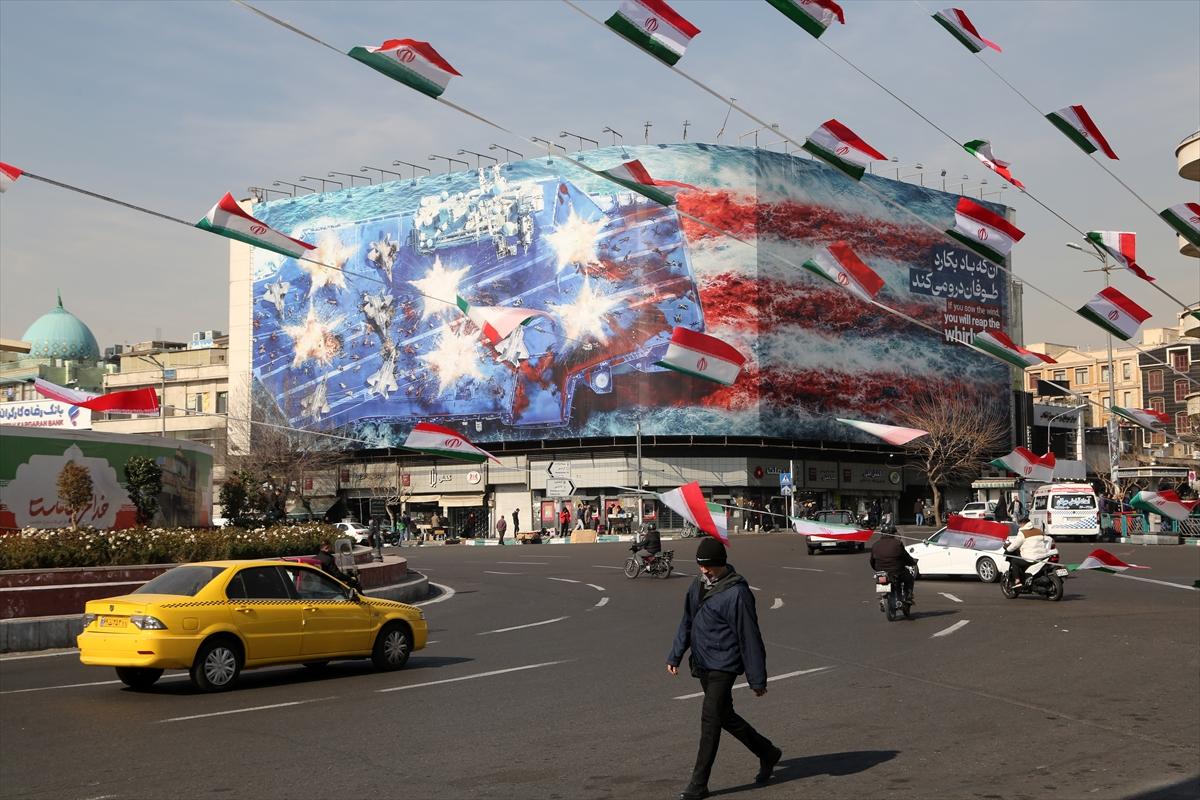
Daily life in Iran, January 28, 2026 - (Anadolu Agency)
Leavitt emphasized that she had met with Trump’s Special Representative Witkoff today and affirmed that talks with Iran would proceed “as planned.” She added: “President Trump always prefers to pursue diplomacy first, but of course this requires cooperation from both sides.”
The White House Press Secretary underscored that President Trump keeps all options on the table regarding Iran and recalled the U.S. strike on Iran’s nuclear facilities last year. Leavitt stated: “However, these talks with Iran will take place toward the end of this week.”
Donald Trump, on February 4, 2026, during a signing ceremony for a temporary budget at the White House, responded to questions from reporters regarding negotiations with Iran.
The U.S. President said: “We will see whether anything is accomplished with Iran. There was an opportunity to reach an agreement not long ago, but it did not happen. They want to negotiate. We are currently negotiating with them.” When asked where the talks with Iran would be held, Trump declined to answer.
Iranian President Masoud Pezeshkian, in a written statement posted on X platform on February 3, 2026, announced that he had issued instructions to Foreign Minister Abbas Araghchi to restart negotiations with the United States.
In his statement, Pezeshkian noted that neighboring friendly states had expressed support for responding to U.S. President Donald Trump’s negotiation offer, adding: “I have instructed the Foreign Minister to lay the groundwork for a fair and just negotiation based on the principles of dignity, wisdom, and national interest, provided that a suitable environment is established, free from threats and unreasonable or irrational demands.”
CENTCOM (U.S. Central Command), in a statement issued on February 3, 2026, reported that an Iranian unmanned aerial vehicle (UAV) approaching a U.S. aircraft carrier in the Sea of Oman had been shot down.
CENTCOM officials told the American network Fox News that the Iranian UAV, identified as such, had been downed by an F-35C fighter jet under the principle of “legitimate self-defense.”
CENTCOM Spokesperson Tim Hawkins provided the following account of the incident: “While the USS Abraham Lincoln was operating in the Arabian Sea approximately 500 miles (800 kilometers) south of Iran’s coast, an Iranian Shahed-139 unmanned aerial vehicle maneuvered unnecessarily toward the ship. An F-35C fighter jet from the Abraham Lincoln downed the Iranian UAV to defend itself and protect the aircraft carrier and its crew.”
According to reports in the Iranian press, Tesnim News Agency stated that the Iranian Shahed-129 UAV was conducting a “routine and lawful reconnaissance mission” in international waters and lost communication during the mission.
The report noted that the UAV had successfully transmitted the imagery collected during its mission to its base, but that an investigation had been launched into the cause of the communication loss and that further details would be shared later.
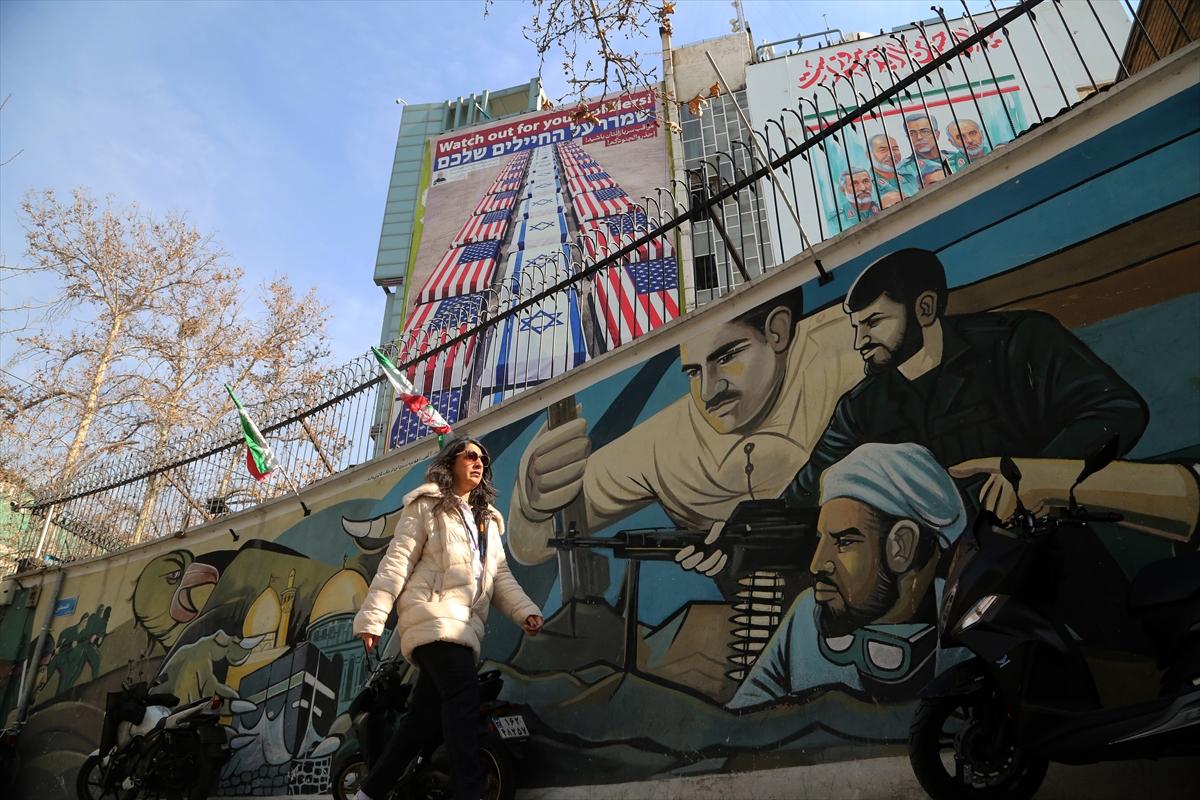
Daily life in Iran, January 28, 2026 - (Anadolu Agency)
Axios, in a report published on February 4, 2026, asserted that talks between the U.S. and Iran would be held in Oman.
Citing two unnamed officials, the report stated that Iran had requested changes to the format and location of the negotiations. Accordingly, it was reported that talks previously alleged to be scheduled for Friday, February 6, in Istanbul, had been moved to Oman, with the U.S. accepting this request.
According to Axios, “many Arab and Muslim countries were planned to observe the Istanbul talks,” but “Iran insisted that negotiations proceed in a bilateral format exclusively with the U.S.”
It was reported that the reason for Tehran’s demand was “its desire to limit discussions solely to nuclear issues and avoid raising topics such as missile programs and proxy groups, which are priorities for other regional countries.”
Al Jazeera. “US Military Says It Shot Down an Iranian Drone in the Arabian Sea.” Accessed February 4, 2026. https://www.aljazeera.com/news/2026/2/3/us-military-says-it-shot-down-an-iranian-drone-in-arabian-sea
Anadolu Ajansı. "ABD Başkanı Trump: İran’la Aktif Olarak Müzakere Yapıyoruz." Accessed February 4, 2026. https://www.aa.com.tr/tr/dunya/abd-baskani-trump-iranla-aktif-olarak-muzakere-yaptiklarini-soyledi/3819453
Anadolu Ajansı. "ABD Başkanı Trump’tan İran’a: Anlaşamazsak Kötü Şeyler Olacak." Accessed February 4, 2026. https://www.aa.com.tr/tr/dunya/abd-baskani-trumptan-irana-anlasamazsak-kotu-seyler-olacak-mesaji/3818341
Anadolu Ajansı. "Axios: ABD ile İran Arasındaki Görüşmeler Umman’da Yapılacak." Accessed February 4, 2026. https://www.aa.com.tr/tr/dunya/axios-abd-ile-iran-arasindaki-gorusmeler-ummanda-yapilacak/3819489
Anadolu Ajansı. “Beyaz Saray: İran ile Görüşmeler Bu Hafta Sonuna Doğru Yapılacak.” Accessed February 4, 2026. https://www.aa.com.tr/tr/dunya/beyaz-saray-iran-ile-gorusmeler-bu-hafta-sonuna-dogru-yapilacak/3819354
Anadolu Ajansı. “CENTCOM: Umman Denizi’nde İran’a Ait Bir İHA’yı Düşürdük.” Accessed February 4, 2026. https://www.aa.com.tr/tr/dunya/centcom-umman-denizinde-irana-ait-bir-ihayi-dusurduklerini-acikladi/3819323
Anadolu Ajansı. “İran Cumhurbaşkanı Pezeşkiyan: ABD ile Müzakere İçin Dışişleri Bakanına Talimat Verdim.” Accessed February 4, 2026. https://www.aa.com.tr/tr/dunya/iran-cumhurbaskani-pezeskiyan-abd-ile-muzakere-icin-disisleri-bakanina-talimat-verdim/3818404
Axios. “Iran risks Trump's ire with new diplomatic demands, provocations.” Axios. Accessed February 4, 2026. https://www.axios.com/2026/02/03/iran-us-nuclear-negotiations-format
Iran International. “Hope for US–Iran talks shaken by drones, gunboats and new demands.” Accessed February 4, 2026. https://www.iranintl.com/en/202602037855

On 28 December 2025, economic protests began in Iran following the rapid depreciation of the national currency, the rial. The demonstrations initially erupted in Tehran and spread to other cities and universities in the following days. Security forces implemented various measures in areas where protests occurred. The protests continued as of 31 December.
No Discussion Added Yet
Start discussion for "Iran Protests (December 2025)" article
December 31, 2025
Economic Background
December 31, 2025
Beginning of the Protests
December 31, 2025
Spread of the Protests
December 31, 2025
Universities and Student Protests
December 31, 2025
Government and Official Statements
December 31, 2025
Administrative Measures and Official Holiday Decisions
January 2, 2026
Background and General Framework of the Protests
January 2, 2026
Beginning of the Protests (28–29 December 2025)
January 2, 2026
Spread of Protests and Fatalities (30 December 2025 – 1 January 2026)
January 6, 2026
General Progress of the Protests and Situation as of January 5
January 6, 2026
Statements by Iranian Judicial and Security Institutions
January 6, 2026
Reactions by Senior Iranian Officials
January 6, 2026
International Reactions and United Nations Statements
January 7, 2026
General Course of Protests (6–7 January 2026)
January 8, 2026
Developments as of January 8, 2026
January 10, 2026
Developments as of January 9, 2026
January 12, 2026
Developments as of January 10, 2026
January 12, 2026
Developments as of January 11, 2026
January 13, 2026
Developments as of January 12–13, 2026
January 14, 2026
Developments as of January 14, 2026
January 15, 2026
Developments as of January 15, 2026
January 17, 2026
Developments as of 16 January 2026
January 17, 2026
Developments as of 17 January 2026
January 19, 2026
Developments as of January 18–19, 2026
January 23, 2026
Developments as of January 21–23, 2026
January 26, 2026
Developments on January 25–26–27, 2026
January 28, 2026
Developments as of January 28, 2026
January 29, 2026
Developments as of January 29, 2026
January 30, 2026
Developments as of January 30, 2026
January 31, 2026
Developments as of January 30, 2026
February 2, 2026
Developments as of February 1-2, 2026
February 4, 2026
Developments on February 3-4, 2026