


This article was automatically translated from the original Turkish version.
+1 More
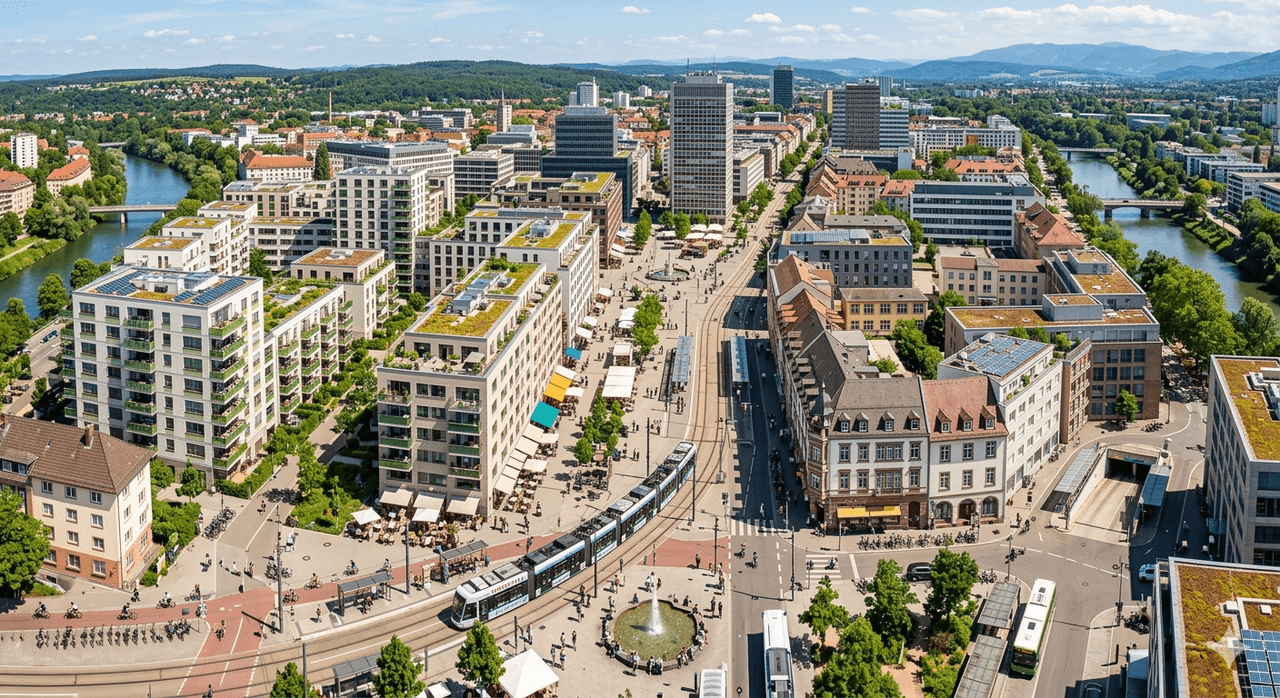
Kompakt Kent (Yapay Zeka ile Oluşturulmuştur.)
Compact City is a sustainable urban form model that emerged as a response to urban sprawl, centered on high residential and population density, mixed land use, and accessibility focused on public transportation. This model encourages vertical and intensive growth within the existing urban fabric by limiting the uncontrolled horizontal expansion of urban areas. Its primary objectives are to increase energy efficiency, minimize the consumption of natural resources and agricultural land, reduce infrastructure costs, and shrink the ecological footprint by decreasing dependence on private vehicles for transportation. Unlike traditional planning approaches, it presents urban functions as an integrated whole rather than separating them.
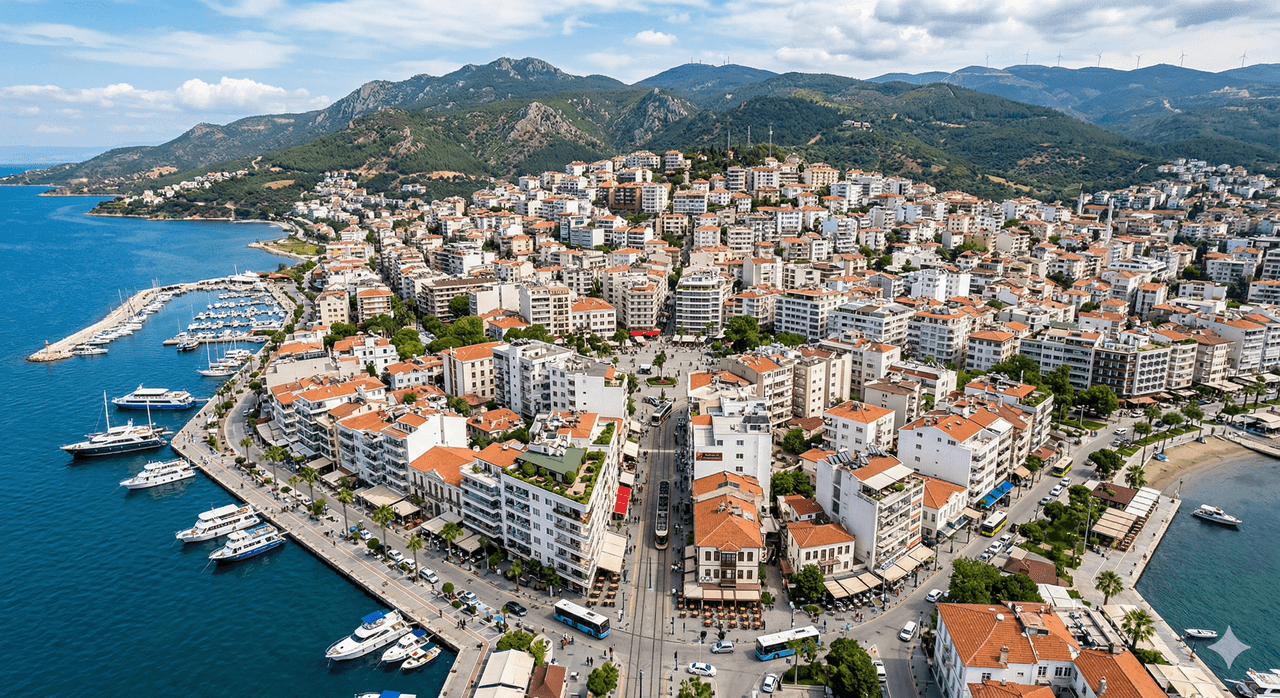
Compact City (Generated by Artificial Intelligence)
The theoretical foundation of the compact city concept was shaped in direct connection with global sustainability debates and accelerating ecological crises during the last quarter of the 20th century. This search for an urban form is fundamentally built on a strong critique of modernist urban planning paradigms and the resulting phenomenon of urban sprawl. The modernist planning tendency to strictly separate urban functions through zoning and its reliance on automobile-oriented horizontal growth led to the rapid depletion of agricultural land, forests, and water basins at urban fringes, unsustainable levels of infrastructure provision costs, and dangerous increases in fossil fuel consumption and greenhouse gas emissions. These emerging environmental, economic, and spatial bottlenecks have made the search for nature-compatible alternative urban forms in the literature an imperative.
In this context, the compact city theory aims to halt the horizontal expansion of cities by applying a macro-form “containment” strategy and to promote spatial “intensification” by directing urban growth inward into existing built environments.【1】Thus, its theoretical basis rests on the necessity of creating a holistic spatial organization that promotes inward growth, optimizes resource use, reduces demand for motorized transport through mixed land use, and protects the environment by revitalizing degraded areas, instead of the unchecked outward expansion that destroys natural ecosystems.
The most fundamental spatial strategy of the compact city model, high-density development, is not merely about vertical building height but about consolidating population, employment, and urban amenities within predefined physical boundaries (urban growth boundaries). This principle aims to halt horizontal growth known as uncontrolled urban sprawl. Consequently, valuable agricultural land, water basins, forests, and sensitive ecosystems at the urban fringe are protected from development pressure. Simultaneously, it necessitates the reactivation of idle, vacant, or derelict areas within the existing built environment. Economically, high density generates economies of scale by significantly reducing per capita costs of urban infrastructure services such as roads, water, sewerage, energy, and waste management, enabling more efficient public investment.【2】
The principle of mixed land use, developed in opposition to the modernist planning approach that divides urban areas into rigid functional zones such as residential, industrial, and commercial, envisions the spatial interweaving of living, working, education, leisure, and commercial functions. This integration minimizes the physical distance between residents’ homes and their workplaces or service destinations. The co-location of functions allows urban spaces to be used throughout the day rather than only during specific hours, enhancing urban vitality and street safety. The problem of urban desolation and spatial fragmentation caused by single-use zones—for example, office districts emptied after working hours or satellite dormitories used only at night—is eliminated. Individuals can access their daily basic needs without relying on motorized vehicles, thanks to the walkable spatial proximity created by this principle.
As a natural consequence and complement to the principles of high density and mixed land use, sustainable mobility is a comprehensive infrastructure framework designed to break dependence on automobiles in urban movement. Rail systems and public transit networks, which are economically unfeasible and costly to operate in dispersed, low-density horizontal settlements, can be efficiently operated in compact city forms because they easily reach the required “threshold population” density. This framework prioritizes pedestrians, cyclists, and public transport over private vehicles in urban mobility planning. As a result of reducing the need for private car ownership through spatial design, urban traffic congestion is mitigated, fossil fuel consumption and greenhouse gas emissions from transportation decline, and ultimately the city’s environmental quality improves, reducing its ecological footprint.
The compact city model is linked to sustainability parameters through ecological planning and climate change adaptation strategies. The model’s structural variables have measurable impacts on the environmental, economic, and social dynamics of urban areas.
The primary environmental function of the compact city form is to alter rates of horizontal land consumption. By limiting urban expansion, it halts the conversion of agricultural land, water basins, and forest areas at the urban fringe into built environments. Mixed land use and high building density reduce the physical distances between origin and destination points within the city. This decreases the rate of motorized vehicle use in daily transportation while increasing walking, cycling, and public transit use. This shift in transportation modes reduces greenhouse gas emissions directly linked to fossil fuel consumption. Additionally, the vertical or adjacent clustering of buildings alters the surface-area-to-volume ratio, influencing energy consumption for heating and cooling.
Economically, the compact form is decisive in determining the unit costs of urban infrastructure (roads, water, sewerage, energy networks) and public services. In areas with high population and building density, the physical length of required infrastructure lines shortens, reducing per capita infrastructure investment costs. Socially, mixed land use narrows the distance between residential areas and urban amenities. This structural proximity enables access to education, healthcare, and recreation facilities without motorized vehicles. The concentration of diverse urban functions within the same area increases the utilization rates of shared public spaces at different times of the day and enhances the likelihood of residents coexisting in the same spaces.
The compact city model is structurally related to the concept of urban resilience, which refers to a city’s capacity to maintain its physical integrity and functionality against climate change-induced environmental shocks such as extreme weather events, flooding, drought, and heatwaves. The model’s spatial variables play a decisive role in both mitigation and adaptation processes in combating climate change.
In terms of mitigation, the compact form limits fossil fuel consumption and associated urban greenhouse gas emissions by curbing urban sprawl and optimizing transportation networks. In terms of adaptation, controlling the physical boundaries of the city ensures that surrounding ecological corridors, water basins, and wetlands remain free from development pressure. These preserved natural buffers continue to perform vital functions such as flood management and surface water infiltration, supporting the built environment’s physical resistance to disaster risks.
In the context of energy management and urban heat island effect, the model embodies a dual dynamic. High-density, reinforced concrete-dominated development has the potential to increase surface temperatures and intensify the urban heat island effect. However, the spatial organization offered by the compact city makes the use of centralized infrastructure systems (regional heating and cooling networks) economically viable for managing this effect and optimizing energy consumption. Moreover, in vertical or adjacent building typologies, the reduction in external surface area per unit volume alters heat loss and gain ratios. This architectural morphology creates an objective parameter that influences cities’ capacity to adapt to changing climate conditions by reducing energy demand for climate control.
Urban morphology examines the street networks, parcel layouts, and building typologies that constitute the built environment. In the compact city model, these morphological elements are organized according to parameters of high density and accessibility. In terms of street networks, a permeable structure with high intersection density and small building blocks is emphasized. This high level of connectivity, achieved by minimizing cul-de-sacs, forms the fundamental spatial infrastructure that physically supports pedestrian and cycling mobility.
At the parcel and building scale, building density (FAR/GRF) is significantly high. Buildings are predominantly constructed in adjacent alignment with minimal setback from the street line, creating a continuous and defined street edge. Building typologies consist of multi-story blocks that house commercial uses on ground floors and residential units above, concretizing mixed-use principles at the building scale rather than single-use detached structures.
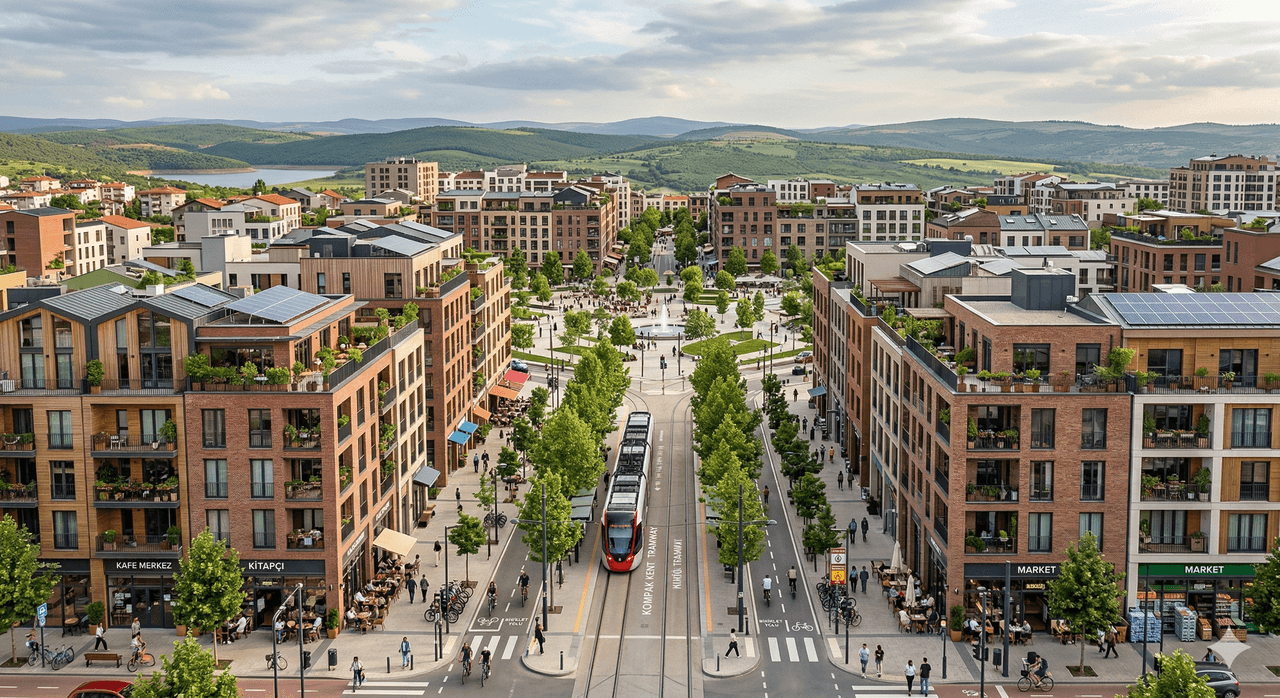
Compact City (Generated by Artificial Intelligence)
The compact city model creates a structural intersection with other contemporary sustainable planning approaches through variables of urban form, density, and land use.
The eco-city (ecological city) approach is based on a closed-loop metabolism in which urban areas function as part of natural ecosystems, aiming for zero waste, renewable energy use, and preservation of natural water cycles. The spatial boundaries and high building density provided by the compact city form create the physical infrastructure necessary to implement eco-city goals. Centralized ecological infrastructure systems—such as greywater treatment networks and regional renewable energy production grids—that are technically difficult and costly to implement in low-density settlements become feasible through the compact city’s economies of scale. Both models prioritize the protection of natural thresholds, agricultural land, and biodiversity by halting urban sprawl.
The smart city concept refers to the data-driven management of urban infrastructure and services—transportation, energy, lighting, security, and waste management—through information and communication technologies (ICT). The high population and building density of the compact city meet the data generation intensity and infrastructure optimization thresholds required for deploying smart grids and sensor networks. Particularly in transportation, the compact city’s mixed land use and public transit-oriented spatial design enable real-time monitoring of traffic flow, public transit routes, and energy consumption when integrated with intelligent transportation systems (ITS). The integration of digital data with the spatial proximity of urban functions shapes resource management toward sustainability goals based on objective data.
[1]
Elif Karakurt Tosun, "Sürdürülebilir Kentsel Gelişim Sürecinde Kompakt Kent Modelinin Analizi," Sosyal Bilimler Enstitüsü Dergisi 15, no. 1 (2013): 33-35. https://dergipark.org.tr/en/download/article-file/53315
[2]
Sılaydın Aydın, Mediha Burcu ve Emine Duygu Kahraman. "Kompakt Kent Üzerine Bir Değerlendirme." Planlama 29, no.2 (2019): 174-176. https://pdf.journalagent.com/planlama/pdfs/PLAN-86547-RESEARCH_ARTICLE-SILAYDIN_AYDIN.pdf

Kompakt Kent (Yapay Zeka ile Oluşturulmuştur.)
Development and Theoretical Foundations
Core Principles
High-Density Development
Mixed Land Use
Sustainable Mobility and Accessibility
Compact City within the Framework of Sustainability
Environmental and Ecological Impacts
Economic and Social Dimensions
Climate Change Adaptation and Resilience
Spatial Design in the Context of Urban Morphology
Relationship and Integration with Other Sustainable Settlement Modelsu
Ecological Planning and Eco-Cities
Compatibility with Smart City Principles