
This article was automatically translated from the original Turkish version.
Türkiye'nin exposure to sanctions under the Countering America's Adversaries Through Sanctions Act (CAATSA) stems from the intersection of Türkiye's long-term policy for acquiring air and missile defense systems and the United States' sanctions regime targeting Russia. The process was fundamentally shaped by Türkiye's decision to purchase the S-400 Triumf air defense system from Russia and the subsequent imposition of sanctions by the United States under Section 231 of CAATSA.
The CAATSA sanctions emerged as a legal enforcement mechanism reflecting longstanding disagreements between Türkiye and the United States in the defense industry. The process has not only affected bilateral defense relations but has also directly influenced technical compatibility debates within NATO, international defense procurement policies, and Türkiye's defense industry strategy.
Türkiye's defense relations with the United States gained a new dimension with Türkiye's accession to the North Atlantic Treaty Organization (NATO) in 1952. Following NATO membership, military training, joint exercises, defense industry cooperation, and military aid programs were developed; American defense platforms played a significant role in the modernization of the Turkish Armed Forces for many years.
During the Cold War, Türkiye, located on NATO's southern flank, was regarded as the alliance's forward defense line against the Soviet Union. Throughout this period, American defense industry products were widely used in modernizing Türkiye's air, land, and naval forces; numerous defense and security agreements were signed between the two countries.
From the 1990s onward, changes in the regional security environment led to evolving defense needs for Türkiye. The Gulf War, instability in Iraq, developments in Syria, and the growing ballistic missile capabilities in the Middle East increased the importance of long-range air and missile defense systems. During this period, Türkiye prioritized enhancing its existing air defense capabilities as a core objective in its defense planning.
Türkiye's efforts to acquire a long-range air and missile defense system are not driven solely by short-term security needs. Following the 1991 Gulf War, Iraq's ballistic missile capability, Iran's subsequent missile program, security risks along the Syrian border during the civil war, and shifting perceptions of regional threats accelerated Türkiye's initiatives in this domain.
During this period, NATO allies periodically deployed Patriot air defense systems in Türkiye. However, these deployments were temporary and did not eliminate Türkiye's need for a permanent, indigenous long-range air defense system.
In its defense planning, Türkiye did not limit its goal to purchasing a ready-made system; technology transfer, joint production, and the development of a domestic defense industry were also key objectives. Consequently, during international negotiations, technology sharing and production partnerships were evaluated alongside cost.
To meet its long-range air defense system requirements, Türkiye evaluated systems developed by various countries. Technical and commercial discussions were conducted on the United States' Patriot system, the European co-developed SAMP/T system, China's HQ-9 system, and Russia's S-400 system.
During negotiations, the technical capabilities, delivery timelines, costs, technology transfer potential, joint production options, and maintenance and sustainment processes of these systems were assessed. Guided by its goal of reducing dependence on foreign suppliers, Türkiye prioritized models that offered technology sharing and contributions to domestic production.
Negotiations with different countries continued over various periods but failed to yield desired outcomes due to technical, financial, and political reasons. This process was one of the developments that paved the way for later talks with Russia on the S-400 system.
Türkiye's negotiations with Russia regarding the S-400 air defense system emerged after years of searching for an appropriate air defense solution. As a result of these talks, an agreement on the procurement of the S-400 air defense system was signed between the two countries in 2017; delivery began in 2019.
Following the commencement of S-400 deliveries to Türkiye, the United States administration announced that the acquisition would be evaluated under CAATSA, initiating a new phase in diplomatic and defense relations between Türkiye and the United States.
CAATSA is a federal law enacted by the U.S. Congress in 2017 to regulate sanctions mechanisms targeting Russia, Iran, and North Korea. Under the law, individuals, institutions, and organizations engaging in "significant transactions" with Russia's defense and intelligence sectors may be subject to sanctions. The sanctions applied to Türkiye were implemented under Section 231 of this legal framework.
The U.S. administration assessed Türkiye's agreement with Rosoboronexport, Russia's state defense export company, as a "significant transaction" under CAATSA. Subsequently, on December 14, 2020, sanctions were announced targeting the Presidency of Defense Industries and certain officials.
The CAATSA process did not remain limited to sanctions alone; it also affected Türkiye's status in the F-35 Joint Strike Fighter Program, defense industry projects, technology transfer processes, F-16 procurement, national defense initiatives, and the future trajectory of Türkiye-US defense relations.
Türkiye's policy to acquire a long-range air and missile defense system has been a core priority in its defense planning since the early 1990s. The changing regional security environment after the end of the Cold War, advances in ballistic missile technology, and crises in Türkiye's neighborhood made strengthening air defense capabilities imperative. In particular, Iraq's ballistic missile capability following the Gulf War was one of the first developments that underscored the importance of long-range air defense systems for Türkiye. Subsequent advances in Iran's missile program, the civil war in Syria, and the diversification of security risks in the Middle East further highlighted this need.
The short- and medium-range air defense systems in the inventory of the Turkish Armed Forces provided protection against specific threats but could not establish a comprehensive defense umbrella against long-range ballistic missiles and high-altitude aerial threats. Therefore, Türkiye included in its long-term defense objectives the acquisition of a system capable of protecting its national airspace, operating at high altitudes, and providing area-wide air defense.
The use of Scud ballistic missiles by Iraq against Israel and Saudi Arabia during the 1991 Gulf War highlighted the regional security significance of ballistic missile threats. Although Türkiye was not directly targeted, the strengthening of its air defenses became a topic on the agenda under NATO security measures during the conflict.
With the start of the Iraq War in 2003, security risks along Türkiye's southern border increased again, and potential missile threats from Iraq were brought onto NATO's agenda. Subsequent advances in Iran's ballistic missile capabilities and security issues along the border during the Syrian civil war that began in 2011 further intensified Türkiye's need for a long-range air defense system.
During the Syrian civil war, rocket and artillery shells falling on border regions, along with international debates on the regime's ballistic missile capabilities and chemical weapons use, became key developments accelerating Türkiye's policy to acquire a national air defense system.
As Türkiye's need for a long-range air defense system grew, NATO allies deployed Patriot air defense systems in Türkiye during various periods. Following temporary deployments during the 1991 Gulf War, a new air defense mission was established in 2012 at Türkiye's request, particularly as the Syrian crisis deepened.
Under this mission, Patriot air defense batteries were deployed by the United States, Germany, and the Netherlands around Gaziantep, Kahramanmaraş, and Adana. The primary mission of these systems was to deter ballistic missile threats from Türkiye's southern border and contribute to NATO air defense.
The Patriot systems operated under NATO command and were operated by different allied countries on a rotational basis before being gradually withdrawn upon completion of their missions. These systems, deployed temporarily under NATO mandates, were not integrated into Türkiye's inventory and served exclusively within the scope of the NATO mission.
This situation did not alter Türkiye's objective of acquiring a permanent, nationally controlled long-range air defense system.
To meet Türkiye's long-range air defense system requirement, the Defense Industry Executive Committee launched the "Turkish Long-Range Regional Air and Missile Defense System Project" (T-LORAMIDS). The project's primary goal was not merely to purchase a ready-made system but to establish a comprehensive procurement model that ensured technology transfer, joint production, maintenance and sustainment capabilities, and the development of a domestic defense industry.
Systems developed by various countries participated in the tender process. The United States' Raytheon and Lockheed Martin partnership offered the Patriot PAC-3 system; the European consortium Eurosam offered the SAMP/T system; Russia's Rosoboronexport offered the S-300VM system; and China's CPMIEC offered the HQ-9 air defense system.
In evaluating the proposals, not only military capabilities but also delivery timelines, costs, technology transfer, joint production opportunities, maintenance infrastructure, and contributions to the domestic industry were considered.
Following an evaluation by the Defense Industry Executive Committee in 2013, China's CPMIEC-developed HQ-9 air defense system was ranked first. The decision cited cost advantages and the technology transfer and joint production offers as decisive factors.
However, the Chinese company's presence on the U.S. sanctions list, debates over the system's compatibility with NATO infrastructure, and objections from allied countries led to intense international scrutiny of the process.
During ongoing negotiations, no definitive agreement was reached on technology sharing, joint production models, or contract terms. Consequently, Türkiye announced in 2015 that it had canceled the HQ-9 tender and restarted the long-range air defense system procurement process.
After the cancellation of the HQ-9 tender, Türkiye resumed negotiations with the United States and European countries. Technical and commercial talks were conducted with the United States regarding the Patriot system and with Eurosam regarding the SAMP/T system.
In these negotiations, Türkiye prioritized technology transfer, joint production, pricing, delivery timelines, and maintenance and sustainment capabilities. Particularly, in line with its goal of reducing dependence on foreign suppliers, the transfer of critical technologies to the domestic industry was among Ankara's key expectations.
The U.S. administration made various offers regarding the sale of the Patriot system, but full agreement on technology transfer and joint production could not be reached. Similarly, negotiations on the European co-developed SAMP/T system continued, but no final agreement capable of meeting Türkiye's immediate needs was achieved in the short term.
Türkiye's fundamental approach in its air defense system procurement process was not merely to purchase a system. To reduce dependence on foreign suppliers, technology transfer, joint production, development of domestic engineering capacity, and the ability to produce critical subsystems domestically were integral components of its procurement policy.
Under this approach, negotiations aimed to transfer radar technologies, command and control systems, missile production, maintenance infrastructure, and software capabilities to the domestic defense industry as much as possible. The foundation for many domestic air defense projects developed in subsequent years, most notably the SİPER air defense system, was established within the framework of these defense policies.
After prolonged negotiations on the Patriot, HQ-9, and SAMP/T systems failed to yield desired results, Türkiye initiated talks with Russia regarding a long-range air defense system. Technical and political engagements between the two countries led to accelerated negotiations on the S-400 Triumf air defense system, eventually laying the groundwork for one of the most comprehensive defense industry agreements between Türkiye and Russia.
Türkiye's contacts with the Russian Federation regarding long-range air defense system procurement gained momentum after negotiations with other countries failed to deliver desired outcomes. Following discussions on the Patriot, SAMP/T, and HQ-9 systems, Ankara continued its evaluations of alternative systems capable of meeting its air defense needs and initiated technical assessments of Russia's S-400 Triumf air defense system.
Defense-related engagements between Türkiye and Russia intensified into a more active diplomatic process from 2016 onward. High-level talks between the two countries addressed energy, trade, regional security, and defense industry cooperation. Long-range air defense system procurement became one of the most important issues in Türkiye-Russia relations during this period.
The S-400 Triumf is a long-range air and missile defense system developed by Russia. The system was designed to counter high-altitude aircraft, cruise missiles, unmanned aerial vehicles, and certain ballistic missile threats.
The S-400 system features a multi-layered air defense architecture and can simultaneously employ different missile types with varying ranges. Thanks to advanced radar systems, it can track multiple aerial targets simultaneously and engage different targets at the same time. The system consists of an integrated air defense structure including early warning radars, target acquisition radars, command and control centers, missile launchers, and support elements.
Developed by Russia, the system has also been integrated into the inventories of countries such as China, India, and Belarus. Türkiye's decision to procure the S-400 system attracted widespread international attention as it marked the first time a NATO member acquired a Russian-made strategic air defense system.
During technical negotiations between Türkiye and Russia, the system's cost, delivery schedule, training activities, maintenance and sustainment processes, and financing model were discussed. Technology transfer and defense industry cooperation were also key topics.
Defense industry cooperation was discussed on various occasions during talks between President Recep Tayyip Erdoğan and Russian President Vladimir Putin; technical teams eventually reached an agreement on the terms of the deal.
The agreement for the procurement of the S-400 Triumf air defense system between Türkiye and Russia was signed in September 2017. Under the approximately $2.5 billion agreement, Türkiye committed to purchasing two S-400 air defense batteries. The agreement became one of Türkiye's largest defense procurement projects to date.
Following the signing of the agreement, both parties initiated preparations for the delivery schedule, personnel training, and the deployment of the systems in Türkiye. Training for Turkish personnel by Russian experts was planned, and technical work on the shipment of the systems commenced.
The first components of the S-400 systems arrived at Ankara's Mürted Air Force Command on July 12, 2019, transported by Russian military cargo aircraft. Following the initial delivery, shipments of radar systems, missile launchers, command and control units, and support equipment continued according to the agreed schedule.
The delivery process was closely monitored by both Türkiye and the international press; the landing of Russian military aircraft in Ankara was recorded as a milestone indicating the formal commencement of the S-400 process.
Deliveries continued over several months; installation, testing, and personnel training were conducted simultaneously.
Following the commencement of deliveries, training activities were conducted to enable Turkish personnel to operate the system. Technical training covered system operation, maintenance, radar management, missile preparation, and command and control procedures.
Additionally, infrastructure preparations for the deployment locations were completed; radar placements, power infrastructure, and logistical support elements were established.
The delivered systems were stored at Mürted Air Force Command near Ankara, and subsequent testing activities were conducted. Türkiye announced that the systems would be used solely to meet national air defense needs and would not be integrated into the NATO command and control network.
Turkish officials stated that the S-400 systems would operate entirely independently, would not share data with NATO systems, and would serve exclusively within the scope of Türkiye's national air defense requirements.
Türkiye's decision to purchase the S-400 air defense system prompted extensive evaluations among NATO member countries and the international security community. NATO officials emphasized the importance of technical compatibility within the alliance's integrated air and missile defense architecture, while the U.S. administration expressed various security concerns regarding the use of Russian-made strategic air defense systems alongside NATO infrastructure.
Türkiye clarified that the S-400 systems would not be connected to NATO networks, would operate independently, and would not engage in data exchange with any allied country's defense systems. After the completion of deliveries, diplomatic engagements between Türkiye and the United States entered a new phase; the S-400 procurement process became one of the central agenda items for subsequent developments related to CAATSA sanctions and the F-35 program.
Türkiye's decision to purchase the S-400 Triumf air defense system from Russia was closely monitored by the U.S. administration from the moment the deal was first announced. Washington stated that this defense cooperation between Türkiye and Russia could affect not only bilateral relations but also NATO's integrated defense architecture. Accordingly, beginning in 2017, the U.S. administration launched various diplomatic initiatives urging Türkiye to abandon the S-400 procurement and instead choose the U.S.-made Patriot air defense system.
U.S. officials emphasized that, as a NATO member, Türkiye should use systems compatible with the alliance's defense infrastructure. They argued that integrating Russian-developed strategic air defense systems into NATO's command and control structure could pose technical and security risks.
One of the U.S.'s primary objections to the S-400 acquisition is its lack of technical compatibility with NATO's integrated air and missile defense infrastructure.
Air defense systems within NATO operate based on common command and control networks, data sharing, identification friend or foe (IFF) systems, radar integration, and joint operational planning. Systems such as Patriot and SAMP/T used by NATO members have been developed to meet NATO standards and integrated into the alliance's common air defense architecture.
According to the U.S. administration, the S-400 system was developed outside this infrastructure and therefore cannot be integrated into NATO networks. Consequently, the deployment of a Russian-made strategic air defense system in a NATO member country created a new situation in terms of the alliance's technical standards.
Türkiye, however, clarified that the S-400 systems would not be connected to NATO networks, would operate independently, and would not exchange data with NATO command and control systems. Ankara argued that this technical incompatibility did not constitute a practical security issue.
The U.S.'s most significant objection is that the S-400 systems will be deployed in Türkiye alongside the F-35 Joint Strike Fighter aircraft.
The U.S. administration contends that the advanced radars in the S-400 systems could collect data on the flight characteristics, radar cross-section, and stealth features of the F-35 fighter jets. According to the U.S., the analysis of this data by Russian defense industry entities over time could undermine the technological superiority of the F-35 program.
Assessments by the U.S. Department of Defense (Pentagon) and various security agencies concluded that it would be unacceptable for the F-35 and S-400 systems to coexist in the same country. Therefore, the U.S. administration publicly stated on multiple occasions that Türkiye could not operate both the S-400 systems and the F-35 fighter jets simultaneously.
Türkiye rejected these assessments, asserting that the S-400 systems would not be connected to NATO networks and would not share data with F-35 aircraft, and maintained that the alleged security risks were not technically substantiated.
Another argument raised by the U.S. administration is that large-scale purchases from Russian defense industry companies would provide economic benefits to Moscow's defense sector.
One of the primary objectives of the CAATSA law, enacted by the U.S. Congress in 2017, is to limit significant commercial transactions with Russia's defense and intelligence sectors and to impose sanctions on individuals or organizations engaging in such transactions.
The U.S. administration stated that Türkiye's agreement with Rosoboronexport, Russia's state defense export company, fell under the scope of CAATSA and qualified as a "significant transaction" under Section 231 of the law.
The U.S. administration made various offers regarding the Patriot air defense system in an effort to persuade Türkiye to abandon the S-400 procurement.
Negotiations were conducted on the sale of the Patriot system, covering delivery schedules, costs, training activities, and technical specifications. However, full agreement could not be reached on issues such as technology transfer, joint production, and pricing.
The U.S. administration repeatedly stated that the S-400 crisis could have been avoided if Türkiye had chosen the Patriot system; Türkiye, however, maintained that it had been unable to secure the Patriot system under its desired conditions over many years, prompting it to pursue alternatives.
As the S-400 delivery process approached, the U.S. administration intensified its diplomatic efforts. Statements from the State Department, Defense Department, and White House indicated that Türkiye could face consequences if it accepted the S-400 systems.
Members of the U.S. Congress also called for sanctions against Türkiye in various statements, asserting that the S-400 acquisition could negatively impact trust within NATO.
During high-level talks between the two countries during this period, the Patriot system, S-400 procurement, F-35 program, and potential CAATSA sanctions formed the core agenda items.
Türkiye proposed the establishment of a joint technical working group to examine the U.S.'s security concerns at a technical level. Ankara stated that a technical commission, including NATO experts, could assess the impact of the S-400 systems on NATO infrastructure and technically verify that the systems would operate independently.
Turkish officials emphasized that their proposal aimed to evaluate security concerns based on concrete data. The U.S. administration, however, rejected the proposal, stating that the core issue was not technical but strategic cooperation with the Russian defense industry.
No common solution was reached through diplomatic talks between 2017 and 2019. Türkiye proceeded with the S-400 procurement as planned; the U.S. administration declared that sanctions under CAATSA would be applied if deliveries occurred and that Türkiye's status in the F-35 program would be reassessed.
On July 12, 2019, with the arrival of the first S-400 components in Türkiye, the diplomatic process entered a new phase; the U.S. administration accelerated preparations for implementing sanctions. This development marked the beginning of the process to apply CAATSA sanctions against Türkiye.
CAATSA (Countering America's Adversaries Through Sanctions Act) is a federal sanctions law enacted by the U.S. Congress and entered into force on August 2, 2017. The law consolidates sanctions mechanisms targeting Russia, Iran, and North Korea and authorizes sanctions on specific transactions involving these countries' defense, intelligence, energy, and financial sectors.
The legal basis for the sanctions applied to Türkiye is found in Section 231 of the law. This section mandates sanctions against individuals, institutions, or organizations engaging in "significant transactions" with the defense or intelligence sectors of the Russian Federation. The U.S. administration assessed Türkiye's agreement with Rosoboronexport for the S-400 air defense system as falling under this provision.
Under CAATSA, the U.S. President is required to implement at least five of the sanctions options specified in the law. While the President has discretion in selecting which sanctions to apply, the scope for deciding whether to apply sanctions at all is limited. In this regard, CAATSA is a binding federal law enacted directly by Congress, distinct from traditional presidential sanctions programs.
Following the commencement of S-400 system deliveries to Türkiye in July 2019, diplomatic contacts between the two countries continued. The U.S. administration made various efforts to encourage Türkiye not to activate the systems, while Ankara maintained that the agreement had been completed and that deliveries would proceed as planned.
During this period, numerous talks were held at the level of Presidents, Foreign Ministers, and Defense Ministers. Discussions covered the Patriot system, the F-35 program, technical compatibility within NATO, and potential sanctions options. However, no common solution emerged from these diplomatic efforts, and the U.S. administration continued its sanctions process.
Following the commencement of S-400 deliveries, the U.S. administration announced in July 2019 that Türkiye's participation in the F-35 Joint Strike Fighter Program was suspended. Accordingly, deliveries of F-35 fighter jets planned for Türkiye were halted, training programs for Turkish pilots in the United States were terminated, and responsibilities of Turkish defense industry companies within the production chain began to be transferred to other countries.
Türkiye contested the decision, asserting that it had fulfilled its financial obligations as a partner country and assumed significant responsibilities in the production process. Ankara maintained that the S-400 procurement did not invalidate Türkiye's participation in the F-35 program; diplomatic talks on this issue continued for some time.
Although the removal from the F-35 program and CAATSA sanctions represent distinct legal processes, both developments were consequences of the same security crisis.
On December 14, 2020, the U.S. Department of the Treasury officially announced the imposition of CAATSA sanctions on Türkiye. The announcement stated that the sanctions were applied due to the S-400 agreement with Rosoboronexport, Russia's defense industry sector.
With this announcement, Türkiye became the first NATO member country to be subjected to CAATSA sanctions. The U.S. administration emphasized that the sanctions were not directed against the Republic of Türkiye or the Turkish Armed Forces but specifically targeted the Presidency of Defense Industries (SSB).
The center of the CAATSA sanctions was the Presidency of Defense Industries. Pursuant to the decision by the U.S. Department of the Treasury, SSB was prohibited from obtaining new export licenses from the United States, and various restrictions were imposed on American companies entering into new defense industry projects with the Presidency.
The sanctions included:
The sanctions did not directly target the existing inventory of the Turkish Armed Forces but affected procurement processes for U.S.-origin subsystems and defense technologies.
In addition to the Presidency of Defense Industries, certain senior officials of the institution were also placed on the sanctions list by the U.S. Department of the Treasury.
These included:
The sanctions included freezing of potential assets held by these individuals in the United States, prohibition of certain financial transactions with U.S. citizens and companies, and restrictions on entry into the United States.
In its initial response to the CAATSA sanctions, Türkiye stated that the decision violated international law and allied relations. The Ministry of Foreign Affairs emphasized that the sanctions were unilateral and called on the U.S. administration to reverse the decision.
Ankara reiterated that the S-400 air defense system was acquired to meet Türkiye's national security needs, that sovereign states have the right to procure defense systems from any country to meet their defense requirements, and that the system would not be integrated into NATO infrastructure.
Türkiye also reiterated its earlier proposal for a joint technical commission to examine security concerns at a technical level, asserting that the issue could be resolved through dialogue rather than sanctions.
Following the announcement of the CAATSA sanctions, various assessments were made by NATO allies and the international community. The NATO Secretary General emphasized the importance of resolving the disagreement between Türkiye and the United States through dialogue; several allied countries in Europe stated that the crisis between two NATO members was being closely monitored in terms of alliance cohesion.
The U.S. administration, however, stated that the sanctions were not directed against Türkiye's NATO membership but were merely the application of a legal provision concerning the S-400 agreement with Russia's defense sector.
With the implementation of the CAATSA sanctions, Türkiye-U.S. defense industry relations entered a new phase. Procurement processes for certain U.S.-origin subsystems used in defense projects were prolonged, and new licensing procedures were introduced for products subject to export licenses.
In parallel, Türkiye accelerated its efforts toward localization in the defense industry, increasing funding for domestic projects in areas such as engine technology, radar systems, electronic warfare, munitions, and air defense. Work to establish alternative supply chains in the defense industry also gained momentum during this period.
The application of CAATSA sanctions did not completely terminate Türkiye-U.S. defense relations; cooperation within NATO, regional security issues, and diplomatic contacts continued.
Although the CAATSA sanctions did not directly target the Republic of Türkiye or the Turkish Armed Forces, they had significant consequences for Türkiye's defense industry through the Presidency of Defense Industries. The suspension of new export licenses by the United States directly affected procurement processes for U.S.-origin subsystems used in certain defense projects; new licensing procedures were introduced for products subject to export licenses.
Due to the significant share of U.S.-origin products in engine systems, electronic components, avionics equipment, optical systems, precision munitions parts, and various software technologies used in defense projects, alternative supply channels had to be established for some projects.
Following the sanctions, efforts to increase the localization rate in projects led by the Presidency of Defense Industries accelerated; investment programs for developing critical technologies domestically were expanded.
Following the CAATSA sanctions, Türkiye continued to reduce dependence on foreign suppliers as a core strategic objective. Accordingly, investments in domestic engine development projects, electronic warfare systems, radar technologies, communication infrastructure, electro-optic systems, munitions production, and air defense technologies were increased.
Public institutions and private sector companies operating in the defense industry launched new R&D projects aimed at developing critical subsystems domestically. During the same period, international cooperation to establish alternative supply chains with other countries was also developed.
The localization policy was not only implemented to ensure the continuity of current projects but also to build a sustainable defense industry infrastructure capable of mitigating the impact of similar future sanctions.
One of the areas most affected by the CAATSA process was Türkiye's participation in the F-35 Joint Strike Fighter Program.
Türkiye joined the program as a partner country in 1999 and, over subsequent years, contributed financially and assumed responsibilities within the production chain through Turkish defense industry companies. Under the program, Turkish companies produced fuselage parts, mid-fuselage components, composite structures, landing gear parts, cockpit displays, and various electronic subsystems.
Türkiye's total financial contribution to the program was estimated at approximately $1.4 billion. It was also projected that Turkish defense industry companies' long-term involvement in the F-35 production chain would generate billions of dollars in export potential.
Following the U.S. decision to remove Türkiye from the program, the F-35 fighter jets planned for delivery were not delivered, training activities for Turkish pilots in the United States were terminated, and Turkish companies' production responsibilities were gradually transferred to other producer countries.
The decision to remove Türkiye from the F-35 production chain had economic consequences for Türkiye's defense industry.
Companies producing under the program had their new orders halted, and production responsibilities were transferred to manufacturers in other countries after a transition period.
However, the production infrastructure, engineering capabilities, and quality standards developed in Türkiye were redirected toward other national defense projects; the production experience gained continued to be utilized in subsequent domestic projects.
Following its removal from the F-35 program, Türkiye accelerated its efforts to modernize its existing F-16 fleet. In this context, in October 2021, Türkiye formally applied to the United States to purchase 40 new F-16 Block 70 fighter jets and 79 modernization kits for its existing fleet.
The application process was reviewed for an extended period by the U.S. Congress, becoming the subject of various political debates linked to Türkiye's foreign policy and Sweden's NATO accession process.
After the U.S. administration approved the sale in 2024, the process regained momentum; the F-16 procurement became one of the key developments that facilitated renewed dialogue in Türkiye-U.S. defense relations.
Following the CAATSA sanctions, Türkiye's national defense projects became more visible. Leading this effort is the KAAN National Combat Aircraft project developed by Turkish Aerospace Industries (TUSAŞ).
The KAAN is designed as Türkiye's fifth-generation fighter aircraft program, aiming to meet the future combat aircraft needs of the Turkish Air Force through domestic capabilities.
The first prototype of KAAN flew in 2024, and its development process is regarded as one of the key initiatives to enhance technological independence in the defense industry.
The initial production blocks of the KAAN project are planned to use General Electric F110 engines manufactured in the United States. Consequently, the engine procurement process has remained one of the significant issues in Türkiye-U.S. defense relations.
In 2026, the U.S. administration formally notified Congress of a proposed sale of F110 engines and related equipment to Türkiye valued at approximately $700 million. It was announced that the sale could proceed if Congress did not object within the specified timeframe.
This development is among the signs that technical cooperation in the defense industry between the two countries has not completely ended despite the ongoing CAATSA sanctions.
Following the CAATSA sanctions, Türkiye pursued not only domestic production but also efforts to develop defense industry cooperation with other countries.
In this context, new cooperation agreements were established with various manufacturers in Europe and Asia in areas such as engine technology, electronic systems, radar components, munitions, and air defense. Policies were implemented to ensure that critical technologies are not dependent on a single country.
The alternative procurement approach became one of the fundamental elements of policies aimed at enhancing supply security in the defense industry and mitigating the impact of potential sanctions.
Following the CAATSA sanctions, Türkiye's defense industry policies became more focused on localization, technology transfer, nationalization of critical subsystems, and strategic independence.
Efforts to develop domestic engineering capacity, increase R&D investments, produce critical technologies domestically, and diversify defense exports continued.
These policies became foundational elements of long-term planning in the defense industry and have guided Türkiye's domestic projects in air defense systems, fighter aircraft, radar technologies, and electronic warfare.
Although various disagreements persisted in Türkiye-U.S. defense relations after the implementation of CAATSA sanctions, diplomatic contacts between the two countries were not interrupted. As NATO allies, Türkiye and the United States continued their cooperation on common security agendas including Black Sea security, the Russia-Ukraine War, counterterrorism, energy security, developments in the Eastern Mediterranean, and the Middle East.
From 2021 onward, talks at the level of Presidents, Foreign Ministers, Defense Ministers, and military delegations addressed not only regional security issues but also CAATSA sanctions, the F-35 program, F-16 procurement, and the future of defense industry cooperation.
NATO Summits in 2023 and 2024, along with bilateral contacts, helped preserve the diplomatic groundwork for reviving dialogue in the defense sector.
Türkiye's October 2021 request for 40 new F-16 Block 70 fighter jets and 79 modernization kits became one of the most important agenda items in Türkiye-U.S. defense relations.
The sale process was reviewed by the U.S. Congress for approximately two years, during which Türkiye's foreign policy, its role within NATO, and Sweden's NATO accession process became subjects of political debate.
After the Turkish Grand National Assembly approved Sweden's NATO membership in 2024, a significant portion of political objections in Congress was removed; the U.S. administration formally approved the sale.
The approval of the F-16 sale marked one of the developments indicating the resumption of dialogue in the defense sector between the two countries. However, the sale process did not imply the lifting of CAATSA sanctions; both issues continued to be evaluated under separate legal processes.
Despite the CAATSA sanctions, military cooperation between Türkiye and the United States did not end entirely. The two countries maintained coordination in NATO activities such as air policing missions, joint exercises, intelligence sharing, Black Sea security, NATO operations in the Balkans, and counterterrorism.
Additionally, cooperation on NATO's shared defense infrastructure, including Incirlik Air Base, continued; both parties preserved military coordination mechanisms for regional crises.
This process demonstrated that the CAATSA sanctions targeted specific defense industry transactions, while alliance relations within NATO continued to endure.
In 2024 and 2025, technical contacts between the two countries regarding defense industry intensified. Discussions were held on F-16 procurement, modernization of the existing fleet, maintenance and sustainment activities, various munitions systems, and engine technologies.
The U.S. administration's positive approach toward the sale of General Electric F110 fighter jet engines to Türkiye was also among the developments demonstrating that technical cooperation in the defense sector continued.
The two parties also continued technical assessments on potential areas for joint work within NATO.
In 2026, the future of CAATSA sanctions was once again on the agenda during diplomatic talks between Türkiye and the United States. High-level discussions between the two countries addressed the enhancement of defense industry cooperation, the impact of existing sanctions on bilateral relations, and potential areas for renewed collaboration in defense projects.
Progress in the F-16 process, initiatives regarding F110 engine sales, and coordination within NATO contributed to renewed momentum in evaluating the future of the sanctions.
In July 2026, Foreign Minister Hakan Fidan stated that discussions regarding CAATSA sanctions between Türkiye and the United States were ongoing.
Fidan indicated that technical and diplomatic efforts to enhance defense industry cooperation were continuing and that initiatives to lift the sanctions were underway. He also emphasized the importance of defense cooperation between two NATO allies in the current international security environment and stated that the issues could be resolved through dialogue.
Following Donald Trump's return to the U.S. presidency, statements regarding Türkiye's defense relations re-emerged on the agenda. Trump previously highlighted the challenges Türkiye faced in the Patriot system procurement process and stated that Ankara's air defense needs had shifted direction due to policies of previous administrations.
In 2026, the U.S. administration's formal notification to Congress regarding the sale of F110 engines and the continuation of technical contacts in the defense sector led to assessments that a more pragmatic approach was being adopted in bilateral relations. However, no official decision to lift the CAATSA sanctions was announced by the U.S. administration.
As CAATSA is a federal law enacted by the U.S. Congress, lifting the sanctions requires a different legal process than other sanction programs.
Although the President has the authority under the law to delay or grant exemptions for certain sanctions, the complete removal of the sanction mechanism cannot be achieved solely by the President's political decision.
Due to Congress's legislative authority and CAATSA's status within federal law, altering or removing the sanctions requires adherence to specific legal procedures.
Therefore, ongoing diplomatic talks between Türkiye and the United States do not, by themselves, change the legal status of the sanctions.
As of 2026, diplomatic contacts between Türkiye and the United States have intensified compared to previous years. Technical talks in the defense industry, progress in the F-16 process, initiatives regarding F110 engines, and coordination within NATO demonstrate that Türkiye-U.S. defense relations continue to exist.
However, Türkiye's unchanged stance on the S-400 air defense systems continues to support the U.S. position that the fundamental justification for the CAATSA sanctions remains in place.
Therefore, the future of the sanctions will continue to be shaped by the U.S. Congress's approach, the U.S.'s broader sanctions policy toward Russia, the trajectory of Türkiye-U.S. defense relations, and the outcomes of ongoing diplomatic talks.
U.S. President Donald Trump, following a meeting with President Recep Tayyip Erdoğan at the NATO Summit of Heads of State and Government held in Ankara on July 7, 2026, made statements regarding the CAATSA sanctions against Türkiye. Trump indicated that he would work to lift the CAATSA sanctions against Türkiye, stating, "We will lift the sanctions imposed on Türkiye. We do not wish to impose sanctions on our friends." He also announced that the process to lift the sanctions would be carried out in coordination with U.S. Secretary of State Marco Rubio and Defense Secretary Pete Hegseth.
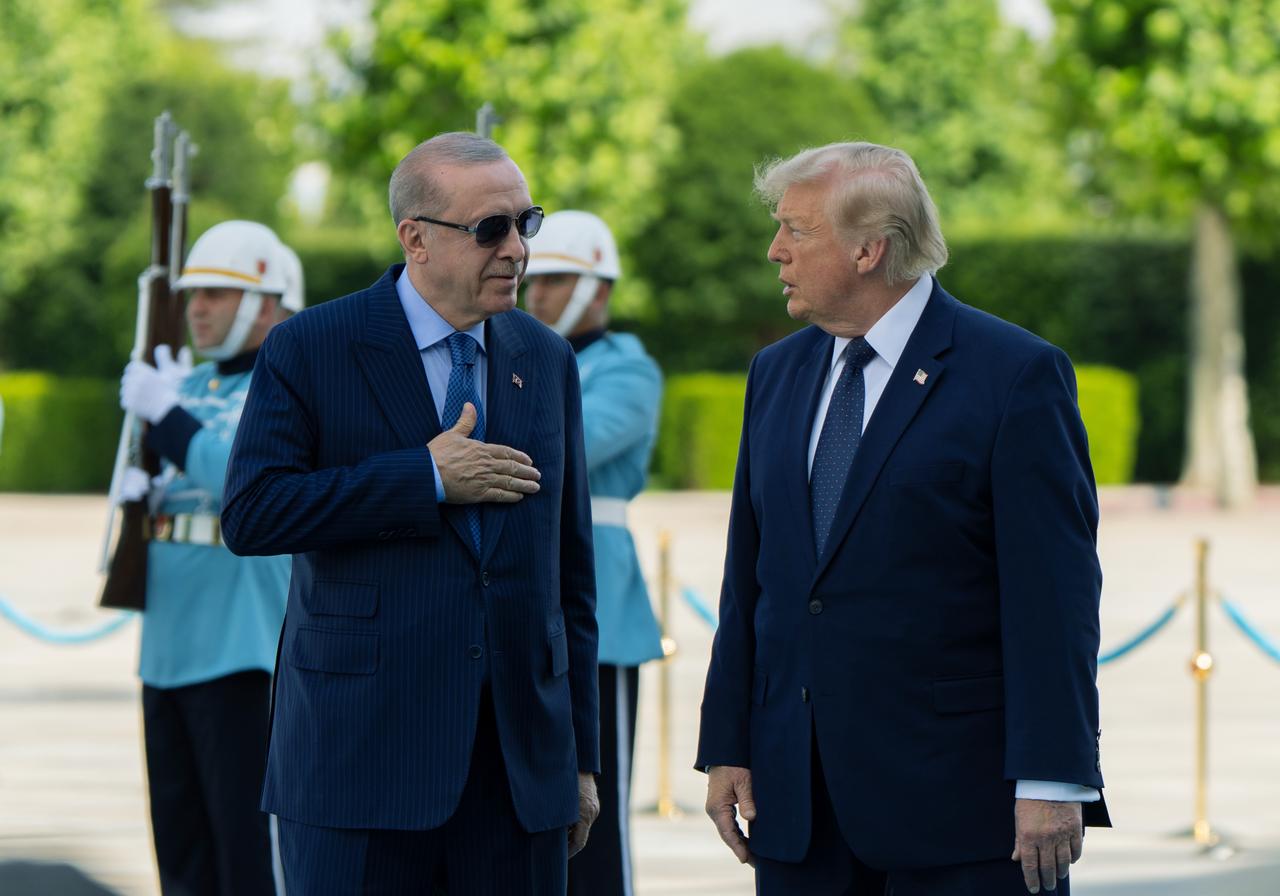
Official Welcoming Ceremony for U.S. President Donald Trump by President Recep Tayyip Erdoğan. (July 7, 2026) Anadolu Agency
In subsequent remarks, Trump stated that the United States wanted to enhance defense cooperation with Türkiye and indicated that the possibility of reselling F-35 fighter jets to Türkiye would also be considered. He emphasized the importance of strengthening Türkiye-U.S. relations and stated that a new era of defense industry cooperation was being evaluated.
Trump's statements reignited diplomatic expectations regarding the future of the CAATSA sanctions. However, because CAATSA is a federal law enacted by the U.S. Congress, the President's political statements do not mean that the sanctions have been legally lifted. Under U.S. legal procedures, lifting or modifying the sanctions requires a separate legal process that follows the procedures outlined in CAATSA and involves the role of Congress. Therefore, the statements made on July 7, 2026, were recorded not as a formal legal decision to lift the sanctions but as a political declaration initiating the process.
Al Monitor. "Trump Says US Will Lift CAATSA Sanctions on Turkey, Consider F-35 Sale." Al-Monitor, July 7, 2026. Accessed July 8, 2026.
Anadolu Ajansı. "Dışişleri Bakanı Fidan: CAATSA yaptırımları konusunda gereken adımları atıyoruz." Accessed July 6, 2026.https://www.aa.com.tr/tr/gundem/disisleri-bakani-fidan-caatsa-yaptirimlari-konusunda-gereken-adimlari-atiyoruz/3984709
Assent. "What Is CAATSA?" Accessed July 8, 2026.https://www.assent.com/resources/knowledge-article/what-is-caatsa/
BBC. "What Are the CAATSA Sanctions Imposed on Türkiye and What Trump Said He Would Lift?" BBC News Türkçe, July 8, 2026. Accessed July 8, 2026.
Deutsche Welle (DW). "Trump'tan Ankara'ya İlk Mesaj: CAATSA Yaptırımları Kalkacak." DW Türkçe, July 8, 2026. Accessed July 8, 2026.https://www.dw.com/tr/trumptan-ankaraya-ilk-mesaj-caatsa-yaptırımları-kalkacak/a-77866083.
NTV. "CAATSA Yaptırımları Nedir, Kalktı mı? Türkiye'ye Yönelik CAATSA Yaptırımları Ne Zaman Kalkacak?" NTV, July 8, 2026. Accessed July 8, 2026.https://www.ntv.com.tr/turkiye/galeri-caatsa-yaptirimlari-nedir-kalkti-mi-turkiyeye-yonelik-caatsa-yaptirimlari-ne-zaman-kalkacak-1731848.
Office of Foreign Assets Control (U.S. Department of the Treasury). "Countering America's Adversaries Through Sanctions Act (CAATSA)-Related Sanctions." Accessed July 8, 2026.https://ofac.treasury.gov/sanctions-programs-and-country-information/countering-americas-adversaries-through-sanctions-act-related-sanctions
Reuters. "Trump Says He Will Lift Turkey Sanctions, Decide on Selling F-35s." July 7, 2026. Accessed July 8, 2026.https://www.reuters.com/world/middle-east/trump-says-will-lift-turkey-sanctions-decide-selling-f-35s-2026-07-07/.
TRT World. "What Are the CAATSA Sanctions and How Their Lifting by US Will Benefit Türkiye." TRT World, July 8, 2026. Accessed July 8, 2026.
U.S. Department of State. "CAATSA/CRIEEA Section 225 Public Guidance." Accessed July 8, 2026.https://www.state.gov/caatsa-crieea-section-225-public-guidance
U.S. Department of State. “The United States Sanctions Turkey Under CAATSA 231.” U.S. Department of State, December 14, 2020. Accessed July 8, 2026.

No Discussion Added Yet
Start discussion for "Türkiye's CAATSA Process" article
Historical Background of Türkiye-US Defense Relations
Türkiye's Need for a Long-Range Air Defense System
Alternative Searches in Defense Procurement
General Framework Leading to the S-400 Procurement Process
General Framework of the CAATSA Process
Türkiye's Search for a Long-Range Air Defense System
Evolution of Türkiye's Air Defense Policies
Impact of the Regional Security Environment
NATO Patriot Missions
T-LORAMIDS Project
China's HQ-9 Selection and Tender Cancellation
Patriot and SAMP/T Negotiations
Domestic Defense Industry and Technology Transfer Policy
Commencement of Talks with Russia
Türkiye's S-400 Air Defense System Procurement Process
Development of Defense Cooperation with Russia
S-400 Triumf Air Defense System
Türkiye-Russia Negotiations
Signing of the Agreement
Commencement of Deliveries
Training and Technical Preparations
Deployment of S-400 Systems in Türkiye
International Repercussions
U.S. Objections to Türkiye's S-400 Acquisition
U.S. Approach to the S-400 Decision
Technical Compatibility Debates with NATO Systems
Security Concerns Regarding the F-35 Program
Strategic Contribution to Russia Debate
Patriot Offers
Diplomatic Warnings
Türkiye's Technical Commission Proposal
Failure of the Diplomatic Process
Application of CAATSA to Türkiye
Legal Basis of the CAATSA Law
Continuation of the Diplomatic Process
Decision to Remove Türkiye from the F-35 Program
Announcement of Sanctions
Sanctions Applied to the Presidency of Defense Industries
Sanctioned Officials
Türkiye's Official Response
International Reactions
Initial Effects of the Sanctions
Impacts of CAATSA Sanctions on Türkiye
Impacts on the Defense Industry
Localization Policy in the Defense Industry
Consequences of Removal from the F-35 Program
Economic Impacts on Türkiye's Defense Industry
F-16 Block 70 and Modernization Process
KAAN Project
Procurement of F110 Engines
Alternative Procurement Policies
Changes in Defense Policies
Efforts Toward Normalization of Türkiye-U.S. Defense Relations and the Future of CAATSA
Resumption of Diplomatic Contacts
Impact of the F-16 Procurement Process on Relations
Continuation of Cooperation within NATO
New Areas of Defense Industry Cooperation
CAATSA Discussions in 2026
Statements by Foreign Minister Hakan Fidan
The Trump Administration's Approach
Legal Process for Lifting CAATSA
Factors Considered for Lifting CAATSA
Trump's Statements on CAATSA During the NATO Summit in Ankara